
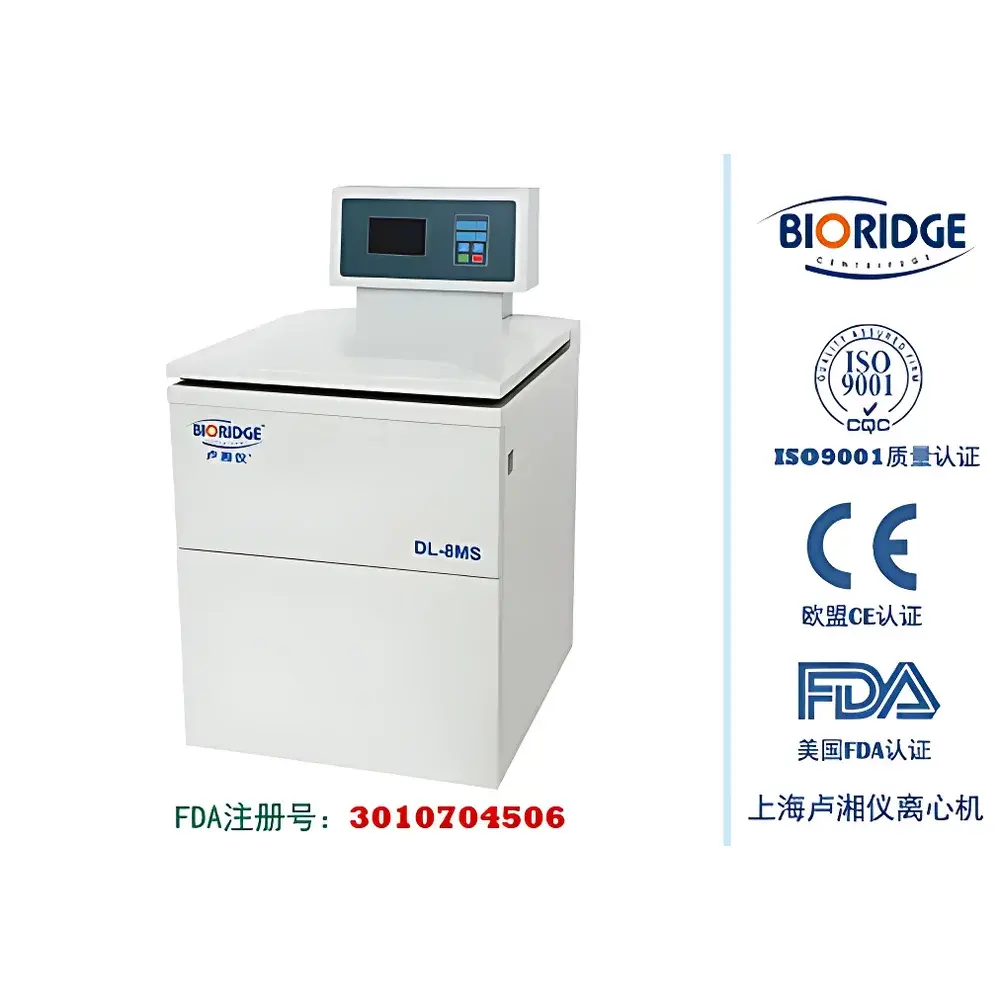
LuXiangYi DL-8MS Large-Capacity Refrigerated Floor-Standing Centrifuge
| Brand | LuXiangYi / BIORIDGE |
|---|---|
| Origin | Shanghai, China |
| Model | DL-8MS |
| Instrument Type | Floor-standing centrifuge |
| Category | Low-speed refrigerated centrifuge |
| Max. Speed | 8,000 rpm |
| Max. RCF | 11,260 × g |
| Max. Capacity | 2,400 mL × 6 (14,400 mL total) |
| Temperature Range | –20 °C to +40 °C |
| Temp. Accuracy | ±1 °C |
| Refrigerant | R404a (non-ozone-depleting) |
| Noise Level | <70 dB(A) |
| Power Supply | AC 380 V, 50 Hz, 40 A |
| Dimensions (L×W×H) | 900 mm × 1000 mm × 1300 mm |
| Net Weight | 510 kg |
| Control Interface | Large LCD touchscreen with programmable protocols |
| Safety Features | Electronic door lock, overspeed/overtemperature/unbalance detection, automatic fault alarm |
| Acceleration/Deceleration Profiles | 10 user-definable ramp curves |
| Compliance | Designed for GLP-compliant laboratories |
Overview
The LuXiangYi DL-8MS is a high-capacity, refrigerated floor-standing centrifuge engineered for large-volume primary separation tasks in blood banking, biopharmaceutical manufacturing, and upstream bioprocessing. It operates on the principle of sedimentation under controlled gravitational force (RCF), enabling efficient separation of whole blood components, cell suspensions, fermentation broths, and bulk reagent solutions. With a maximum capacity of 14,400 mL per run (6 × 2,400 mL bottles), the DL-8MS addresses throughput bottlenecks common in centralized transfusion services and GMP-grade production facilities where batch consistency, thermal stability, and operational repeatability are critical. Its robust cast-iron frame, high-torque AC frequency-controlled motor, and precision-balanced rotor assembly ensure mechanical stability at sustained low-speed operation—optimized for delicate biological matrices requiring minimal shear stress.
Key Features
- High-throughput capability: Supports up to six 2,400 mL centrifuge bottles or twelve 400 mL blood bags simultaneously—currently the highest blood bag capacity among commercially available low-speed refrigerated centrifuges in the Chinese domestic market.
- Intelligent temperature management: Equipped with an imported high-efficiency compressor system using R404a refrigerant, delivering precise thermal control from –20 °C to +40 °C (±1 °C accuracy) across full-load conditions, essential for preserving labile plasma proteins and platelet integrity.
- Programmable operational logic: Touchscreen interface enables storage of up to 10 preconfigured protocols, each with independent acceleration/deceleration profiles, time-limited runs (1 min–99 h 59 min), and real-time RPM/RCF conversion—facilitating method standardization across shifts and operators.
- Comprehensive safety architecture: Integrated electronic door interlock, dynamic imbalance sensing, overspeed cutoff, and overtemperature shutdown comply with IEC 61010-2-020 requirements for centrifuge safety. All fault events trigger audible/visual alerts and log timestamps for traceability.
- Acoustic optimization: Sound-dampened housing and vibration-isolated drive train maintain noise levels below 70 dB(A) at rated load—supporting installation in shared laboratory environments without dedicated acoustic enclosures.
Sample Compatibility & Compliance
The DL-8MS accommodates a range of large-format vessels including 500 mL, 2,000 mL, and 2,400 mL fixed-angle and horizontal rotors—validated for use with standard ISO-certified plastic and stainless-steel containers. Optional adapters support common formats such as 50 mL, 100 mL, and 250 mL conical tubes. The system is routinely deployed in blood bank settings compliant with WHO Blood Transfusion Guidelines and national standards GB/T 26129–2010 (Blood Bank Equipment). While not certified to UL or CE as shipped, its electrical design meets IEC 61000-6-3 (EMC) and IEC 61000-6-4 emission limits. When paired with validated LIMS-integrated software, it supports ALCOA+ data integrity principles required under FDA 21 CFR Part 11 and EU Annex 11.
Software & Data Management
The embedded firmware logs all run parameters—including start/stop time, setpoint deviations, temperature history, and fault codes—with non-volatile memory retention. Export is supported via USB 2.0 port in CSV format for external analysis. For regulated environments, optional PC-based control software provides electronic signature capability, user access tiers (admin/operator/auditor), and automated report generation aligned with ISO/IEC 17025 documentation requirements. Audit trails record every parameter change, user login, and protocol modification with immutable timestamps—enabling full reconstruction of analytical history during regulatory inspections.
Applications
- Blood component processing: Separation of red blood cells, white blood cells, platelets, and plasma from whole blood in central blood banks and mobile collection units.
- Biopharmaceutical clarification: Harvesting mammalian or microbial cell cultures prior to downstream chromatography or filtration steps.
- Vaccine production: Pellet recovery of inactivated viral particles or bacterial antigens from large-scale bioreactor harvests.
- Clinical diagnostics: High-volume serum/plasma preparation for automated immunoassay platforms requiring consistent supernatant clarity.
- Research-scale biomolecule isolation: Initial fractionation of extracellular vesicles, lipoproteins, or subcellular organelles from tissue homogenates.
FAQ
What is the maximum permissible imbalance tolerance for safe operation?
The DL-8MS detects mass asymmetry exceeding ±5 g per rotor position and halts acceleration before reaching operational speed.
Can the centrifuge maintain –20 °C at maximum rotor load and 8,000 rpm?
No—full refrigeration performance is specified at ≤4,000 rpm; continuous operation at 8,000 rpm is limited to ambient or +4 °C minimum setpoint to prevent compressor overload.
Is rotor calibration traceable to national metrology institutes?
Yes—factory-calibrated rotors include NIST-traceable certificates of angular velocity and RCF verification per ISO 21501-4.
Does the system support remote monitoring via Ethernet or RS-232?
Standard configuration includes only local USB export; optional RS-485 module enables integration into building SCADA systems for predictive maintenance logging.
Are cleaning and decontamination procedures validated for biosafety level 2 (BSL-2) use?
The chamber interior and rotor surfaces are compatible with 70% ethanol, 0.5% sodium hypochlorite, and vaporized hydrogen peroxide (VHP); validation kits and SOP templates are available upon request.



