
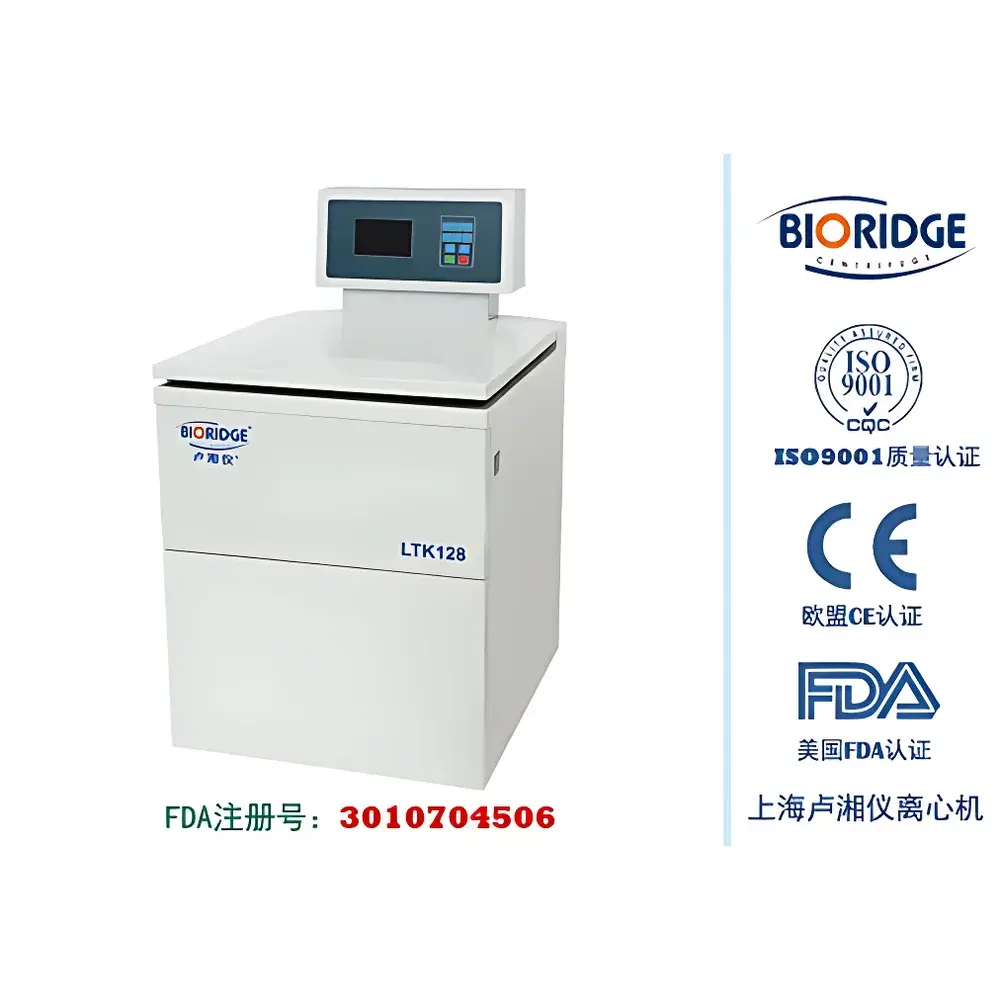
Brookfield LTK128 Automated Cap-Removal Centrifuge
| Brand | BIORIDGE |
|---|---|
| Origin | Shanghai, China |
| Model | LTK128 |
| Instrument Type | Floor-standing centrifuge |
| Speed Range | 0–4000 rpm |
| Max RCF | 3780 × g |
| Capacity | 128 tubes (32 × 4 positions) of 5–7 mL vacuum blood collection tubes |
| Tube Length Compatibility | 81 mm, 101 mm, 106 mm |
| Timer Range | 1 min – 99 h 59 min (or 1–99 min in short-mode) |
| Noise Level | <65 dB(A) |
| Dimensions (L×W×H) | 650 × 710 × 1100 mm |
| Net Weight | 140 kg |
| Safety Features | Electronic door lock, automatic imbalance detection, overspeed protection, lid interlock |
| Vibration Damping | Optimized passive damping system with auto-balance compensation |
| Cap-removal success rate | >90% |
| Power Supply | AC 220 V, 50 Hz, 20 A |
Overview
The BIORIDGE LTK128 Automated Cap-Removal Centrifuge is a floor-standing, high-capacity clinical centrifuge engineered specifically for automated processing of vacuum blood collection tubes in diagnostic laboratories and hospital core labs. Unlike conventional centrifuges requiring manual cap removal post-run—a step associated with workflow bottlenecks, sample re-mixing, aerosol generation, and biosafety risks—the LTK128 integrates mechanical cap separation directly into the centrifugation cycle. Its operation relies on controlled inertial displacement: during deceleration, calibrated vertical motion of the specialized cap-removal basket induces axial separation between tube body and plastic cap, leveraging differential mass and friction coefficients. This principle eliminates operator intervention while maintaining ISO 22870-compliant pre-analytical integrity. Designed for routine hematology, clinical chemistry, and coagulation workflows, the LTK128 supports full compliance with CLSI H26-A3 guidelines on specimen handling and aligns with WHO Good Laboratory Practice (GLP) requirements for traceable, reproducible sample preparation.
Key Features
- Automated cap removal with >90% success rate across three standard vacuum tube lengths (81 mm, 101 mm, 106 mm), validated per IEC 61010-1 safety standards
- Dual-mode timer: extended range (1 min – 99 h 59 min) for batched overnight protocols; rapid mode (1–99 min) for STAT serum/plasma separation
- Real-time rpm/RCF conversion display and setpoint entry—enabling direct force-based method transfer without manual calculation
- Electronically interlocked swing-out rotor door with fail-safe latch verification and audible confirmation upon closure
- Passive vibration isolation architecture incorporating tuned mass dampers and dynamically balanced rotor assembly, reducing operational noise to <65 dB(A)
- Multi-layer safety system: rotor imbalance detection (±5 g tolerance), overspeed cutoff (>4050 rpm), lid-open interrupt, and thermal overload monitoring
- Cap-removal basket designed for ISO 6710-compliant 5–7 mL evacuated tubes; accommodates standard 32 × 4 configuration (128 total tubes)
Sample Compatibility & Compliance
The LTK128 accepts all major brands of CE-marked, ISO 6710-certified vacuum blood collection tubes—including EDTA, heparin, citrate, serum separator (SST), and lithium heparin formulations—in nominal volumes of 5 mL and 7 mL. Tube length adaptability ensures compatibility with BD Vacutainer®, Greiner Bio-One Vacuette®, and Sarstedt Monovette® systems. The instrument meets EN 61326-1 (EMC) and EN 61010-1 (safety) requirements for laboratory equipment. Its cap-removal mechanism avoids mechanical shearing or torque application that could compromise tube integrity, preserving sample stability per CLSI GP44-A6 recommendations. Data logging capabilities support audit readiness for CAP, COLA, and JCI-accredited facilities under ISO 15189:2022 clause 5.4.2 (pre-examination processes).
Software & Data Management
While the LTK128 operates via an embedded microcontroller interface (no PC dependency), its front-panel controller records run metadata—including date/time stamp, speed, RCF, duration, and error codes—for local review via LCD history buffer (last 100 cycles). Optional RS-232 serial output enables integration with LIS/HIS platforms using HL7 v2.5 or ASTM E1384 messaging. All parameter changes are logged with timestamp and user ID (when paired with external authentication module), satisfying FDA 21 CFR Part 11 requirements for electronic records where enabled by site-specific validation protocols. Firmware updates are performed via secure USB interface with cryptographic signature verification.
Applications
- Routine serum and plasma separation in hospital core laboratories and reference labs
- High-throughput preprocessing for immunoassay, ELISA, and mass spectrometry workflows
- Blood bank specimen preparation requiring strict avoidance of hemolysis and clot disruption
- Clinical trial biobanking where cap-handling consistency impacts downstream nucleic acid yield
- Point-of-care satellite labs needing walk-away automation without robotic integration
- Regulatory-compliant QC/QA environments where manual cap removal introduces uncontrolled variables
FAQ
Does the LTK128 require calibration for cap-removal performance?
No routine calibration is required; cap-removal efficacy is mechanically determined by basket geometry and deceleration profile, both factory-verified and stable over 10,000 cycles.
Can the instrument process non-vacuum tubes or microcentrifuge tubes?
No—it is engineered exclusively for rigid-wall, evacuated 5–7 mL clinical blood tubes conforming to ISO 6710 dimensions and pressure specifications.
Is rotor balancing necessary before each run?
The auto-balance compensation system corrects minor load asymmetries up to ±5 g per bucket; however, gross imbalance (e.g., mismatched tube counts across quadrants) must be avoided per IEC 61010-2-20 guidance.
What maintenance intervals are recommended?
Annual inspection of door latch mechanism, basket retention clips, and vibration damping mounts is advised; no lubrication or rotor recalibration is required under normal use conditions.
How is compliance with GLP/GMP documentation supported?
Run logs, error histories, and firmware version reports can be exported via RS-232 for inclusion in batch records; full validation documentation packages (IQ/OQ/PQ) are available upon request for regulated environments.
Related Products



