
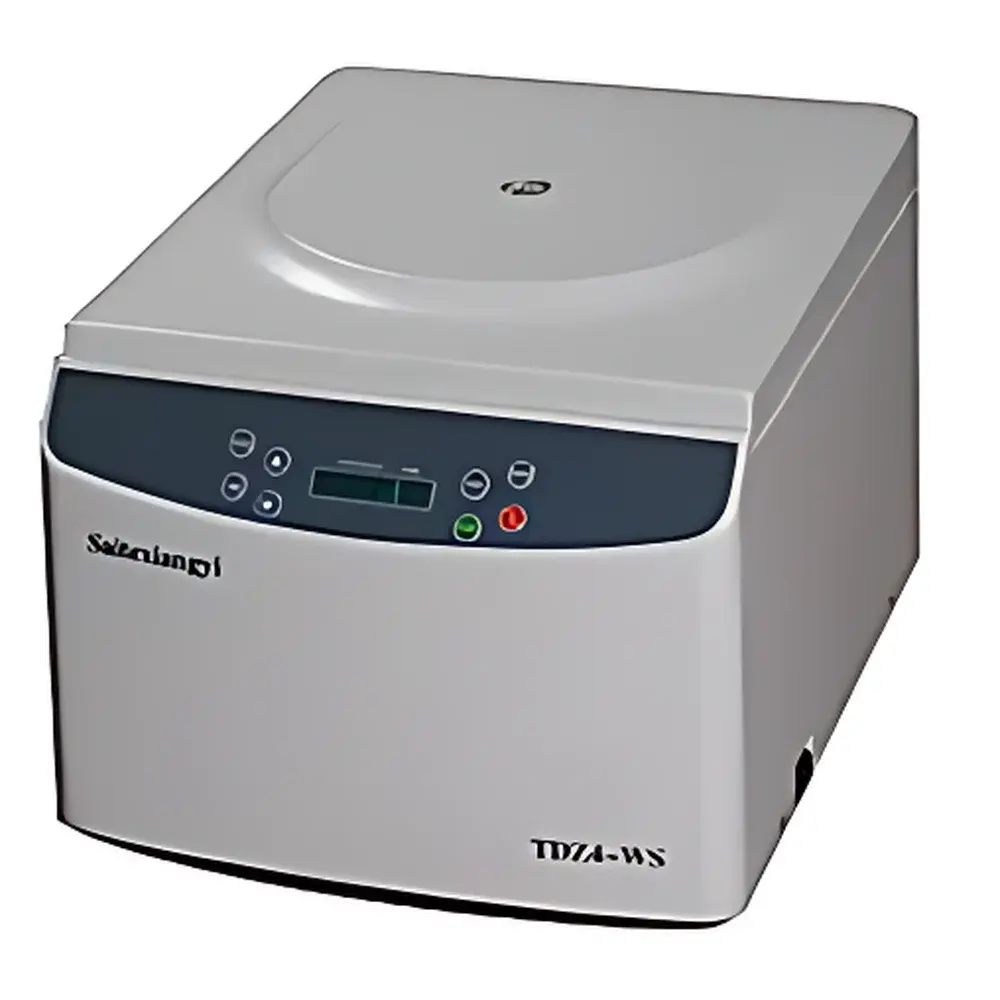
TDZ4-WS & TDZ4A-WS Desktop Low-Speed Programmable Centrifuges
| Origin | Shanghai, China |
|---|---|
| Manufacturer Type | Authorized Distributor |
| Origin Category | Domestic (PRC) |
| Models | TDZ4-WS, TDZ4A-WS |
| Pricing | Upon Request |
| Max Speed | 5000 rpm |
| Max RCF (TDZ4-WS) | 3470 ×g |
| Max RCF (TDZ4A-WS) | 2515 ×g |
| Angle Rotors | TDZ4-WS — 10 mL × 18, 10 mL × 24, 20 mL × 12 |
| Timer Range | 0–99 min |
| Power Supply | AC 220 V, 50 Hz, 5 A |
| Dimensions (TDZ4-WS) | 330 × 420 × 275 mm (L×W×H) |
| Dimensions (TDZ4A-WS) | 230 × 310 × 240 mm (L×W×H) |
| Weight (TDZ4-WS) | 15 kg |
| Weight (TDZ4A-WS) | 10 kg |
Overview
The TDZ4-WS and TDZ4A-WS are microprocessor-controlled, low-speed desktop centrifuges engineered for routine separation tasks in clinical laboratories, academic research settings, and quality control environments. Operating on the principle of sedimentation under controlled gravitational force (RCF), these instruments generate reproducible centrifugal fields to separate heterogeneous mixtures—such as whole blood into plasma/serum and cellular components, cell suspensions, precipitated proteins, or particulate-laden buffers—based on particle density, size, and shape. Designed for operational safety and procedural consistency, both models integrate brushless DC motor technology for quiet, maintenance-free rotation with precise speed regulation (±10 rpm accuracy) and real-time RCF calculation based on user-input rotor radius. The centrifuges comply with IEC 61010-1:2010 safety standards for laboratory electrical equipment and incorporate mechanical and electronic safeguards aligned with ISO 13485-informed risk management practices.
Key Features
- Microprocessor-based digital control system with high-contrast LED display for simultaneous monitoring of speed (rpm), RCF (×g), time remaining, and rotor identification.
- Capacitive touch panel interface supporting intuitive programming of multi-step protocols—including ramp-up/down profiles, pause intervals, and automatic brake release.
- Dual-safety interlock architecture: electromagnetic door latch integrated with mechanical lid switch ensures rotor chamber remains sealed until rotational motion ceases and RCF drops below 100 ×g.
- Comprehensive protection suite: automatic shutdown triggered by overspeed detection, dynamic imbalance sensing (±5 g threshold), lid-open events, and motor overtemperature (>65 °C).
- Brushless DC motor delivers >20,000-hour service life, zero carbon dust emission, and consistent torque delivery across the full speed range (0–5000 rpm).
- Compact footprint optimized for benchtop integration: TDZ4A-WS occupies <7,200 cm³ volume, enabling deployment in biosafety cabinets or shared instrumentation spaces.
Sample Compatibility & Compliance
These centrifuges accommodate standard conical-bottom polypropylene and glass tubes (10–20 mL capacity) using interchangeable angle rotors certified for autoclaving at 121 °C for 20 minutes. All rotors feature precision-machined aluminum alloy construction with anodized surface finish (hardness ≥60 HV) to resist corrosion from common reagents including ethanol, acetone, and diluted acids/bases. The systems meet EN 61326-1:2013 requirements for electromagnetic compatibility (EMC) and are validated for use in GLP-compliant workflows where audit trails for run parameters (speed, time, RCF, date/time stamp) must be retained per internal SOPs. While not FDA 21 CFR Part 11–certified out-of-the-box, the firmware supports manual export of run logs in CSV format for archival in validated LIMS environments.
Software & Data Management
No proprietary software installation is required. All configuration and operation occur via the embedded GUI. Each run generates a non-editable internal log entry containing timestamp, selected rotor ID, setpoint rpm and time, actual achieved RCF, final brake status, and fault codes (if any). Logs are stored in non-volatile memory (1000-entry capacity) and can be exported manually via USB-C port (optional adapter) to external storage. For integration into automated lab networks, RS-232 serial output (TTL level, 9600 bps) enables basic remote start/stop and status polling using third-party SCADA or LabVIEW drivers.
Applications
- Routine clinical specimen processing: serum/plasma separation from venous blood samples (EDTA, heparin, SST tubes).
- Cell pellet recovery in microbiology and immunology workflows (e.g., PBMC isolation pre-Ficoll, bacterial biomass concentration).
- Clarification of crude lysates and supernatant harvesting following centrifugal filtration or precipitation steps.
- Quality assurance testing of colloidal suspensions, emulsions, and nanoparticle dispersions where gentle sedimentation is required to avoid aggregation artifacts.
- Educational demonstrations of sedimentation kinetics and density gradient principles in undergraduate biophysics laboratories.
FAQ
What is the difference between TDZ4-WS and TDZ4A-WS?
The TDZ4-WS offers higher maximum RCF (3470 ×g) and larger capacity rotors (e.g., 20 mL × 12), making it suitable for higher-volume batch processing. The TDZ4A-WS prioritizes space efficiency and lower mass (10 kg), with a reduced max RCF (2515 ×g) and optimized rotor configurations for smaller-scale or high-throughput tube formats.
Are rotors interchangeable between the two models?
No. Rotor mounting interfaces and balance algorithms are model-specific. Only rotors explicitly designated for TDZ4-WS or TDZ4A-WS may be used to ensure mechanical integrity and compliance with safety certifications.
Does the centrifuge support continuous operation mode?
Yes—both models offer “Hold” mode, allowing indefinite runtime at set speed until manually stopped or interrupted by a safety event.
Can I calibrate speed or RCF myself?
Speed calibration requires traceable tachometer verification against NIST-traceable reference standards and must be performed by authorized service personnel. End users may validate performance using certified reference centrifuge test kits per ISO 21501-4 Annex B protocols.
Is the instrument compatible with 110 V / 60 Hz power supplies?
No. These units are configured exclusively for AC 220 V, 50 Hz input. Operation on alternate voltage/frequency grids requires an externally rated isolation transformer meeting IEC 61558-2-6 specifications.



