
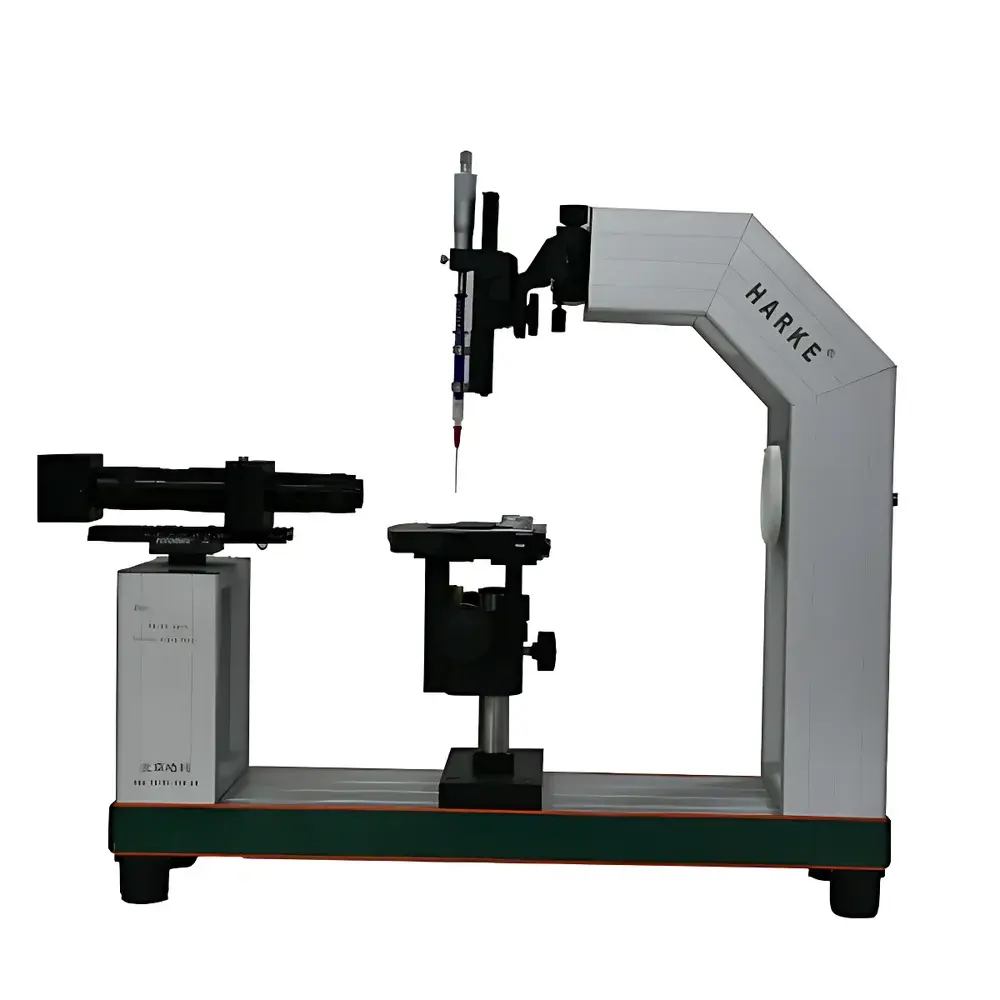
HARKE SPCA-1 Video-Based Optical Contact Angle Analyzer
| Brand | HARKE |
|---|---|
| Origin | Beijing, China |
| Manufacturer Type | Direct Manufacturer |
| Instrument Category | Domestic (China-made) |
| Model | HARKE-SPCA-1 |
| Instrument Type | Benchtop Laboratory System |
| Measurement Principle | Video-based Optical Analysis via Drop Shape Analysis |
| Primary Technique | Sessile Drop & Captive Bubble Methods |
| Angular Range | 0–180° |
| Angular Accuracy | ±0.1° |
| Image Capture | High-Resolution CMOS Camera with Real-time Recording & Frame-by-Frame Playback |
| Optical System | 0.75×–4.5× Continuous Zoom Microscope (Parfocal, HARKE-Engineered) |
| Sample Stage Travel | X: ±35 mm, Y: ±20 mm, Z: 50 mm (Vertical), +30 mm (Telescopic Base) |
| Sample Holder Translation | ±75 mm (Front–Back) |
| Dispenser Positioning | X: ±50 mm, Z: 100 mm |
| Microscope Translation | ±50 mm (Front–Back) |
| Maximum Sample Dimensions | 100 mm (W) × 80 mm (D) × Unlimited Height |
| Stage Surface | 100 mm × 120 mm |
| Dispensing Volume Range | 0–100 µL (Computer-Controlled), 1 mL (Manual Syringe) |
| Dispensing Precision | ±0.1 µL |
| Analysis Algorithms | Automated Circle, Ellipse, Tangent (Global & Local), Height–Width, Young–Laplace Fitting, Curvimeter |
| Dynamic Contact Angle Mode | Advancing/Receding Angle Tracking with Automated Droplet Volume Modulation |
| Surface Energy Calculation Methods | Zisman Plot, Fowkes, Owens–Wendt–Rabel–Kaelble (OWRK), Wu Harmonic Mean |
| Image Processing | Manual ROI Adjustment, Auto-Thresholding, Edge Detection, Background Subtraction |
| Capture Modes | Single-frame Snapshot, Time-Lapse Interval Capture (Configurable ms–s), Full Video Export, Individual Frame Extraction from Recorded Sequence |
Overview
The HARKE SPCA-1 is a precision-engineered benchtop video-based optical contact angle analyzer designed for rigorous surface wettability characterization in academic research laboratories, quality control environments, and materials development facilities. It operates on the fundamental principle of drop shape analysis (DSA), leveraging high-resolution digital imaging and advanced edge-detection algorithms to quantify the interfacial tension balance at the three-phase boundary (solid–liquid–vapor). By capturing and analyzing the geometric profile of sessile drops or captive bubbles under controlled environmental conditions, the system delivers quantitative metrics essential for evaluating surface heterogeneity, chemical modification efficacy, coating uniformity, and interfacial thermodynamics. Its modular mechanical architecture supports static, dynamic, and topographically corrected measurements—enabling reproducible assessment across flat, curved, tilted, concave, and convex substrates without manual recalibration.
Key Features
- High-fidelity optical path featuring a parfocal 0.75×–4.5× continuous zoom microscope engineered exclusively for HARKE, eliminating refocusing drift during magnification changes
- Dual-mode liquid deposition: computer-controlled microdispensing (0–100 µL, ±0.1 µL resolution) and manual syringe operation (1 mL capacity)
- Multi-algorithm contact angle computation engine supporting seven distinct fitting models—including Young–Laplace curve fitting for non-ideal droplets and curvimeter-based contour tracing for irregular surfaces
- Full-axis motorized stage system with independent X/Y/Z translation (±35 mm / ±20 mm / 50 mm), telescopic base extension (+30 mm), and extended front–back carrier travel (±75 mm) for large or irregular samples
- Real-time video acquisition at configurable frame rates, with lossless AVI export, time-lapse snapshot scheduling (ms–s intervals), and individual frame extraction from recorded sequences
- Integrated surface energy module implementing Zisman, Fowkes, and OWRK methodologies, enabling calculation of dispersive and polar surface energy components alongside adhesion work and spreading coefficients
Sample Compatibility & Compliance
The SPCA-1 accommodates diverse solid substrates up to 100 mm wide and 80 mm deep, including thin films, fibers, porous membranes, patterned wafers, and textured polymers. Its adaptive stage geometry and tilt-compensated analysis routines ensure metrological validity on non-planar geometries—critical for biomaterials, microfluidic devices, and functional textiles. The instrument complies with ASTM D7334–22 (Standard Practice for Surface Wettability Assessment by Contact Angle Measurement) and ISO 19403-2:2017 (Paints and Varnishes — Contact Angle Measurement — Part 2: Static Contact Angle), and supports GLP/GMP-aligned workflows through audit-trail-capable software logging (user actions, parameter changes, calibration events). All image processing steps are fully traceable and reversible, satisfying documentation requirements for regulatory submissions under FDA 21 CFR Part 11 where electronic records are employed.
Software & Data Management
The proprietary SPCA Analysis Suite provides a deterministic, scriptable interface for measurement protocol definition, batch processing, and statistical reporting. Each session generates a timestamped project file containing raw images, processed contours, numerical outputs (contact angle, surface energy, hysteresis), and full metadata (stage coordinates, dispensing volume, illumination settings). Export options include CSV (for statistical packages), PDF reports with embedded annotated images, and TIFF stacks for third-party morphological analysis. Version-controlled firmware updates maintain backward compatibility with legacy datasets, while role-based access control (administrator/operator modes) enforces procedural integrity in shared-lab environments.
Applications
- Surface treatment validation (plasma, corona, flame, silanization) in semiconductor packaging and medical device manufacturing
- Hydrophobicity/hydrophilicity mapping of filtration membranes, battery separators, and wound dressings
- Dynamic wetting behavior analysis during inkjet printing, spray coating, and adhesive dispensing processes
- Surface energy quantification for polymer blend compatibility prediction and composite interfacial adhesion modeling
- Quality assurance of anti-fog, anti-reflective, and self-cleaning coatings on optical lenses and architectural glass
- Colloid and interface science studies involving surfactant adsorption kinetics and nanomaterial dispersion stability
FAQ
What is the minimum droplet volume resolvable by the SPCA-1’s automated dispenser?
The computer-controlled microdispenser achieves ±0.1 µL precision within a 0–100 µL operational range, enabling stable sub-1 µL droplet formation suitable for micro-patterned surfaces.
Can the system measure contact angles on vertically oriented or rotating samples?
Yes—the motorized stage supports programmable tilt and azimuthal rotation; combined with real-time image stabilization and curvature correction algorithms, it enables reliable measurements on inclined or cylindrical substrates.
Is Young–Laplace fitting validated against reference standards?
The algorithm has been benchmarked using NIST-traceable spherical cap standards and certified polymer reference surfaces (e.g., PTFE, clean silicon wafer), demonstrating <±0.2° deviation under ISO 19403-4 test conditions.
Does the software support automated pass/fail criteria for QC workflows?
Yes—users may define tolerance windows per parameter (e.g., θadv ∈ [110°, 118°]), triggering visual alerts and generating compliance flags in exported reports.
How is thermal drift mitigated during long-duration dynamic measurements?
The optical enclosure features passive thermal mass stabilization and optional ambient temperature monitoring; all positional axes employ closed-loop stepper control to maintain sub-micron repeatability over 60+ minute acquisitions.



