
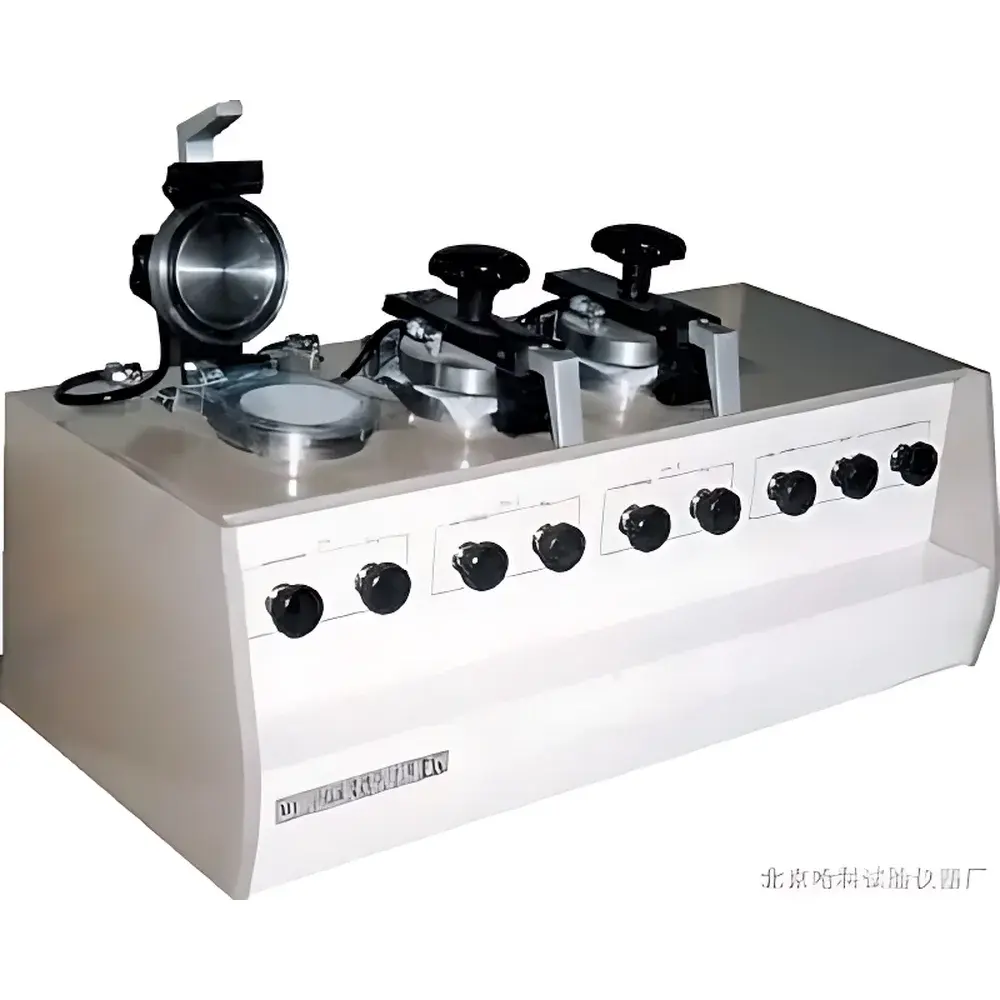
HARKE HK-Q3 Vacuum-Method Gas Permeability Tester
| Brand | HARKE |
|---|---|
| Model | HK-Q3 |
| Measurement Principle | Vacuum Method (ASTM D1434, ISO 2556, ISO 15105-1) |
| Test Gases | O₂, N₂, CO₂, Air, He, H₂, CH₄, C₃H₈, C₄H₁₀, NH₃ |
| Permeation Range | 0.05–160,000 cm³/(m²·24h·0.1 MPa) |
| Resolution | 0.001 cm³/(m²·24h·0.1 MPa) |
| Vacuum Resolution | 0.1 Pa |
| Temperature Control Range | 5–95 °C (external chiller/heater required) |
| Temp. Stability | ±0.1 °C |
| Sample Thickness | ≤5 mm (customizable) |
| Sample Area | 48 cm² |
| Sample Dimensions | ≥150 mm × 94 mm or circular |
| Test Pressure Range | −0.1 to +0.1 MPa |
| Supply Gas Pressure | 0.3–1.0 MPa |
| Gas Inlet Port | Ø8 mm |
| Dimensions (L×D×H) | 330 × 600 × 330 mm |
| Weight | 28 kg |
| Power | AC 220 V, 50 Hz |
| Compliance | ASTM D1434, ISO 2556, ISO 15105-1, GB/T 1038, YY/T 0698.5 |
Overview
The HARKE HK-Q3 Vacuum-Method Gas Permeability Tester is a precision-engineered instrument designed for quantitative determination of gas transmission rates (GTR), permeability coefficients (P), diffusion coefficients (D), and solubility coefficients (S) in polymeric films, laminates, foils, and advanced barrier materials. It operates on the standardized vacuum method—where a known test gas is introduced on the high-pressure side while the low-pressure side is evacuated to a stable sub-atmospheric condition—and measures the rate of gas accumulation in the evacuated chamber via high-sensitivity pressure transducers. This principle ensures traceable, reproducible results aligned with internationally recognized standards including ASTM D1434 (Standard Test Method for Determining Gas Permeability Characteristics of Plastic Film and Sheeting), ISO 2556 (Plastics—Determination of gas transmission rate), and ISO 15105-1 (Plastics—Film and sheeting—Determination of gas-transmission rate—Part 1: Constant-volume, constant-pressure method). The system is calibrated for use across a wide temperature range (5–95 °C), enabling kinetic analysis of gas transport mechanisms under controlled thermal conditions—critical for predicting shelf-life performance of pharmaceutical blister packs, sterile medical device pouches, and active food packaging systems.
Key Features
- Vacuum-based measurement architecture delivering high-resolution gas transmission data down to 0.001 cm³/(m²·24h·0.1 MPa), with vacuum stability maintained at ±0.1 Pa
- Dual-zone thermal management interface compatible with external chiller/heater units for precise isothermal control (±0.1 °C) across the full 5–95 °C operating range
- Modular gas handling design supporting O₂, N₂, CO₂, air, He, H₂, CH₄, C₃H₈, C₄H₁₀, and NH₃—with dedicated inlet filtration and pressure regulation (0.3–1.0 MPa supply)
- Standardized 48 cm² test area with adaptable sample fixtures accommodating rectangular (≥150 × 94 mm) or circular specimens up to 5 mm thickness
- Robust stainless-steel test chamber with leak-tight sealing mechanism and integrated real-time pressure monitoring
- Compliance-ready architecture supporting audit trails, user access levels, and electronic record integrity per FDA 21 CFR Part 11 when paired with validated software modules
Sample Compatibility & Compliance
The HK-Q3 accommodates a broad spectrum of rigid and flexible barrier substrates, including aluminum foil composites, metallized PET and CPP films, PVC hard sheets, PVDC-coated substrates, coextruded IV bags, paper-plastic laminates, cast films, synthetic skin analogs, aerospace-grade polymer films, biodegradable PLA/PBAT blends, lithium-ion battery separators, reverse osmosis membranes, elastomeric seals, tire innerliners, and metallized cigarette packaging papers. All testing protocols adhere to regulatory expectations for material qualification in regulated environments: ASTM D1434 governs general film permeability; ISO 2556 and ISO 15105-1 define metrological requirements for comparative barrier assessment; GB/T 1038 specifies Chinese national methodology for plastic film gas transmission; and YY/T 0698.5 establishes validation criteria for medical packaging materials used in sterilization barrier systems. When configured with optional GLP-compliant software, the system supports full traceability—including operator ID, calibration logs, environmental metadata, and raw pressure-time datasets—for GMP audits and regulatory submissions.
Software & Data Management
The HK-Q3 integrates with HARKE’s proprietary PermeaSoft™ v3.2 analytical suite, which provides automated calculation of GTR, P, D, and S using Fickian diffusion models and real-time curve fitting algorithms. Raw pressure vs. time data is acquired at configurable sampling intervals (100 ms–10 s), stored in encrypted .pdx binary format, and exportable to CSV, PDF, or XML for LIMS integration. The software enforces role-based access control (administrator, technician, reviewer), maintains immutable audit trails of all test modifications and calibration events, and generates compliant test reports containing instrument ID, sensor calibration certificates, environmental parameters, statistical uncertainty estimates (k=2), and signature fields for QA sign-off. Optional 21 CFR Part 11 add-on enables electronic signatures, biometric login, and secure audit log archiving—meeting requirements for pharmaceutical packaging validation and medical device master files.
Applications
This instrument serves as a primary characterization tool in R&D laboratories, quality control departments, and regulatory testing centers focused on barrier performance evaluation. Typical use cases include accelerated aging studies of pharmaceutical blister lidding foils under elevated humidity/temperature; comparative ranking of oxygen transmission rates (OTR) in multilayer snack packaging films; diffusion coefficient modeling of CO₂ through modified atmosphere packaging (MAP) films; helium leak screening of hermetically sealed diagnostic cartridges; hydrogen permeation analysis in fuel cell membrane development; and water vapor transmission rate (WVTR) correlation studies using inert carrier gases. Its adaptability to hazardous gases (e.g., NH₃, H₂, CH₄) — subject to pre-installation safety review and venting configuration — extends utility into specialty chemical containment, battery electrolyte barrier research, and industrial gas separation membrane qualification.
FAQ
What standards does the HK-Q3 comply with?
The system conforms to ASTM D1434, ISO 2556, ISO 15105-1, GB/T 1038, and YY/T 0698.5. Full compliance documentation and certificate of conformance are provided with each unit.
Is temperature control included in the base configuration?
No. A precision external chiller/heater circulator is required to achieve the specified 5–95 °C range and ±0.1 °C stability. Recommended models are listed in the accessories catalog.
Can the HK-Q3 measure water vapor transmission?
Not natively. It is optimized for permanent gases. For WVTR, HARKE recommends the HK-W3000 series gravimetric moisture permeability tester.
What safety provisions exist for flammable or toxic test gases?
All hazardous gas configurations require pre-delivery risk assessment, explosion-proof sensor options, dedicated exhaust ducting, and gas-specific leak detection integration—subject to site survey and engineering approval prior to shipment.
How is calibration verified and maintained?
Each unit ships with NIST-traceable pressure transducer calibration certificates. Annual recalibration is recommended; HARKE-certified service engineers perform on-site verification using certified reference gases and secondary manometers.




