
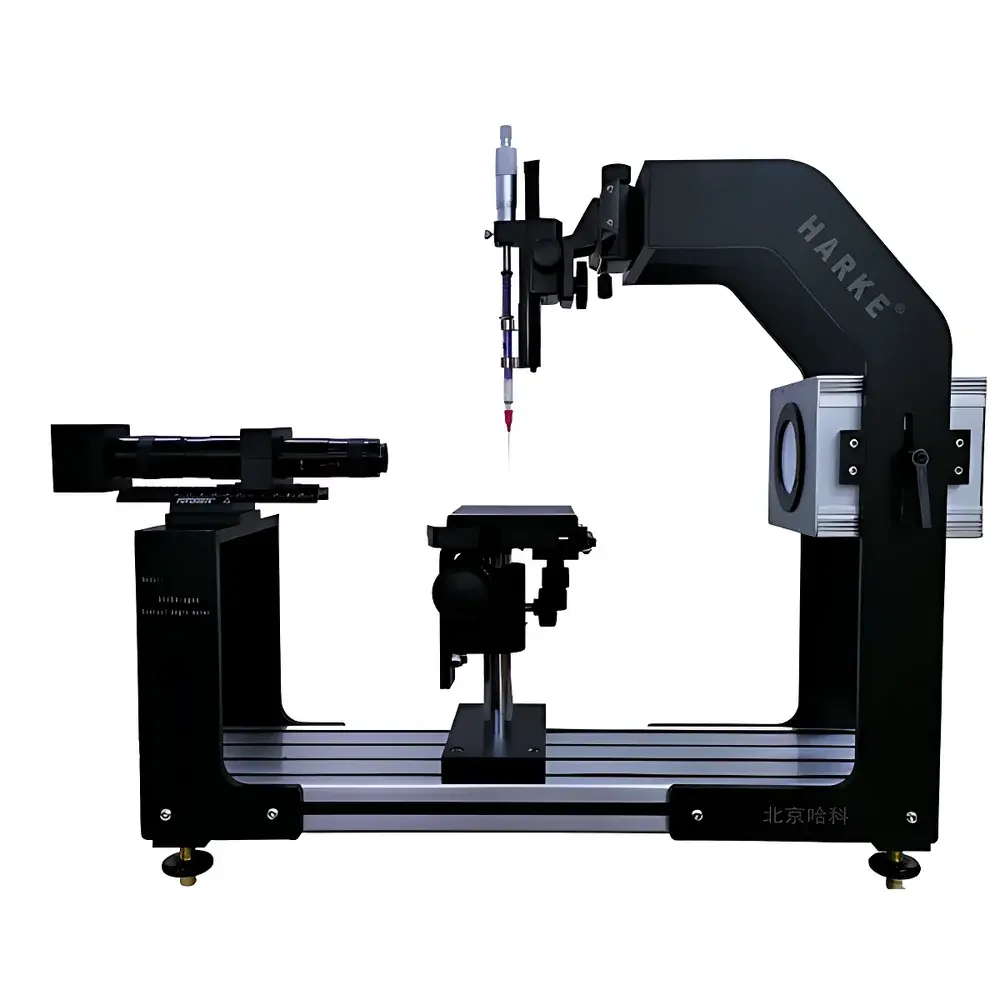
HARKE SPCAXD Video-Based Optical Contact Angle Analyzer
| Brand | HARKE |
|---|---|
| Model | SPCAXD |
| Origin | Beijing, China |
| Manufacturer Type | Direct Manufacturer |
| Instrument Category | Domestic (China-made) |
| Instrument Type | Benchtop Laboratory System |
| Contact Angle Measurement Range | 0–180° |
| Contact Angle Measurement Accuracy | ±0.01° |
| Fixed Sample Stage Dimensions | 120 × 120 mm |
| Optical Magnification | 0.75×–4.5× (parfocal zoom) |
| Surface/Interfacial Tension Measurement Range | 0.01–1000 mN/m |
| Surface/Interfacial Tension Measurement Accuracy | ±0.01 mN/m |
| Automated Syringe Dispensing Volume | 0–100 μL (computer-controlled), ±0.1 μL precision |
| Manual Syringe Capacity | 1 mL |
| Image Capture | High-resolution CMOS camera with real-time recording, frame-by-frame playback, time-lapse snapshot export, and single-frame extraction from video sequences |
| Stage Mobility | Vertical: 50 mm |
| Horizontal (X/Y) | 70 mm × 40 mm |
| Extension | 30 mm |
| Fixed Plate Translation (Z-axis) | 150 mm |
| Dispenser Movement | 100 mm (vertical) × 100 mm (horizontal) |
| Microscope Translation | 100 mm (Z-axis) |
| Max Sample Dimensions | 100 mm (W) × 80 mm (D) × variable height |
| Overall Dimensions | 240 mm (W) × 640 mm (D) × 630 mm (H) |
Overview
The HARKE SPCAXD is a high-precision, benchtop video-based optical contact angle analyzer engineered for rigorous surface and interfacial characterization in research laboratories and quality control environments. It operates on the principle of digital image analysis of sessile or pendant liquid droplets captured via a parfocal, continuously variable magnification optical system (0.75×–4.5×). By quantifying the geometric intersection between a liquid–vapor interface and a solid surface—i.e., the contact angle—the instrument enables quantitative assessment of wettability, surface heterogeneity, and interfacial thermodynamics. Its measurement range spans the full theoretical spectrum (0° to 180°), supporting both hydrophilic and superhydrophobic material evaluation. The system integrates advanced computational algorithms for multi-method contact angle fitting—including automated circle, ellipse, tangent (global and local), height-width, Young–Laplace, and curve-ruler approaches—ensuring robustness across curved, tilted, and textured substrates. This capability is essential for validating surface treatments, coatings, microstructured materials, and biomedical devices where conventional flat-surface assumptions fail.
Key Features
- Parfocal zoom optics (0.75×–4.5×) with HARKE-engineered lens assembly, eliminating refocusing during magnification changes and preserving measurement repeatability.
- High-sensitivity CMOS imaging system with real-time video capture, frame-accurate playback, programmable time-lapse snapshot acquisition, and lossless single-frame export from recorded sequences.
- Computer-controlled microdispensing unit (0–100 µL range, ±0.1 µL accuracy) enabling precise dynamic contact angle measurements (advancing/receding), hysteresis profiling, and automated multi-droplet analysis.
- Multi-axis motorized stage system: vertical (50 mm), horizontal X/Y (70 mm × 40 mm), extension (30 mm), fixed plate translation (150 mm), dispenser (100 mm × 100 mm), and microscope Z-movement (100 mm)—supporting complex sample positioning and tilt-angle experiments.
- Comprehensive surface energy calculation suite: Zisman plot, Fowkes, Owens–Wendt–Rabel–Kaelble (OWRK), Wu harmonic mean, and van Oss–Chaudhury–Good (vOCG) models—compatible with user-defined liquid libraries and batch processing.
- Integrated interfacial tension analysis (0.01–1000 mN/m, ±0.01 mN/m) using pendant drop and captive bubble methods, calibrated per ISO 19403-2 and ASTM D7490 guidelines.
Sample Compatibility & Compliance
The SPCAXD accommodates diverse substrate geometries: flat, convex, concave, and inclined surfaces up to ±90° tilt (with optional tilt stage add-on). Its 120 × 120 mm fixed stage and extended sample handling capacity (up to 100 mm width × 80 mm depth) support standard wafers, polymer films, textiles, porous membranes, and irregularly shaped components. All measurement protocols adhere to internationally recognized standards including ISO 19403 (Contact angle measurement — Part 1–4), ASTM D7334 (Surface wettability of coatings), and ISO 14210 (Determination of surface free energy of solids). Data integrity complies with GLP and GMP documentation requirements; audit trails, user access logs, and electronic signature support are available via optional software modules aligned with FDA 21 CFR Part 11.
Software & Data Management
The proprietary HARKE Analysis Suite provides a deterministic, scriptable environment for image preprocessing (background subtraction, noise filtering, edge enhancement), contact angle fitting, statistical reporting, and export to CSV, PDF, or TIFF formats. Batch analysis workflows support unattended processing of hundreds of images with configurable pass/fail thresholds. Raw video files are stored with embedded metadata (timestamp, operator ID, instrument configuration, calibration status). Version-controlled software updates maintain traceability, while optional network deployment enables centralized data archiving compliant with ISO/IEC 17025 laboratory information management system (LIMS) integration.
Applications
- Quality assurance of plasma-treated, corona-treated, or silanized surfaces in semiconductor packaging and medical device manufacturing.
- Characterization of hydrophobic/hydrophilic coatings on optical lenses, solar panels, and anti-fog films.
- Development and validation of self-cleaning, anti-icing, and drag-reducing functional surfaces.
- Surface energy mapping of heterogeneous catalysts, battery electrode materials, and filtration membranes.
- Biomedical research: protein adsorption kinetics, cell adhesion screening, and biomaterial wettability correlation with in vitro response.
- Formulation science: surfactant efficacy evaluation, emulsion stability prediction, and inkjet printability assessment.
FAQ
What droplet formation methods does the SPCAXD support?
Sessile drop, pendant drop, captive bubble, and tilting-stage dynamic methods (advancing/receding angles), all implemented via programmable syringe control and synchronized image capture.
Can the system measure contact angles on non-planar or rough surfaces?
Yes—integrated curvature correction algorithms and local tangent fitting enable reliable measurements on convex, concave, and micro-roughened surfaces without manual intervention.
Is the software compliant with regulatory data integrity requirements?
The optional HARKE Compliance Edition supports 21 CFR Part 11-compliant electronic signatures, audit trails, and role-based access control for regulated environments.
What calibration standards are recommended for routine verification?
Certified reference goniometers (e.g., Krüss KSV NIMA certified angle standards) and surfactant solutions with known interfacial tension values (e.g., ethanol/water mixtures per ISO 19403-3) are recommended for daily performance checks.
Does the system support third-party automation integration?
Yes—RS-232, USB-TTL, and Ethernet interfaces allow integration with PLCs, robotic sample handlers, and enterprise LIMS via Modbus TCP or custom API scripting.
Related Products



