
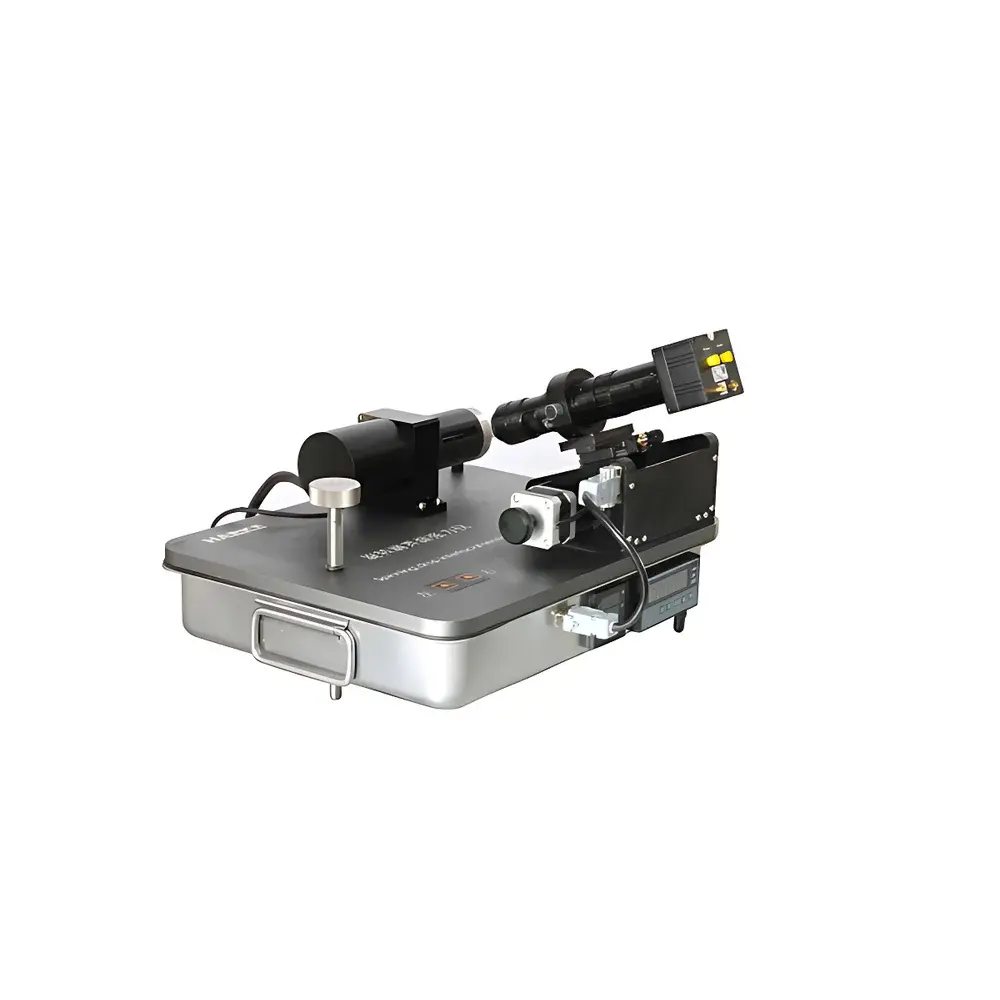
HARKE SDT-SP Advanced Rotational Drop Ultra-Low Interfacial Tensiometer
| Brand | HARKE |
|---|---|
| Origin | Beijing, China |
| Manufacturer Type | Direct Manufacturer |
| Product Category | Domestic |
| Model | HARKE-SDT-SP |
| Measurement Range | 1×10⁻⁶–2×10³ mN/m |
| Resolution | 0.1 mN/m |
| Accuracy | ±1% F.S. |
| Temperature Control Range | Ambient to 70 °C |
| Temperature Display Resolution | 0.1 °C |
| Optical System | 0.7×–5× Step-Zoom Lens |
| Video Capture | High-Speed Digital Imaging with PC-Based Control |
| Sample Tube ID Options | Φ2 mm & Φ6 mm |
| Lens Vertical Travel | 0–100 mm |
| Dimensions (W×D×H) | 420×320×260 mm |
| Weight | 15 kg |
| Power Supply | 220 V AC / 3 A / 50 Hz |
| Software | HARKE-SDT v1.0 |
Overview
The HARKE SDT-SP is an advanced rotational drop ultra-low interfacial tensiometer engineered for precise, reproducible measurement of interfacial tension (IFT) between immiscible liquid phases—particularly at the ultra-low range (10⁻⁶–10⁻³ mN/m)—where conventional pendant or sessile drop methods lack sufficient sensitivity. It operates on the fundamental principle of rotational drop analysis: a denser droplet of one liquid phase is suspended within a less-dense continuous phase inside a rotating horizontal capillary tube. Under controlled centrifugal force, the droplet deforms into an elongated ellipsoid; its shape is governed by the balance between centrifugal stress and interfacial restoring forces. By capturing high-resolution video of the equilibrium droplet profile and applying Young–Laplace-based numerical fitting algorithms, the instrument calculates IFT with trace-level resolution. Designed for formulation science, enhanced oil recovery (EOR), microemulsion characterization, and surfactant screening, the SDT-SP delivers metrologically traceable results aligned with ASTM D971 and ISO 6295 standards for interfacial tension measurement.
Key Features
- Ultra-low detection limit down to 1×10⁻⁶ mN/m—enabling quantitative characterization of ultradilute surfactant systems and near-critical fluid interfaces.
- Dual sample tube configuration (Φ2 mm and Φ6 mm inner diameter) supports flexibility across viscosity ranges and interfacial relaxation times.
- Motorized, software-controlled high-precision rotation stage with speed stability better than ±0.1 rpm over extended measurement cycles.
- Integrated thermoregulation system combining Peltier-assisted heating (ambient to 70 °C) and optional external chiller coupling for isothermal precision (±0.1 °C display resolution).
- 0.7×–5× motorized step-zoom optical path with coaxial LED illumination ensures optimal image contrast and edge definition across magnification settings.
- High-speed CMOS camera (≥120 fps at full resolution) synchronized with real-time centroid tracking and dynamic droplet contour extraction.
- Rigid aluminum alloy chassis and vibration-damped base minimize mechanical drift during long-duration measurements (>30 min).
Sample Compatibility & Compliance
The SDT-SP accommodates a broad spectrum of liquid–liquid systems—including aqueous/non-aqueous, hydrocarbon/water, polymer melt interfaces, and CO₂-expanded liquids—provided density contrast exceeds 0.05 g/cm³ and viscosity remains below 500 mPa·s for stable droplet formation. Compatible with standard quartz or borosilicate capillaries (length ≥80 mm). All hardware and firmware comply with CE electromagnetic compatibility (EMC) directives. Measurement protocols support GLP-compliant data integrity: user authentication, audit-trail-enabled software logging, and timestamped raw image archives. The HARKE-SDT v1.0 software meets basic requirements for 21 CFR Part 11 readiness (electronic signatures, operation logs, and data immutability upon export), though full validation documentation must be configured per site-specific SOPs.
Software & Data Management
HARKE-SDT v1.0 is a Windows-native application offering real-time video acquisition, automated droplet detection, iterative Young–Laplace curve fitting, and multi-parameter export (CSV, PDF, PNG). It includes built-in calibration routines for pixel-to-micron scaling and rotational speed verification using certified reference oils. Data files embed metadata including operator ID, environmental temperature/humidity (when interfaced with optional sensors), instrument serial number, and full acquisition parameters. Batch processing mode enables unattended sequential analysis of up to 24 samples. Exported datasets include raw images, fitted contours, residual error maps, and statistical summaries (mean, SD, CV%) across replicate runs—facilitating compliance with ISO/IEC 17025 reporting requirements.
Applications
- Surfactant efficiency evaluation in EOR formulations, including alkali-surfactant-polymer (ASP) floods.
- Microemulsion phase behavior mapping and Winsor classification.
- Quality control of silicone oils, fluorosurfactants, and biosurfactants in pharmaceutical excipient development.
- Interfacial rheology pre-screening prior to interfacial shear rheometry (ISR) experiments.
- Thermodynamic modeling input generation (e.g., for UNIFAC or NRTL parameterization).
- Stability assessment of nanoemulsions and Pickering emulsions under thermal stress.
FAQ
What is the minimum measurable interfacial tension value, and under what conditions is it achievable?
The theoretical lower limit of 1×10⁻⁶ mN/m requires use of the Φ2 mm capillary, low-viscosity continuous phase (0.3 g/cm³), and measurement duration ≥15 minutes to ensure full droplet equilibration.
Can the SDT-SP measure dynamic interfacial tension?
No—it is designed for equilibrium IFT determination only. Dynamic measurements require complementary techniques such as oscillating jet or maximum bubble pressure tensiometry.
Is third-party calibration certification available?
Yes—HARKE provides NIST-traceable calibration reports for rotational speed, temperature sensor, and optical scale, issued by an ILAC-accredited metrology lab upon request.
Does the system support integration with external thermostats or data acquisition platforms?
Yes—the instrument features RS-232 and USB-TTL interfaces for bidirectional communication with external chillers, environmental chambers, or LabVIEW-based DAQ systems.
How does the software handle ambiguous droplet boundaries due to low contrast or turbidity?
HARKE-SDT v1.0 includes adaptive histogram equalization, edge-enhancement filters, and manual contour override tools to ensure robust segmentation even in optically challenging systems.



