
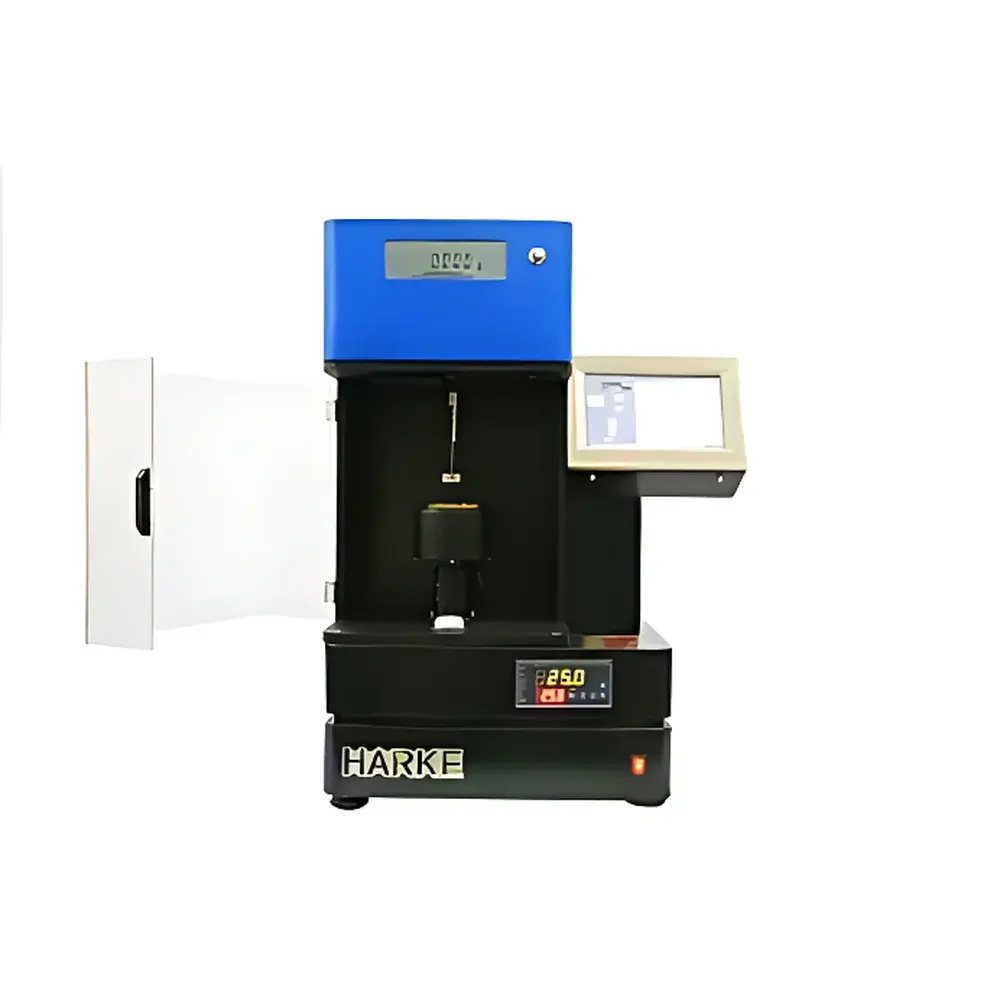
HARKE SFT-A3 Advanced Surface Tensiometer
| Brand | HARKE |
|---|---|
| Model | SFT-A3 |
| Measurement Principle | Du Noüy Ring Method & Wilhelmy Plate Method |
| Measurement Range | 0–400 mN/m |
| Resolution | ±0.01 mN/m |
| Accuracy | ±0.1 mN/m |
| Temperature Control | Ambient (optional Peltier or circulating bath integration) |
| Sensor Type | Electromagnetic Force Compensation Balance |
| Max Load Capacity | 120 g |
| Stage Vertical Travel | 0–80 mm |
| Stage Speed | 0–10 mm/s |
| Stage Positioning Accuracy | ±0.1 mm |
| Sample Vessel Diameter | Φ50 mm |
| Software | SFT-A1 v3.x (GLP-compliant, audit trail enabled) |
| Dimensions (W×D×H) | 360 × 360 × 620 mm |
| Weight | 20 kg |
| Compliance | ASTM D971, ISO 6295, ISO 1409, USP <1041>, EN 14370 |
| Optional Accessories | Peltier temperature control module, external thermostatic circulation jacket, density measurement kit |
Overview
The HARKE SFT-A3 Advanced Surface Tensiometer is a dual-method, microprocessor-controlled instrument engineered for high-reproducibility measurement of surface and interfacial tension in liquid systems. It operates on two internationally standardized physical principles: the Du Noüy ring method (ASTM D971, ISO 6295) and the Wilhelmy plate method (ISO 1409, USP ). Unlike torsion-wire-based tensiometers, the SFT-A3 employs an electromagnetic force compensation transducer — a metrologically traceable balance architecture widely adopted in primary calibration laboratories — ensuring long-term zero stability, minimal hysteresis, and immunity to mechanical drift induced by ambient vibration or thermal expansion. Its embedded real-time operating system eliminates dependency on external PCs while retaining full computational parity with desktop-based platforms, including dynamic force curve acquisition, real-time visualization of meniscus detachment events, and automatic baseline correction. The instrument is designed for routine QC testing in chemical, pharmaceutical, and coatings industries, as well as for fundamental research into surfactant adsorption kinetics, micellization thresholds, and interfacial rheology.
Key Features
- Electromagnetic force compensation sensor with 120 g capacity and sub-microgram force resolution, delivering ±0.1 mN/m absolute accuracy per ISO 1409 calibration protocols
- Dual-method capability: fully compliant Du Noüy ring and Wilhelmy plate modules, both using ASTM/ISO-specified platinum-iridium alloy rings (Φ19.2 mm) and plates (10 × 20 mm), precision-welded and certified for dimensional conformity
- Motorized vertical stage with programmable speed (0–10 mm/s), travel range (0–80 mm), and positioning repeatability of ±0.1 mm — enabling precise control over immersion depth and withdrawal velocity
- Integrated density measurement function via buoyancy-based mass determination, supporting concurrent surface tension and liquid density analysis without hardware modification
- SFT-A1 software suite featuring GLP-compliant data handling: electronic signatures, user-level access control, versioned method templates (A3/A4/A5), and 21 CFR Part 11–ready audit trails
- Modular thermal interface: supports optional Peltier-based sample-stage heating/cooling (±0.1 °C stability) or integration with external thermostatic circulators for extended temperature studies (–10 to +80 °C)
Sample Compatibility & Compliance
The SFT-A3 accommodates standard cylindrical sample vessels (Φ50 mm) compatible with low-volume formulations (<15 mL) and high-viscosity systems (up to 10,000 mPa·s). Its open-access design permits rapid exchange of ring/plate fixtures and cleaning between samples — critical for GMP-regulated environments where carryover must be quantified and controlled. All measurement routines adhere to ISO/IEC 17025–aligned validation protocols. Test reports include metadata stamps (operator ID, timestamp, environmental temperature/humidity), raw force-vs.-displacement curves, and uncertainty budgets derived from sensor calibration certificates (traceable to NIM, China). The instrument meets requirements for regulatory submissions under FDA, EMA, and PMDA guidelines when operated within validated SOPs.
Software & Data Management
SFT-A1 v3.x is a native Windows-compatible application built on a deterministic real-time kernel. It provides synchronized dual-display output: numeric surface tension values updated at 50 Hz alongside time-resolved force profiles visualized in real time. Method templates embed calculation algorithms per ISO 6295 (ring correction factor f), ISO 1409 (plate perimeter correction), and custom polynomial fits for non-Newtonian interfaces. Data export supports CSV, PDF (with embedded digital signatures), and XML formats compliant with LIMS integration. Audit logs record every parameter change, calibration event, and report generation — all encrypted and immutable per 21 CFR Part 11 Annex 11 specifications.
Applications
- Surfactant critical micelle concentration (CMC) determination in R&D labs
- Quality control of emulsifiers, wetting agents, and dispersants in paint, ink, and agrochemical manufacturing
- Stability assessment of oil-in-water and water-in-oil emulsions via interfacial tension monitoring
- Surface energy evaluation of polymer films and biomaterials using contact angle–tension correlations
- Density-tension co-analysis for formulation optimization in pharmaceutical oral suspensions and injectables
- Evaluation of temperature-dependent interfacial behavior in enhanced oil recovery (EOR) surfactant screening
FAQ
Does the SFT-A3 support both ring and plate methods without hardware reconfiguration?
Yes — the instrument includes quick-release mounts and auto-detectable transducer calibration profiles for seamless switching between Du Noüy ring and Wilhelmy plate configurations.
Is temperature control included as standard equipment?
No — ambient operation is standard; temperature regulation requires selection of either the integrated Peltier module or external circulation jacket (both sold separately).
Can raw force data be exported for third-party kinetic modeling?
Yes — SFT-A1 exports unprocessed .dat files containing time-stamped force (µN), position (µm), and temperature (°C) vectors at user-defined sampling intervals (1–100 Hz).
What calibration standards are supplied with the instrument?
Each unit ships with NIST-traceable calibration weights (1 g, 10 g, 50 g), certified platinum-iridium ring and plate fixtures, and a reference ethanol/water mixture certificate (surface tension = 22.27 mN/m at 20.0 °C).
Is remote operation supported via network protocol?
Yes — SFT-A1 supports TCP/IP communication for LAN-based instrument control and data streaming, compatible with LabVIEW, Python (PySerial), and MATLAB interfaces.



