
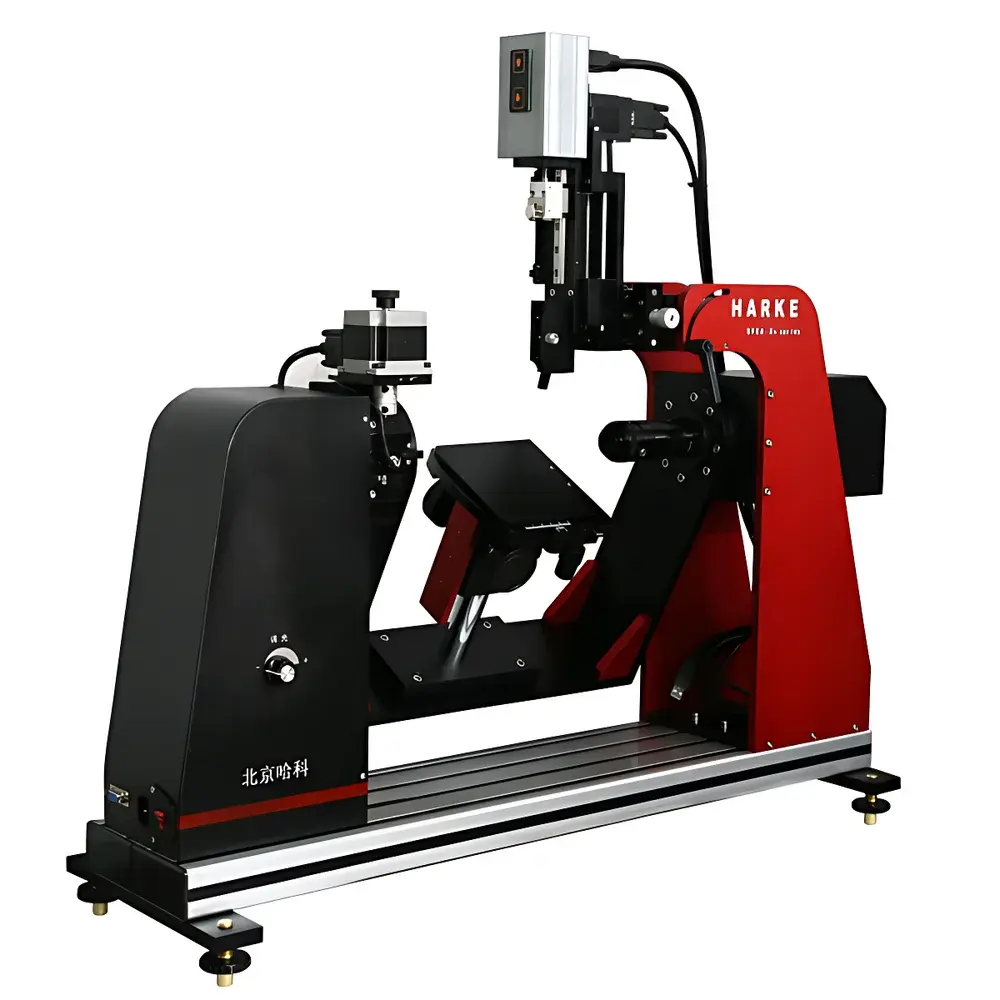
HARKE SPCA X3 Video-Based Optical Contact Angle Meter
| Brand | HARKE |
|---|---|
| Model | SPCA X3 |
| Instrument Type | Benchtop Video Optical Contact Angle Meter |
| Contact Angle Range | 0–180° |
| Contact Angle Accuracy | ±0.1° |
| Sample Stage Dimensions | 120 × 120 mm |
| Optical Magnification | 0.7–4.7× (parfocal zoom) |
| Surface/Interfacial Tension Range | 0–1000 mN/m |
| Surface/Interfacial Tension Resolution | 0.01 mN/m |
| Automated Syringe Dispenser Volume Range | 0–100 mL (computer-controlled), Manual Mode: 1 mL |
| Dispensing Precision | 0.1 µL |
| Stage Translation | X ±70 mm, Y ±40 mm, Z ±50 mm |
| Fixed Plate Translation | +150 mm (Y) |
| Microscope Translation | ±100 mm (Y) |
| Maximum Sample Height | 80 mm |
| Overall Dimensions | 240 × 640 × 630 mm (W × L × H) |
Overview
The HARKE SPCA X3 is a high-precision, benchtop video-based optical contact angle meter engineered for rigorous surface and interfacial property characterization in research laboratories and quality control environments. It operates on the principle of sessile drop and captive bubble analysis, capturing high-resolution images of liquid–solid or liquid–gas interfaces using a parfocal, continuously variable magnification optical system (0.7–4.7×) coupled with a high-speed CMOS camera. The instrument quantifies contact angle—the angle formed at the three-phase boundary between solid, liquid, and vapor—by applying multiple geometric and physical models including circle fitting, ellipse fitting, tangent-based local and global contour analysis, Young–Laplace curve fitting, and spline-based profile reconstruction. These methods enable robust, operator-independent measurements across heterogeneous, rough, or chemically patterned surfaces. Designed for reproducibility and traceability, the SPCA X3 supports ISO 19403-2 (2017), ASTM D7334 (surface energy of polymer films), and ISO 14210 (contact angle measurement by sessile drop), and its architecture aligns with GLP-compliant data integrity requirements.
Key Features
- Parfocal precision zoom optics (0.7–4.7×) with zero focus drift during magnification adjustment—engineered exclusively for HARKE to ensure consistent image sharpness across measurement sequences.
- High-resolution CMOS imaging system with real-time video capture, frame-by-frame playback, programmable time-lapse snapshot acquisition, and single-frame export from recorded sequences.
- Computer-controlled microdispensing module with dual-range capability: 0–100 mL automated syringe actuation (software-triggered) and manual 1 mL dispensing mode, both achieving ±0.1 µL volumetric resolution.
- Motorized 3-axis sample stage (X: ±70 mm, Y: ±40 mm, Z: ±50 mm) plus independent fixed plate translation (+150 mm Y) and microscope carriage movement (±100 mm Y), enabling precise positioning of irregular or oversized specimens up to 100 mm wide × 80 mm thick.
- Integrated surface energy calculation suite supporting Zisman plot, Fowkes, Owens–Wendt–Rabel–Kaelble (OWRK), Wu harmonic mean, and van Oss–Chaudhury–Good (vOCG) methodologies.
- Automated calculation of adhesion work, spreading coefficient, and interfacial tension via pendant/sessile drop analysis, compliant with ISO 19403-4 (2017) for interfacial tension determination.
Sample Compatibility & Compliance
The SPCA X3 accommodates rigid and flexible substrates—including metals, polymers, ceramics, thin films, textiles, and coated glass—with maximum dimensions of 100 mm (width) × 80 mm (thickness). Its open-stage design permits in situ environmental control (e.g., humidity chambers or temperature stages) when integrated externally. All measurement algorithms and calibration routines adhere to internationally recognized standards: contact angle accuracy (±0.1°) meets ISO 19403-1 Annex A validation criteria; surface tension range (0–1000 mN/m) and resolution (0.01 mN/m) conform to ISO 19403-4 performance benchmarks. Data audit trails, user access logs, and electronic signature support are configurable to satisfy FDA 21 CFR Part 11 requirements for regulated environments.
Software & Data Management
The proprietary HARKE Surface Analysis Suite provides a deterministic, scriptable interface for measurement protocol definition, batch processing, and statistical reporting. Raw image files are stored in lossless TIFF format with embedded metadata (timestamp, stage coordinates, dispense volume, lens magnification, lighting parameters). Software modules include dynamic contact angle tracking (advancing/receding), hysteresis analysis, time-resolved surface energy mapping, and export-ready reports in PDF, CSV, and XML formats. Version-controlled firmware and software updates ensure long-term compatibility with evolving laboratory IT infrastructure and cybersecurity policies.
Applications
- Characterization of hydrophobic/hydrophilic coatings on biomedical devices per ISO 10993-4 biocompatibility screening protocols.
- Quality assurance of anti-fog, anti-reflective, or oleophobic layers on optical lenses and display panels.
- Development and validation of inkjet printing formulations for printed electronics substrates.
- Surface treatment efficacy evaluation (plasma, corona, flame) on polymer packaging materials per ASTM D2578.
- Adsorption kinetics modeling of surfactants at oil–water interfaces in enhanced oil recovery research.
- Wettability assessment of porous media in geoscience and reservoir engineering applications.
FAQ
What contact angle analysis methods does the SPCA X3 support?
It implements automatic circle fitting, ellipse fitting, full and local tangent methods, Young–Laplace curve fitting, spline-based contour analysis, and manual interactive correction—all selectable per image or applied in batch mode.
Is the instrument compatible with environmental control accessories?
Yes—the open mechanical architecture allows integration with external temperature stages, humidity chambers, or gas purging enclosures without hardware modification.
Can surface energy be calculated for heterogeneous or anisotropic surfaces?
The software supports multi-point spatial mapping and directional analysis using anisotropic OWRK and vOCG models, provided sufficient regional homogeneity is confirmed via optical inspection.
Does the system meet regulatory data integrity requirements?
When configured with audit trail logging, role-based access control, and electronic signatures, it satisfies core elements of FDA 21 CFR Part 11 and EU Annex 11 for computerized systems in GxP environments.
What is the minimum droplet volume resolvable for dynamic contact angle studies?
With the 0.1 µL dispensing resolution and sub-pixel edge detection algorithm, stable sessile drops as small as 0.5 µL can be reliably analyzed under controlled ambient conditions.



