
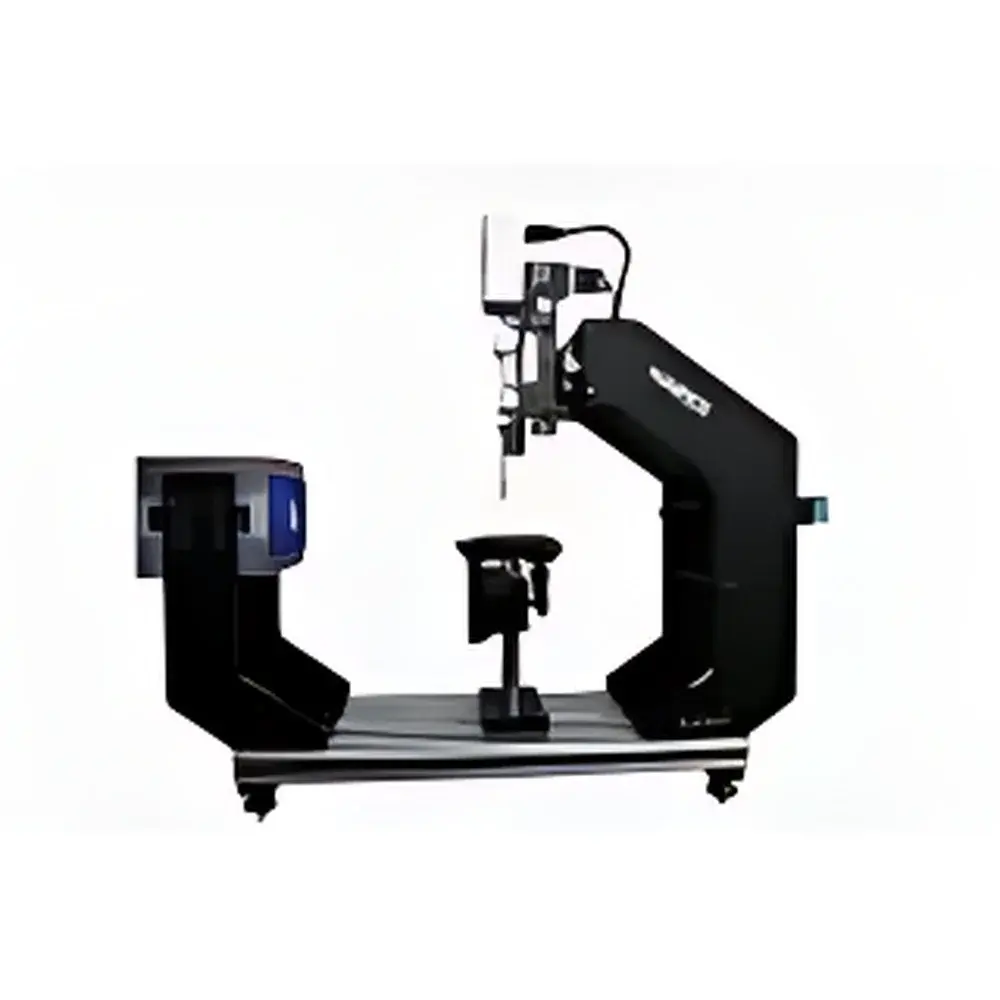
HARKE SPCA-X1 Video-Based Optical Contact Angle Meter
| Brand | HARKE |
|---|---|
| Model | SPCA-X1 |
| Instrument Type | Benchtop Video Optical Contact Angle Analyzer |
| Contact Angle Range | 0–180° |
| Contact Angle Measurement Accuracy | ±0.1° |
| Contact Angle Display Resolution | ±0.01° |
| Surface/Interfacial Tension Range | 0–1000 mN/m |
| Surface/Interfacial Tension Accuracy | ±0.01 mN/m |
| Sample Stage Dimensions | 100 mm × 120 mm |
| Lens Magnification | 0.7×–5× (stepped zoom optics) |
| Camera Interface | USB 3.0 |
| Frame Rate Options | 30 fps (standard), up to 1000 fps (optional) |
| Lens Vertical Travel | 30 mm |
| Injection System Travel | 30 mm |
| XY Manual Stage Precision | ±0.1 mm |
| Software | SPCA 1.0 |
| Power Supply | 220 V, 3 A, 50 Hz |
| Operating Temperature | Ambient |
| Measurement Methods | Circle Fit, Ellipse Fit, Height-Width Method, Young-Laplace Fitting, Sessile Drop, Pendant Drop, Tilting Plate, and Dynamic Advancing/Receding Protocols |
| Optional Modules | Dynamic Contact Angle (Expansion/Contraction & Tilting Plate), Solid Surface Free Energy Analysis, Interfacial Tension (Pendant Drop Method) |
Overview
The HARKE SPCA-X1 is a benchtop video-based optical contact angle meter engineered for high-precision quantification of solid-liquid interfacial interactions. It operates on the principle of sessile drop analysis using real-time digital image capture and advanced edge-detection algorithms, enabling direct measurement of static, advancing, and receding contact angles — critical parameters in surface wettability characterization. The system integrates a calibrated optical path with stepped zoom lenses (0.7×–5×), a high-sensitivity USB 3.0 camera (30 fps standard; optional ultra-high-speed variants up to 1000 fps), and motorized or manual precision positioning stages. Designed for laboratory environments where reproducibility and traceability are essential, the SPCA-X1 supports both ISO 19403 (Contact angle measurement — Part 1–4) and ASTM D7334 (Standard Practice for Surface Wettability Assessment) compliant workflows. Its modular architecture allows seamless integration of pendant drop analysis for interfacial tension determination and dynamic tilt-stage modules for sliding angle and hysteresis evaluation.
Key Features
- Benchtop design with compact footprint (300 mm × 760 mm) and robust aluminum-alloy frame for vibration-damped operation
- High-resolution optical path featuring parfocal, stepped-zoom lens system (0.7×–5×) ensuring consistent focus across magnification steps without recalibration
- USB 3.0 monochrome CMOS camera with adjustable exposure, gain, and gamma control; supports real-time frame rates from 30 fps (standard) to 1000 fps (optional) for transient droplet dynamics
- Precision mechanical stage: manually operated X-Y translation with ±0.1 mm repeatability; vertical lens travel of 30 mm for optimal focal plane alignment
- Integrated syringe pump module with 30 mm vertical travel and programmable dispensing for automated drop deposition and sequential multi-drop analysis
- SPCA 1.0 software platform supporting eight validated fitting algorithms — including Circle, Ellipse, Height-Width, Young-Laplace, and Axisymmetric Drop Shape Analysis (ADSA) — each selectable based on droplet morphology and substrate heterogeneity
- Real-time auto-recognition of droplet contours with adaptive thresholding, eliminating manual ROI definition in routine measurements
Sample Compatibility & Compliance
The SPCA-X1 accommodates flat, rigid, or flexible substrates up to 120 mm wide × 100 mm deep on its fixed horizontal sample stage. Samples may include polymers, metals, ceramics, thin films, textiles, and coated surfaces — provided they remain dimensionally stable under ambient conditions. No vacuum or environmental chamber is required for standard operation, though optional humidity- and temperature-controlled enclosures can be integrated for ISO 8510-2 or ASTM D5725 compliance. All measurement data — including raw images, fitted profiles, and metadata (timestamp, operator ID, instrument settings) — are stored in audit-trail-enabled format. The system supports GLP/GMP-aligned documentation practices, with optional 21 CFR Part 11-compliant user authentication and electronic signature modules available upon request.
Software & Data Management
SPCA 1.0 is a Windows-based application developed specifically for interfacial metrology. It provides full control over camera acquisition, stage movement, droplet dispensing, and real-time image processing. Each measurement session generates a structured project file (.spca) containing embedded TIFF images, CSV-exportable numerical results (contact angle, surface tension, base diameter, volume, etc.), and full parameter logs. Batch processing mode enables unattended multi-sample analysis with configurable pass/fail criteria. Export formats include PDF reports (with customizable templates), Excel-compatible CSV, and PNG/JPEG for publication-grade figures. Raw image sequences (AVI or TIFF stack) are retained for retrospective reanalysis, supporting method validation per ISO/IEC 17025 requirements.
Applications
- Quality control of hydrophobic/hydrophilic coatings in medical device manufacturing (e.g., catheter surface treatment verification)
- Characterization of plasma-treated polymer surfaces for adhesion optimization in automotive composites
- Surface energy mapping of printed electronics substrates using Owens-Wendt, Wu, or van Oss-Chaudhury-Good models
- Stability assessment of emulsions and foams via pendant drop interfacial tension monitoring
- Dynamic wettability screening of filtration membranes under controlled expansion/retraction cycles
- Academic research in colloid and interface science, including contact angle hysteresis quantification and Cassie-Baxter/Wenzel state transition analysis
FAQ
What measurement methods does the SPCA-X1 support?
The instrument implements eight algorithmic approaches: Circle Fit, Ellipse Fit, Height-Width Method, Young-Laplace Fitting, Sessile Drop, Pendant Drop, Tilting Plate, and Dynamic Advancing/Receding protocols.
Can the system measure interfacial tension between two immiscible liquids?
Yes — using the pendant drop method with optional software module activation and appropriate dual-liquid cell configuration.
Is the SPCA-X1 compatible with regulated environments requiring electronic records and signatures?
The base system supports audit trail generation; 21 CFR Part 11 compliance is achievable via optional software upgrade and validated IT infrastructure.
What is the minimum detectable contact angle resolution?
Display resolution is ±0.01°; typical measurement uncertainty under controlled lab conditions is ±0.1° (k = 2, ISO 5725-2).
Does the system require external calibration standards?
No physical calibration artifacts are needed — geometric calibration is performed internally using pixel-to-mm mapping routines embedded in SPCA 1.0.
Related Products



