
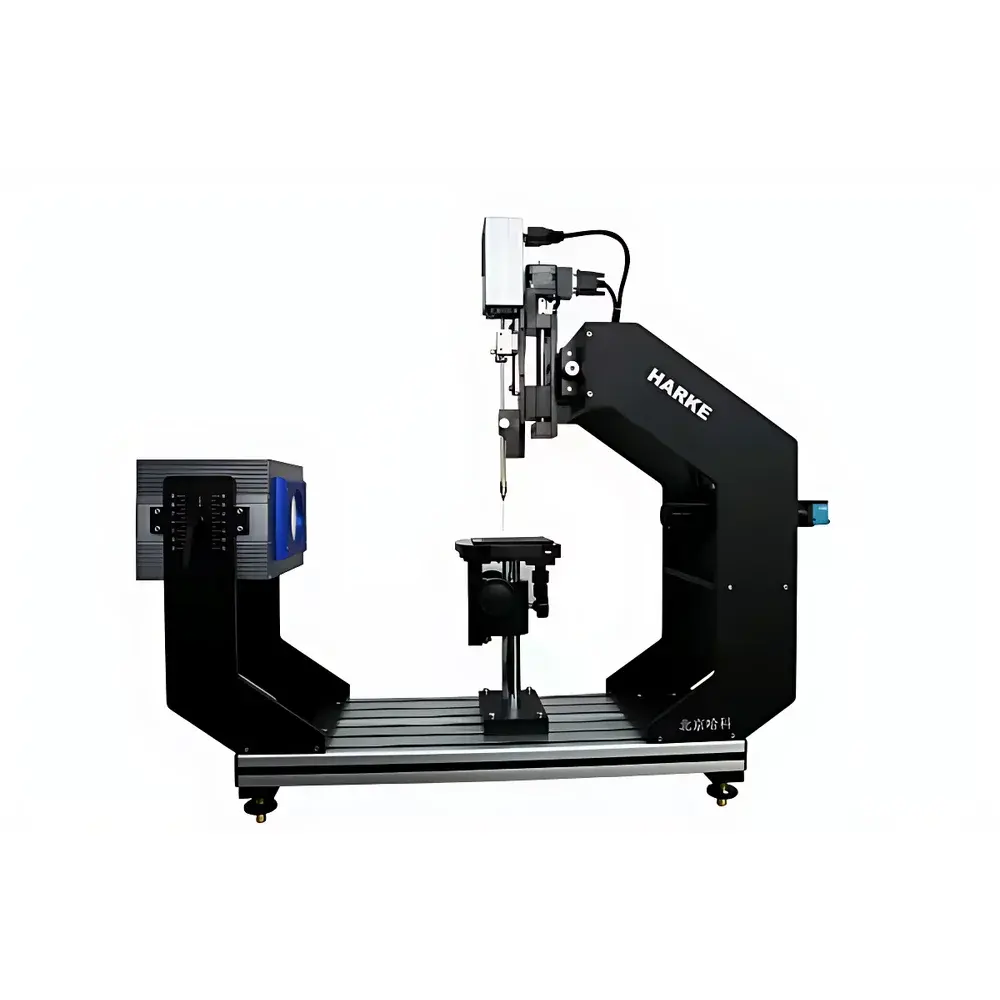
HARKE SPCAX1 Video-Based Optical Contact Angle Analyzer
| Brand | HARKE |
|---|---|
| Origin | Beijing, China |
| Manufacturer Type | Manufacturer |
| Product Category | Domestic |
| Model | HARKE-SPCAX1 |
| Instrument Type | Benchtop Laboratory System |
| Contact Angle Measurement Range | 0–180° |
| Contact Angle Measurement Accuracy | ±0.1° |
| Sample Stage Dimensions | 100 mm × 120 mm |
| Optical Magnification | 0.7×–4.5× |
| Surface/Interfacial Tension Range | 0–1000 mN/m |
| Surface/Interfacial Tension Resolution | 0.01 mN/m |
| Imaging System | USB 3.0 High-Speed Camera (30 fps standard |
| Software | SPCA 1.0 |
| Measurement Methods | Circle Fitting, Ellipse Fitting, Height-Width Method, Young-Laplace Fitting, and 5 Additional Algorithmic Models |
| Baseline Detection | Automated Edge Recognition |
| Data Export | CSV, PNG, PDF, Excel-compatible Report Templates |
| Positioning Precision (Motorized Stage & Dispenser) | ±0.1 mm |
| Vertical Lens Travel | 30 mm |
| Power Supply | 220 V, 3 A, 50 Hz |
| Operating Temperature | Ambient |
| Weight | 30 kg |
| Dimensions (W×D×H) | 300 mm × 760 mm × — mm |
| Compliance | ASTM D7334, ISO 19403-2, ISO 15989, USP <1058> (for instrument qualification), GLP/GMP-ready audit trail functionality in SPCA software |
Overview
The HARKE SPCAX1 is a precision-engineered benchtop video-based optical contact angle analyzer designed for quantitative characterization of solid surface wettability and liquid interfacial behavior. It operates on the fundamental principle of sessile drop analysis: a controlled volume of liquid is dispensed onto a solid substrate under ambient or conditioned environments, and high-resolution optical imaging captures the static or dynamic droplet profile at the three-phase (solid–liquid–vapor) contact line. Using advanced digital image processing algorithms—including circle, ellipse, height-width, and Young–Laplace fitting—the system computes the contact angle θ with sub-degree resolution. The Young–Laplace equation is rigorously applied in curvature-based fitting modes to model axisymmetric droplet contours, enabling accurate determination of both contact angle and interfacial tension—critical parameters in surface energy estimation via Owens–Wendt, Wu, or van Oss–Chaudhury–Good models. Engineered for reproducibility in R&D labs and QC environments, the SPCAX1 supports full traceability, method validation, and compliance-aligned workflows.
Key Features
- High-fidelity optical path featuring a motorized 0.7×–4.5× parfocal zoom lens with fixed magnification steps, ensuring consistent pixel-to-length calibration across measurement sessions.
- USB 3.0 industrial camera delivering real-time imaging at 30 fps (standard); optional high-speed modules support 100 fps, 300 fps, and up to 1000 fps for dynamic contact angle studies (e.g., advancing/receding, absorption kinetics).
- Fully motorized XYZ positioning system with ±0.1 mm repeatability: integrated dispenser actuation and vertical lens translation enable precise droplet placement and focus optimization without manual intervention.
- SPCA 1.0 software platform with automated baseline detection, intelligent edge recognition under variable lighting conditions, and multi-algorithm comparison mode for method robustness assessment.
- Eight built-in contact angle calculation methods—including Young–Laplace iterative fitting—allow cross-validation against sample heterogeneity, roughness, or chemical anisotropy.
- Real-time video recording with timestamped frame indexing and post-acquisition replay; users can manually or algorithmically select optimal frames for analysis, eliminating operator bias in frame selection.
- Comprehensive data export suite supporting CSV (raw coordinates), PNG (annotated images), PDF (formatted reports), and Excel-compatible templates compliant with internal SOPs and external audit requirements.
Sample Compatibility & Compliance
The SPCAX1 accommodates rigid and flexible substrates up to 120 mm × 100 mm, including thin films, membranes, coated metals, ceramics, polymers, and biomedical materials. Its open-stage architecture permits integration of environmental chambers (temperature/humidity control), tensile stages, or electrochemical cells for in situ wettability studies. The system meets core international standards for surface characterization: ASTM D7334 (standard practice for surface wettability evaluation), ISO 19403-2 (contact angle measurement by optical methods), and ISO 15989 (interfacial tension by pendant drop). SPCA 1.0 software includes configurable user roles, electronic signatures, audit trail logging, and data integrity safeguards aligned with FDA 21 CFR Part 11 and EU Annex 11 expectations—making it suitable for GLP and GMP-regulated environments.
Software & Data Management
SPCA 1.0 is a Windows-native application developed specifically for surface science metrology. It provides full instrument control (motorized stage, syringe pump, illumination, camera exposure), real-time droplet tracking, and batch-processing capability for multi-sample sequences. All measurement parameters—including dispensing volume, delay time, frame rate, and fitting method—are saved as protocol files for method transferability. Raw image datasets retain EXIF metadata (timestamp, magnification, exposure), and processed results include uncertainty propagation based on pixel resolution and edge-detection confidence thresholds. Audit trails record every user action (login, parameter change, result export), with immutable timestamps and operator ID linkage—essential for regulatory submissions and internal quality audits.
Applications
- Surface treatment validation (plasma, corona, flame, silanization) in automotive, aerospace, and packaging industries.
- Quality control of hydrophobic/hydrophilic coatings on medical devices, filtration membranes, and lab-on-chip substrates.
- Formulation development for inks, adhesives, paints, and agrochemical sprays—correlating contact angle hysteresis with spreading dynamics.
- Characterization of biomaterials (e.g., tissue scaffolds, dental composites) where surface energy governs protein adsorption and cell adhesion.
- Research into smart surfaces (thermo-/photo-responsive polymers, switchable wettability) requiring time-resolved contact angle acquisition.
- Interfacial tension quantification of surfactant solutions, microemulsions, and biopolymer dispersions using pendant drop or constrained sessile drop modes.
FAQ
What contact angle measurement methods are implemented in SPCA 1.0?
The software includes eight validated algorithms: Circle Fitting, Ellipse Fitting, Height-Width Method, Young–Laplace Fitting (axisymmetric), Spline Fitting, Polynomial Fitting, Tangent Method, and Dual-Baseline Method—each selectable per measurement for comparative analysis.
Does the system support interfacial tension measurement?
Yes—via pendant drop analysis using Young–Laplace curve fitting, covering 0–1000 mN/m with 0.01 mN/m resolution. Calibration is performed using standard liquids (e.g., pure water, diiodomethane) traceable to NIST SRMs.
Is the SPCAX1 compliant with FDA 21 CFR Part 11?
SPCA 1.0 includes electronic signature support, audit trail generation, and role-based access control—fully configurable to meet 21 CFR Part 11 and EU Annex 11 requirements when deployed within a validated IT infrastructure.
Can the instrument be integrated into automated production lines?
While primarily a laboratory benchtop system, its RS-232 and Ethernet interfaces, along with COM/ActiveX API support in SPCA 1.0, allow integration into MES or SCADA environments for inline QC sampling protocols.
What is the typical calibration frequency and procedure?
Optical calibration (pixel-to-mm) is performed once per magnification setting using a certified stage micrometer. Contact angle verification uses standard reference slides (e.g., 60°, 90°, 120° certified polymer surfaces) per ASTM D7334 Annex A1—recommended before each test series or daily in regulated settings.



