
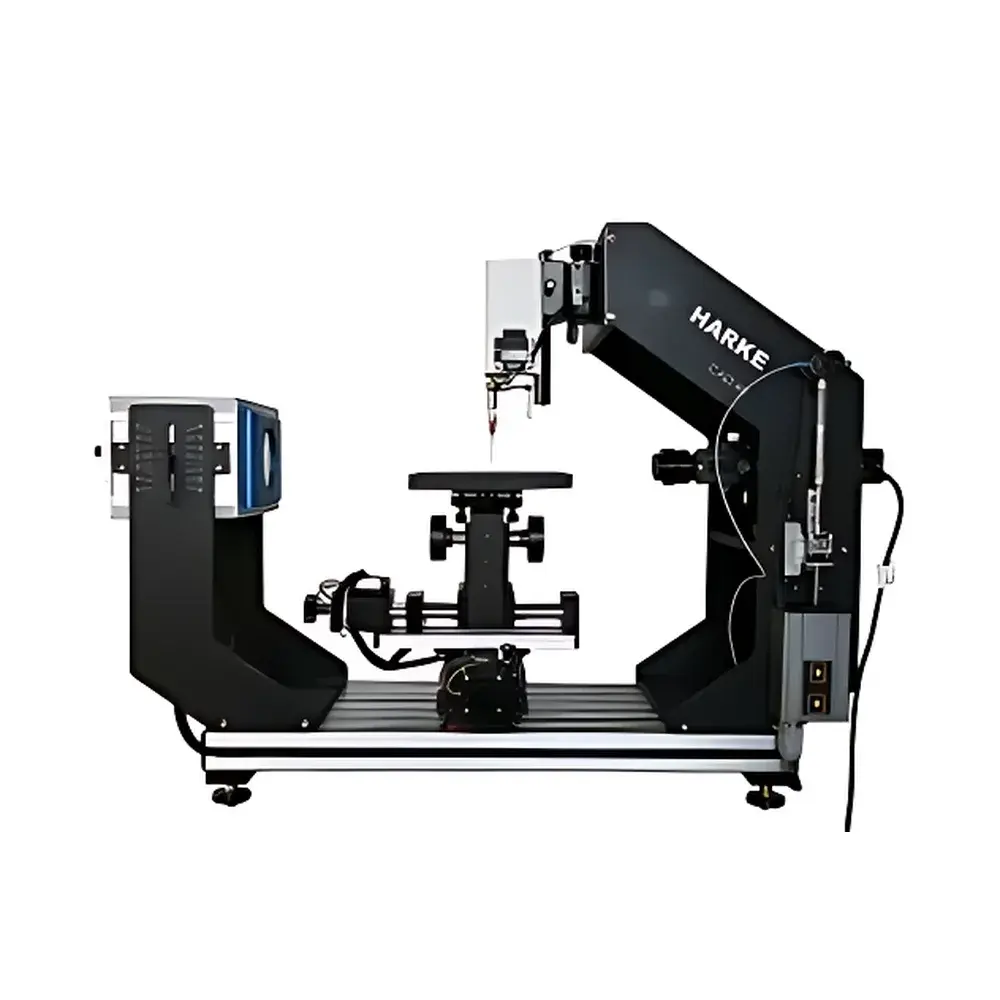
HARKE HK-SPCAX2 Video-Based Optical Contact Angle Analyzer
| Brand | HARKE |
|---|---|
| Model | HK-SPCAX2 |
| Type | Benchtop Video Optical Contact Angle Analyzer |
| Contact Angle Range | 0–180° |
| Contact Angle Accuracy | ±0.1° |
| Contact Angle Resolution | ±0.01° |
| Stage Dimensions | 100 mm × 120 mm |
| Lens Magnification | 0.7×–5× (stepped zoom) |
| Surface/Interfacial Tension Range | 0–1000 mN/m |
| Surface/Interfacial Tension Resolution | 0.01 mN/m |
| Imaging System | USB 3.0 CMOS camera, 30 fps standard (optional: 100/300/1000+ fps) |
| Droplet Dispensing Precision | ±0.1 mm |
| Vertical Lens Travel | 30 mm |
| Instrument Dimensions | 300 mm × 760 mm × 520 mm (W × H × D) |
| Weight | 30 kg |
| Power Supply | 220 V, 3 A, 50 Hz |
| Operating Temperature | Ambient |
| Analysis Methods | Circle, Ellipse, Height-Width, Spline, Young-Laplace Fitting, Tangent, Baseline-Independent, and Dynamic Advancing/Receding (Sessile Drop Expansion/Contraction & Tilting) |
| Software | SPCA 1.0 with GLP-compliant audit trail, automated droplet recognition, time-resolved contact angle kinetics, and surface free energy calculation modules (Owens-Wendt, Wu, Fowkes, van Oss-Chaudhury-Good) |
Overview
The HARKE HK-SPCAX2 is a precision-engineered benchtop video optical contact angle analyzer designed for quantitative characterization of solid-liquid interfacial behavior in advanced materials research and quality control laboratories. It operates on the principle of high-resolution silhouette imaging of sessile or pendant liquid drops deposited on solid substrates, followed by pixel-level geometric or physically constrained Young-Laplace curve fitting to extract contact angle values. The system supports static, quasi-static, and dynamic measurement protocols—including advancing/receding angles via controlled drop volume modulation and slide-angle determination via programmable sample-stage tilting—enabling comprehensive wettability profiling of heterogeneous, anisotropic, or time-sensitive surfaces such as carbon fiber composites, polymer matrix laminates, ceramic coatings, and functionalized nanocomposites. Its modular architecture integrates optomechanical stability with real-time image acquisition and physics-based analysis, making it suitable for ISO 19403-2/-3 compliant surface energy evaluation and ASTM D7334–22 referenced hydrophobicity assessment.
Key Features
- Benchtop design with rigid aluminum alloy frame and vibration-damped optical baseplate for high reproducibility under ambient lab conditions
- Stepped zoom optical path (0.7×–5×) featuring parfocal, aberration-corrected lens assembly ensuring consistent focus across magnification ranges without recalibration
- USB 3.0 monochrome CMOS camera (1280 × 1024 resolution) delivering 30 fps standard acquisition; optional ultra-high-speed modules support up to 1000 fps for rapid dynamic wetting event capture
- Motorized XYZ translation stage with ±0.1 mm repeatability and programmable positioning for multi-site mapping and automated batch analysis
- Integrated syringe pump with micro-stepping drive enabling precise dispensing volumes from 0.1 µL to 100 µL, compatible with aqueous, organic, and molten polymer test liquids
- SPCA 1.0 software platform compliant with FDA 21 CFR Part 11 requirements, including electronic signatures, user access levels, and immutable audit trails for GxP environments
Sample Compatibility & Compliance
The HK-SPCAX2 accommodates flat, rigid, or moderately curved specimens up to 100 mm × 120 mm and 25 mm thick—including CFRP panels, prepreg tapes, injection-molded thermoplastic composites, and coated metallic substrates. Its non-contact optical methodology avoids mechanical interference with delicate or low-modulus surfaces. All measurement algorithms adhere to ISO 19403 series standards for contact angle and surface free energy determination. Surface tension calculations follow pendant drop analysis per ISO 19403-4 and ASTM D1331. The instrument’s software validation package supports GLP/GMP documentation workflows, including IQ/OQ protocols and traceable calibration logs against NIST-traceable reference liquids (e.g., ultrapure water, diiodomethane, ethylene glycol).
Software & Data Management
SPCA 1.0 provides a unified interface for acquisition, processing, and reporting. Core capabilities include real-time droplet contour detection using adaptive thresholding, automatic baseline correction for tilted or uneven substrates, and time-series export of contact angle, diameter, volume, and surface tension at user-defined intervals. Eight built-in fitting models—Circle, Ellipse, Height-Width, Spline, Young-Laplace (axisymmetric and asymmetric), Tangent, Baseline-Independent, and Dynamic Cycle—are selectable based on drop morphology and substrate heterogeneity. Surface free energy modules implement Owens-Wendt, Wu, Fowkes, and van Oss-Chaudhury-Good theories with customizable component databases. Export formats include CSV, PDF reports with embedded metadata, and HDF5 for integration with MATLAB or Python-based data pipelines.
Applications
- Wettability screening of composite layups prior to resin infusion or adhesive bonding
- Quantitative evaluation of plasma, corona, or chemical surface treatments on carbon fiber or glass fabric
- Time-dependent contact angle decay analysis for assessing surface reorganization in thermoplastic matrices
- Interfacial tension measurement of epoxy–hardener systems during cure monitoring
- Dynamic contact angle hysteresis mapping for predicting delamination resistance in sandwich structures
- Surface energy component analysis to correlate adhesion performance with polar/apolar interaction parameters
FAQ
What measurement methods does the HK-SPCAX2 support for static contact angle analysis?
Circle, ellipse, height-width, spline, tangent, baseline-independent, and Young-Laplace fitting—each optimized for specific droplet symmetry and substrate conditions.
Can the system quantify surface free energy of composite substrates?
Yes, using multiple theoretical models (Owens-Wendt, Wu, Fowkes, van Oss-Chaudhury-Good) with user-defined probe liquid libraries and automatic component decomposition.
Is the software validated for regulated pharmaceutical or aerospace QA/QC use?
SPCA 1.0 includes 21 CFR Part 11 compliance features: role-based access control, electronic signatures, and tamper-evident audit logs—validated per GAMP 5 guidelines.
What high-speed imaging options are available for dynamic contact angle studies?
Standard 30 fps is upgradable to 100 fps, 300 fps, or 1000+ fps configurations with synchronized lighting and hardware-triggered acquisition.
Does the instrument support interfacial tension measurement of immiscible liquid pairs?
Yes, via pendant drop analysis for liquid–liquid interfaces, covering 0–1000 mN/m with 0.01 mN/m resolution and automated density correction.



