
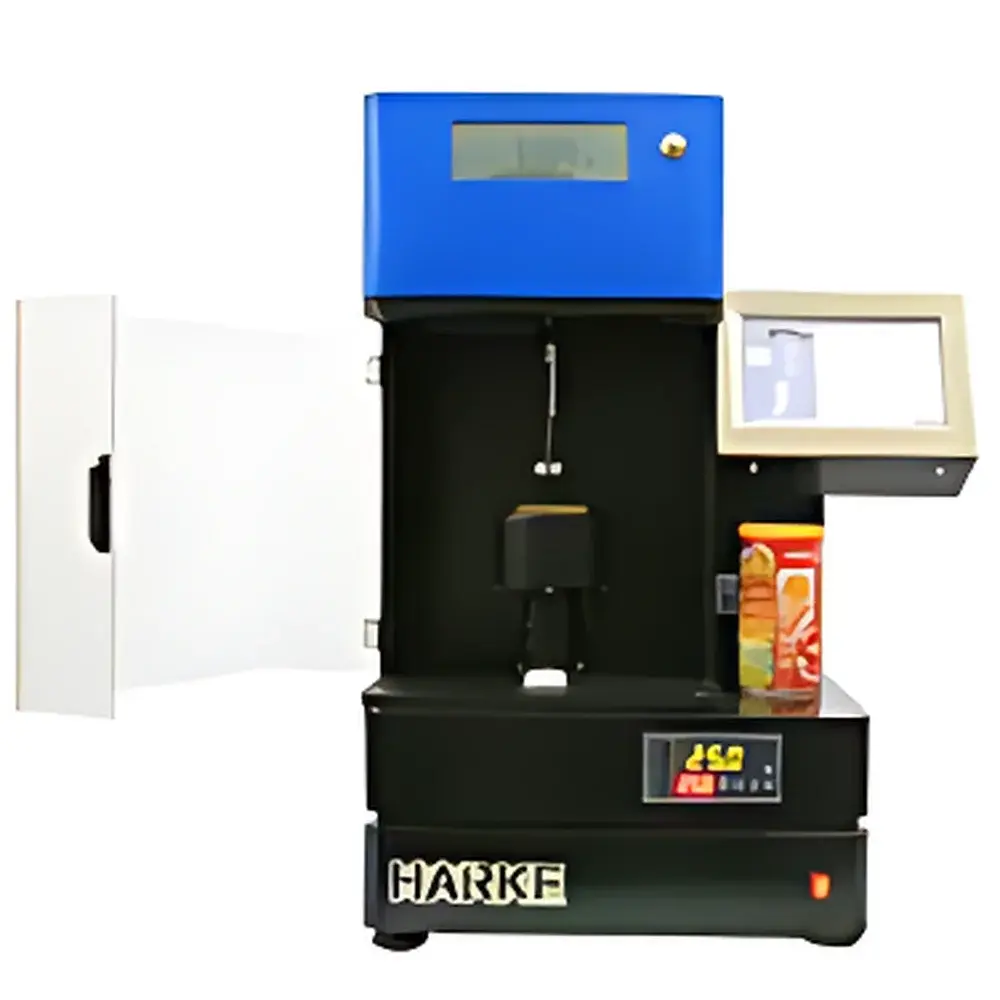
HARKE A3 Surface Tensiometer
| Origin | Beijing, China |
|---|---|
| Manufacturer Type | Authorized Distributor |
| Origin Category | Domestic (China) |
| Model | HARKE-A3 |
| Quotation | Available Upon Request |
| Surface Tension Range | 0–1000 mN/m |
| Accuracy | ±1% of F.S. |
| Resolution | ±0.1 mN/m |
| Sample Stage Vertical Travel | 45 mm |
| Stage Speed | 0–1 mm/min |
| Sample Vessel Diameter | Ø55 mm |
| Heating Power | 100 W |
| Temperature Control | PID On/Off Mode |
| Temp. Stability | ±0.1 °C |
| Display | 7.0″ TFT LCD, 800×400 resolution |
| Test Methods | Du Noüy Ring Method, Wilhelmy Plate Method |
| Functions | Surface Tension Measurement, Mass Measurement |
| Mass Range | 0–120 g |
| Mass Accuracy | 0.0001 g |
| Total Power Consumption | 120 W |
| Input Power | 220 V AC, 3 A, 60 Hz |
| Dimensions (L×W×H) | 500 × 500 × 700 mm |
| Net Weight | 30 kg |
Overview
The HARKE A3 Surface Tensiometer is a benchtop, dual-mode interfacial property analyzer engineered for high-reproducibility surface tension measurement in research laboratories, quality control environments, and industrial R&D settings. It operates on two internationally standardized mechanical equilibrium principles: the Du Noüy ring method (ASTM D971, ISO 6295) and the Wilhelmy plate method (ISO 1409, ASTM D1331). Both methods rely on precise force transduction via electromagnetic balance technology—eliminating mechanical drift associated with torsion-wire systems—and deliver traceable, SI-aligned results directly in millinewtons per meter (mN/m). The instrument integrates thermal control (up to 150 °C), programmable immersion kinetics, and real-time force profiling, enabling dynamic surface tension analysis under controlled temperature and time-resolved conditions. Its embedded computing architecture replaces external PCs while maintaining full data acquisition, processing, and archival capabilities consistent with GLP-compliant workflows.
Key Features
- Electromagnetic balance sensor with 0.0001 g mass resolution and ±0.1 mN/m surface tension resolution—ensuring long-term zero stability and minimal hysteresis.
- Dual-standard compliance: Ring and plate geometries manufactured to ISO-defined dimensions (e.g., platinum-iridium ring diameter 19.2 mm, Wilhelmy plate perimeter 60 mm), certified for inter-laboratory comparability.
- Programmable vertical stage with adjustable immersion speed (0–1 mm/min) and dwell time—critical for studying adsorption kinetics and equilibrium establishment in surfactant solutions.
- PID-controlled heating system (100 W, ±0.1 °C stability) integrated into the sample stage, supporting temperature-dependent surface thermodynamics studies (e.g., critical micelle concentration vs. temperature).
- 7-inch high-contrast TFT display (800×400) with dual-parameter real-time visualization: simultaneous display of surface tension value (mN/m) and raw tensile force (mN), facilitating direct verification using classical correction equations (e.g., Harkins–Jordan factor, Zuidema–Waters correction).
- Integrated precision microbalance functionality (0–120 g, 0.1 mg readability)—enabling density determination (via buoyancy method), concentration calibration, and sample mass tracking without auxiliary instrumentation.
Sample Compatibility & Compliance
The HARKE A3 accommodates aqueous and organic liquids, polymer melts, ionic liquids, and nanoparticle dispersions within standard Ø55 mm glass or quartz vessels. Its non-contact thermal design prevents convective interference during measurement. All operational parameters—including immersion depth, dwell time, temperature ramp rate, and data sampling interval—are programmable and auditable. The system supports documentation protocols aligned with ISO/IEC 17025, USP , and FDA 21 CFR Part 11 requirements when paired with validated software export modules. Calibration routines follow ISO 17034 guidelines using certified reference materials (e.g., ultra-pure water at 20 °C: 72.75 mN/m; 2-propanol at 20 °C: 23.0 mN/m).
Software & Data Management
The embedded operating system provides intuitive menu navigation, multi-language UI support (English, German, Chinese), and timestamped data logging with automatic metadata tagging (operator ID, method name, temperature, date/time). Raw force vs. time curves are exportable in CSV and ASCII formats for post-processing in MATLAB, Origin, or Python-based analysis pipelines. Audit trails record all parameter changes, calibration events, and user logins—essential for GMP/GLP-regulated environments. Optional USB storage enables offline report generation (PDF/Excel) with customizable templates compliant with internal SOPs.
Applications
- Surfactant formulation optimization (CMC determination, adsorption isotherms)
- Quality assurance of coatings, inks, and pharmaceutical emulsions
- Surface energy estimation for polymer film adhesion studies
- Temperature-dependent interfacial thermodynamics of biofluids (e.g., synovial fluid, tear film)
- Colloidal stability assessment via interfacial rheology coupling (with optional oscillatory module)
- Educational demonstration of Young–Laplace equation validation and contact angle correlation
FAQ
What standards does the HARKE A3 comply with for surface tension measurement?
It conforms to ASTM D971 (ring method), ASTM D1331 (plate method), ISO 6295, ISO 1409, and DIN 53914.
Can the instrument measure dynamic surface tension?
Yes—by programming variable immersion speed and dwell time, users can capture time-dependent surface tension profiles relevant to fast-acting surfactants.
Is temperature control available during Wilhelmy plate measurements?
Yes—the heated sample stage maintains uniform bath temperature throughout the entire measurement cycle, including plate immersion and detachment phases.
Does the system support automated calibration verification?
It includes guided calibration workflows using certified reference liquids; full traceability documentation is generated upon completion.
What is the maximum operating temperature of the sample bath?
The integrated heater supports stable operation up to 150 °C, with thermal shielding to protect the sensor assembly.



