
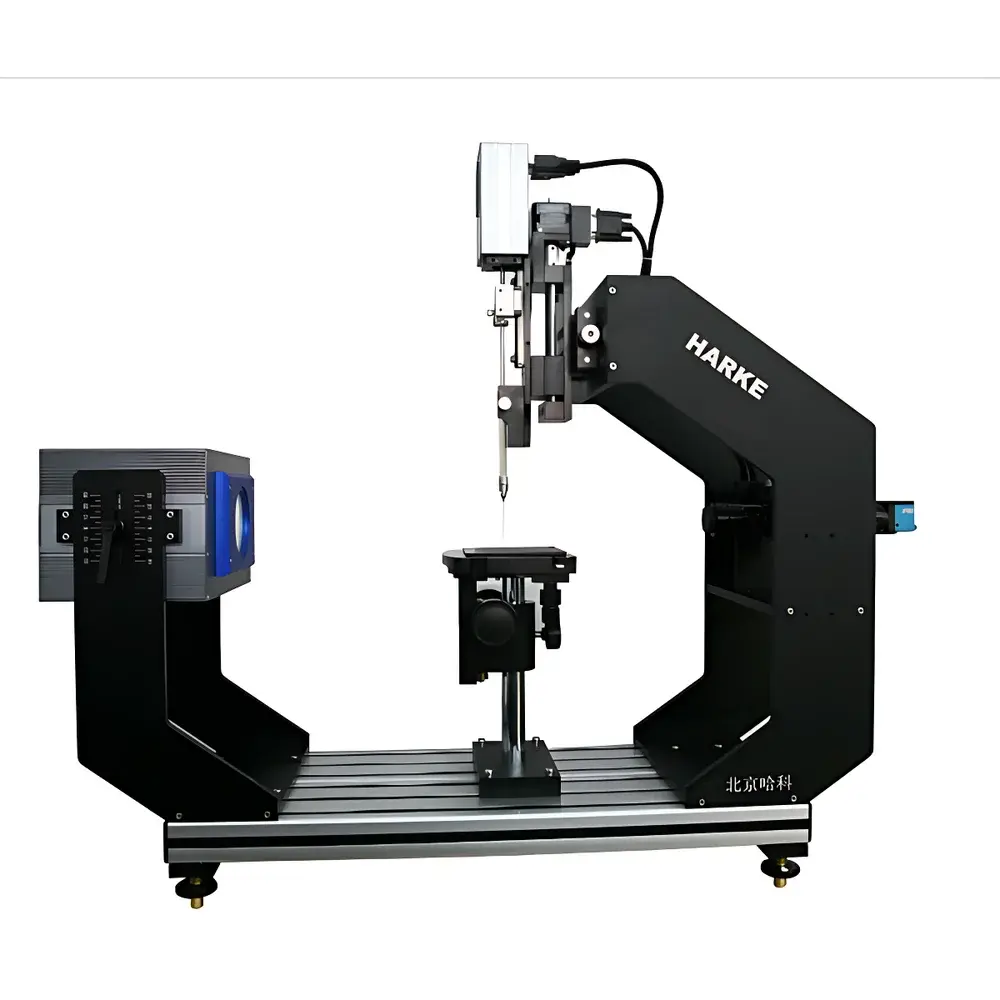
HARKE HK-SPCA-X1 Advanced Video-Based Contact Angle Goniometer
| Brand | HARKE |
|---|---|
| Origin | Beijing, China |
| Manufacturer Type | Direct Manufacturer |
| Instrument Type | Benchtop Laboratory Goniometer |
| Measurement Principle | Optical Imaging & Contour Analysis |
| Contact Angle Range | 0–180° |
| Contact Angle Resolution | ±0.01° |
| Contact Angle Accuracy | ±0.1° |
| Surface/Interfacial Tension Range | 0–1000 mN/m |
| Optical System | 0.7×–5× Motorized Zoom Lens with Fixed-Position Calibration |
| High-Speed Imaging | USB 3.0 Camera (30 fps standard |
| Sample Stage Dimensions | 100 mm × 120 mm |
| Lens Vertical Travel | 30 mm |
| Syringe Dispenser Travel | 30 mm |
| Positioning Accuracy (Motorized XYZ) | ±0.1 mm |
| Software | SPCA 1.0 (Windows-based, GLP-compliant data logging) |
| Power Supply | 220 V, 3 A, 50 Hz |
| Dimensions (W×D×H) | 300 mm × 760 mm × — mm |
| Weight | 30 kg |
| Measurement Methods | Circle Fitting, Ellipse Fitting, Height-Width Method, and 5 Additional Algorithmic Models (Total 8) |
Overview
The HARKE HK-SPCA-X1 is a research-grade, video-optical contact angle goniometer engineered for high-precision quantification of interfacial phenomena at solid–liquid–vapor boundaries. It operates on the principle of digital image acquisition and geometric contour analysis: a high-resolution camera captures side-view silhouettes of sessile or pendant liquid droplets deposited on or suspended from a solid substrate; proprietary algorithms then compute the tangent angle formed between the liquid–vapor interface and the solid surface at the three-phase contact line. This method enables non-invasive, quantitative assessment of surface wettability, interfacial thermodynamics, and dynamic interfacial kinetics—critical parameters in materials science, colloidal chemistry, biomaterials development, and microfluidics design. The instrument integrates motorized fluid dispensing, programmable stage tilt, and real-time image capture, supporting both static and time-resolved measurements under ambient laboratory conditions.
Key Features
- Fully automated liquid dispensing system with programmable volume control (0.1–100 µL increments) and anti-drip syringe actuation
- Motorized sample stage with precise X–Y translation (±0.1 mm repeatability) and continuous 0–90° tilt capability for roll-off angle and advancing/receding contact angle determination
- High-stability optical path featuring a parfocal, fixed-position zoom lens (0.7×–5× magnification) with calibrated pixel-to-length mapping for traceable geometry reconstruction
- USB 3.0 monochrome CMOS camera (1920 × 1080 resolution) operating at 30 fps standard; optional high-speed modules support 100 fps, 300 fps, or 1000 fps for transient wetting dynamics
- Eight built-in contact angle calculation algorithms—including circle, ellipse, height-width, Young–Laplace fitting, and conic section models—each selectable per measurement protocol to match sample morphology and droplet symmetry
- Integrated SPCA 1.0 software with audit-trail-enabled data logging, compliant with GLP documentation requirements and compatible with 21 CFR Part 11–ready configurations (when paired with validated IT infrastructure)
Sample Compatibility & Compliance
The HK-SPCA-X1 accommodates flat, curved, porous, fibrous, and particulate substrates—including powders (via compressed pellet method), micropatterned surfaces, hydrophobic/hydrophilic coatings, and biomedical membranes. Its modular design permits attachment of specialized accessories: a submersion cell for captive bubble analysis, a temperature-controlled stage (−10°C to 80°C, optional), and a humidity chamber (10–95% RH, optional). All measurement protocols align with internationally recognized standards including ASTM D7334 (surface energy of polymer films), ISO 19403-2 (contact angle determination), and ISO 14210 (interfacial tension via pendant drop). Raw image files, metadata logs, and processed results are stored in vendor-neutral formats (TIFF, CSV, XML) to ensure long-term data integrity and third-party analysis compatibility.
Software & Data Management
SPCA 1.0 is a Windows-native application developed specifically for interfacial metrology workflows. It provides synchronized control of hardware axes, camera exposure, lighting intensity, and dispensing sequences. Each session generates timestamped project files containing original images, annotated droplet contours, numerical outputs (θA, θR, hysteresis Δθ, γLV, γSV, WA), and full parameter histories. The software supports batch processing of multi-sample datasets, customizable report templates (PDF/Excel export), and statistical summaries (mean, SD, CV%). Audit trails record user ID, timestamp, action type, and parameter changes—enabling full traceability for ISO/IEC 17025 or FDA-regulated environments when deployed with appropriate network security and backup policies.
Applications
- Static and dynamic contact angle mapping of functionalized surfaces (e.g., plasma-treated polymers, self-assembled monolayers, sol–gel coatings)
- Time-resolved absorption kinetics on porous media (paper, textiles, filters) using continuous droplet deposition and contour tracking
- Surface free energy decomposition (Owens–Wendt, Wu, van Oss–Chaudhury–Good models) for predictive adhesion modeling in packaging and composites
- Pendant drop analysis for interfacial tension and polarity/dispersion component quantification of surfactant solutions and emulsions
- Roll-off angle and sliding behavior characterization of superhydrophobic/superoleophobic surfaces for anti-icing or self-cleaning applications
- Quality control of wafer-level hydrophobicity in semiconductor photolithography and MEMS packaging processes
- Biocompatibility screening via protein adsorption correlation studies using water/glycerol contact angle pairs
FAQ
What calibration procedures are required before measurement?
The system requires daily verification using certified reference angles (e.g., 30°, 60°, 90° glass wedges) and interfacial tension standards (e.g., pure water at 20°C = 72.75 mN/m). SPCA 1.0 includes automated calibration wizards for lens distortion correction and pixel scaling.
Can the instrument measure contact angles on rough or heterogeneous surfaces?
Yes—advanced contour detection algorithms accommodate asymmetric droplets and local topographic variations. For statistically robust results, users are advised to perform ≥5 replicate measurements across distinct surface regions and apply Weibull or Gaussian distribution fitting.
Is the software compatible with LIMS or ELN integration?
SPCA 1.0 supports CSV and XML export with configurable field mappings. API access is available under enterprise licensing agreements for direct integration with validated Laboratory Information Management Systems (LIMS) or Electronic Lab Notebooks (ELN).
Does the system meet regulatory requirements for pharmaceutical R&D?
When configured with password-protected user roles, electronic signatures, and audit-trail archiving, the HK-SPCA-X1 meets foundational elements of FDA 21 CFR Part 11 and EU Annex 11 for computerized systems used in GxP environments—subject to site-specific validation protocols.
What maintenance is recommended for long-term optical stability?
Lens cleaning with spectroscopic-grade solvents every 200 hours of operation; annual recalibration of motor encoders and camera synchronization by authorized HARKE service engineers is recommended.



