
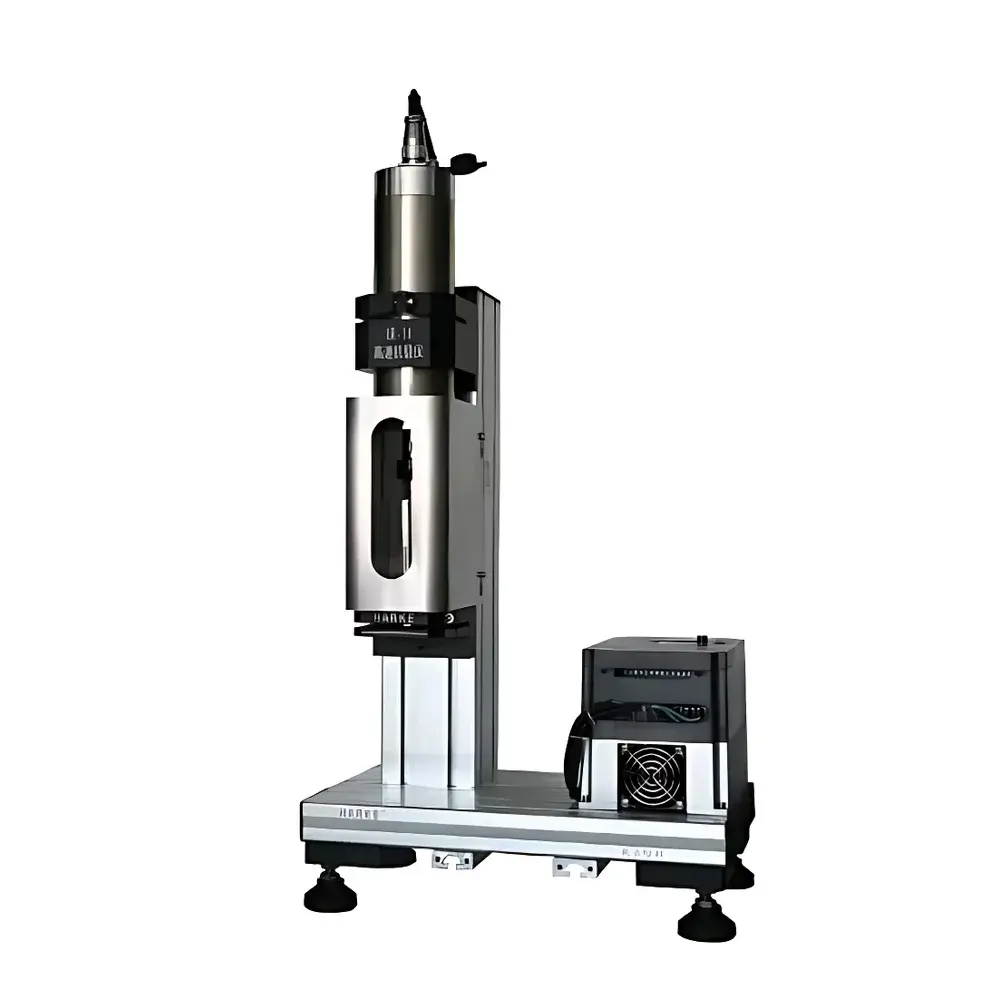
HARKE HK-XR-14Q High-Speed Mechanical Stability Tester for Latex
| Brand | HARKE |
|---|---|
| Origin | Beijing, China |
| Manufacturer Type | Manufacturer |
| Country of Origin | Domestic (China) |
| Model | HK-XR-14Q |
| Price | Upon Request |
| Stirring Speed | 14,000 rpm ± 200 rpm |
| Temperature Control Range | 35 °C ± 1 °C (sample) |
| Operating Ambient | 10–40 °C, <85% RH |
| Stirrer Disc Diameter (Natural Rubber Latex) | 20.83 ± 0.03 mm |
| Stirrer Disc Diameter (Synthetic Rubber Latex) | 36.12 ± 0.03 mm |
| Disc Thickness | 1.57 ± 0.05 mm |
| Stirrer Tip Diameter | 6.3 mm |
| Sample Container | Cylindrical Glass Vessel (ID 58 mm, OD 63 mm, H > 100 mm) |
| Speed Resolution | 1 rpm |
| Speed Accuracy | ≤0.1% |
| Max Speed | 20,000 rpm |
| Min Speed | 2,000 rpm |
| Power Supply | 220 V ±10%, 50 Hz, 1500 W |
| Dimensions (W×D×H) | 400 × 350 × 720 mm |
| Cooling System | Integrated Water Circulation Pump |
Overview
The HARKE HK-XR-14Q High-Speed Mechanical Stability Tester for Latex is a precision-engineered instrument designed to quantify the resistance of natural and synthetic rubber latices to mechanical degradation under standardized high-shear conditions. It operates on the principle of controlled high-speed rotational agitation—applying consistent hydrodynamic stress via a calibrated stirrer disc rotating at 14,000 rpm ± 200 rpm—to accelerate destabilization mechanisms such as coagulation, flocculation, and phase separation. This method directly correlates with real-world processing stresses encountered during latex dipping, coating, or foam manufacturing. The system complies strictly with two foundational industry standards: GB/T 8301–2008 “Concentrated Natural Rubber Latex—Determination of Mechanical Stability” and SH/T 1151–1998 “Synthetic Rubber Latex—Determination of High-Speed Mechanical Stability.” Its design emphasizes repeatability, thermal consistency, and operator-independent endpoint detection—critical for QC laboratories in rubber compound formulation, raw material qualification, and regulatory documentation.
Key Features
- Dual-disc configuration: Interchangeable stainless-steel stirrer discs (20.83 mm diameter for natural latex; 36.12 mm for synthetic latex), each manufactured to ±0.03 mm dimensional tolerance and 1.57 ± 0.05 mm thickness per ASTM D1644 and ISO 2007 standards.
- Precision speed control: Digital frequency converter with LED display ensures stable 14,000 rpm operation (±200 rpm), supported by real-time tachometric verification (resolution: 1 rpm; accuracy: ≤0.1%).
- Thermally regulated sample environment: Integrated heating module maintains sample temperature at 35 °C ± 1 °C throughout testing—verified prior to insertion into the agitator chamber per GB/T 8301 protocol.
- Robust mechanical architecture: Heavy-duty motor (1500 W), reinforced support frame, and vibration-damped base minimize runout and ensure long-term rotational stability.
- Integrated cooling system: Dedicated water-circulation pump mitigates thermal drift in the drive assembly, extending bearing life and maintaining torque fidelity across extended test cycles.
- Standardized sample containment: Supplied borosilicate glass cylinder (ID 58 mm, OD 63 mm, height >100 mm) meets dimensional requirements specified in both GB/T 8301 and SH/T 1151.
Sample Compatibility & Compliance
The HK-XR-14Q accommodates aqueous dispersions of natural rubber (Hevea brasiliensis), styrene-butadiene rubber (SBR), nitrile rubber (NBR), chloroprene (CR), and carboxylated synthetic latices—provided solids content is adjusted to 55 wt% using ammonia stabilization prior to testing. All operational parameters—including disc geometry, rotational speed, temperature setpoint, and endpoint evaluation methodology—are traceable to nationally recognized test methods. The instrument supports GLP-compliant workflows: its fixed-speed operation eliminates variable ramping, enabling unambiguous audit trails when paired with external calibrated timers and documented endpoint assessments (e.g., palm test or water dispersion test). While not intrinsically 21 CFR Part 11 compliant, its deterministic, non-software-controlled measurement process aligns with FDA expectations for manual, observer-based endpoint determination in compendial testing environments.
Software & Data Management
The HK-XR-14Q is a hardware-centric, analog-digital hybrid instrument with no embedded operating system or data logging software. Speed and runtime are monitored externally via the integrated LED display and supplied mechanical stopwatch. All measurements—including start time, observed endpoint time, ambient conditions (recorded manually), and endpoint confirmation steps—are intended for entry into laboratory notebooks or LIMS platforms per institutional SOPs. This architecture avoids software validation burdens while preserving full procedural transparency. Users may integrate third-party digital timers with CSV export capability or connect external tachometers with analog output for automated timestamping—provided calibration certificates are maintained per ISO/IEC 17025 requirements.
Applications
- Quality control of incoming natural and synthetic latex batches in tire cord, glove, and foam manufacturers.
- Development of stabilizer systems (e.g., surfactants, dispersants, pH buffers) for improved shear resistance.
- Comparative evaluation of coagulant sensitivity across latex grades under accelerated mechanical stress.
- Supporting R&D for low-ammonia or ammonia-free latex formulations requiring validated stability benchmarks.
- Training and method transfer in ISO 17025-accredited rubber testing laboratories.
- Regulatory submission testing where GB/T or SH/T compliance is mandated for product registration in APAC markets.
FAQ
What standards does the HK-XR-14Q explicitly support?
GB/T 8301–2008 (natural rubber latex) and SH/T 1151–1998 (synthetic rubber latex). Instrument geometry, speed tolerance, and thermal specifications are engineered to satisfy all apparatus-related clauses in both documents.
Is the endpoint determination automated?
No. Endpoint detection remains operator-executed per standard protocols—either the palm test (visual identification of first coagulum) or water dispersion test (observed flocculation on black background). This preserves method equivalence with reference laboratories.
Can the instrument operate continuously for multiple tests?
Yes—provided the integrated water-cooling system is connected to a recirculating chiller or tap-water source with stable flow rate ≥2 L/min. Thermal management enables back-to-back runs without performance drift.
Are replacement stirrer discs certified for traceability?
Each disc is supplied with a dimensional inspection report (diameter, thickness, surface finish) conforming to SH/T 1151 Annex A tolerances. Calibration certificates are available upon request for metrological traceability.
Does the instrument require annual recalibration?
While no formal recalibration interval is mandated by the standards, users should verify stirrer disc dimensions annually using certified micrometers and confirm speed accuracy against a NIST-traceable tachometer—documenting results per internal QA procedures.





