
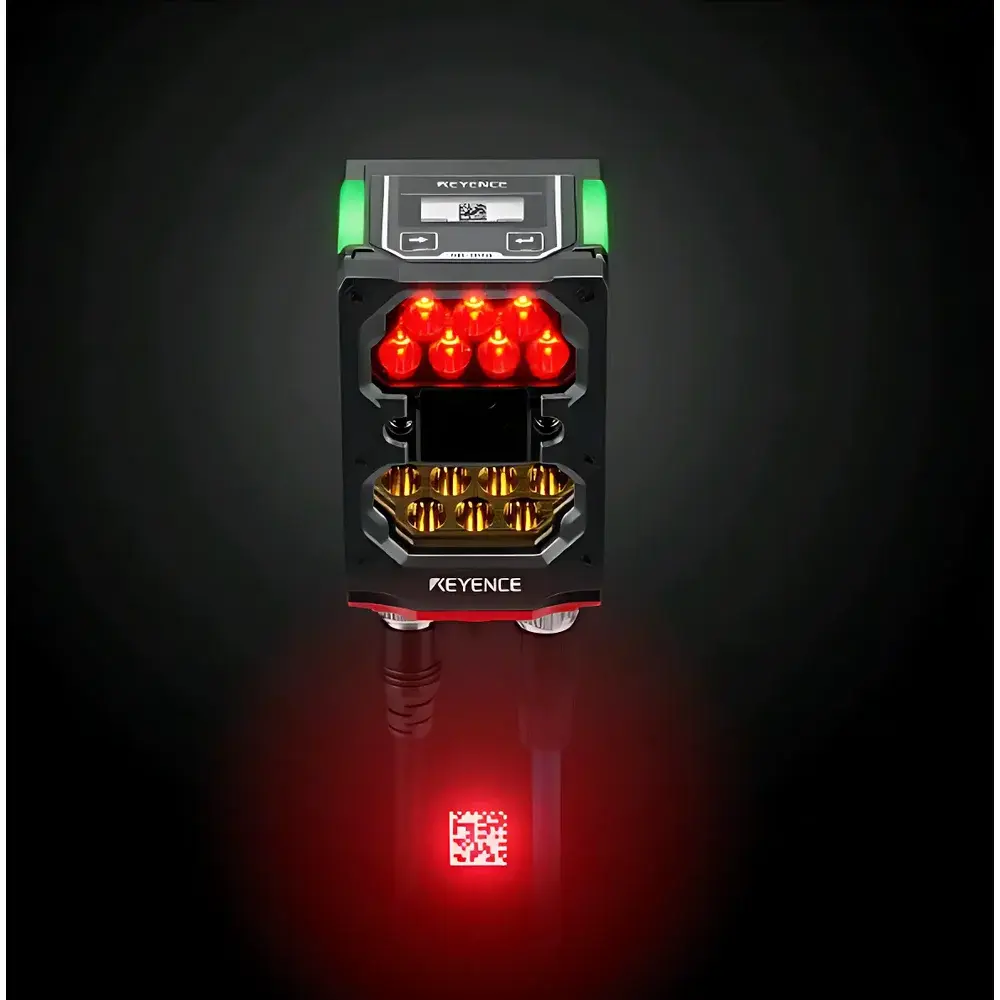
KEYENCE SR2000 High-Performance Industrial Barcode and 2D Code Reader
| Brand | KEYENCE |
|---|---|
| Origin | Japan |
| Manufacturer Type | Original Equipment Manufacturer (OEM) |
| Product Origin | Imported |
| Model | SR2000 |
| Pricing | Available Upon Request |
Overview
The KEYENCE SR2000 is a high-speed, industrial-grade fixed-mount barcode and 2D code reader engineered for demanding automation environments. Utilizing advanced CMOS image-based decoding technology with adaptive illumination and real-time autofocus algorithms, the SR2000 delivers reliable identification of 1D barcodes (e.g., Code 39, Code 128, EAN/UPC) and 2D symbologies (e.g., QR Code, Data Matrix, Aztec) under dynamic, non-ideal conditions. Its optical architecture supports wide-depth-of-field imaging—up to 1,200 mm working distance with ±150 mm depth tolerance—enabling consistent decoding of codes on moving, tilted, or irregularly positioned objects without mechanical adjustment. Designed for integration into conveyor lines, overhead monorail systems, cleanroom enclosures, and vacuum chambers, the SR2000 operates as a core component in traceability, assembly verification, and logistics control systems compliant with ISO/IEC 15415, ISO/IEC 15416, and AIM DPM Grade standards.
Key Features
- Extended Depth of Field (EDOF): Simultaneous focus across multiple planes enables stable reading of codes on parts suspended on overhead conveyors—even when oscillating vertically or laterally during transport.
- Through-Glass Imaging Capability: Optimized near-infrared (NIR) illumination and spectral filtering allow high-fidelity code capture through transparent barriers—including borosilicate glass, acrylic, and quartz windows—without requiring internal sensor placement inside vacuum or inert-atmosphere chambers.
- Dynamic Motion Tolerance: Proprietary motion-compensated image capture synchronizes exposure timing with object velocity, supporting accurate decoding of codes on rotating cylindrical surfaces (e.g., lithium-ion battery casings) at speeds up to 3 m/s.
- Non-Contact, Hands-Free Operation: No manual triggering or physical alignment required; auto-triggering via integrated photoelectric sensor or external PLC signal ensures continuous scanning across variable-height pallets and stacked cartons.
- Adaptive Position Recognition: Intelligent pattern-matching algorithms detect and decode barcodes regardless of label orientation, skew angle (±45°), partial occlusion, or inconsistent placement—eliminating reliance on precise “edge-aligned” packaging.
- IP67-rated aluminum housing with M12 I/O connectors ensures robustness in industrial settings subject to dust, moisture, vibration, and temperature fluctuations from 0 °C to 45 °C.
Sample Compatibility & Compliance
The SR2000 is validated for use with printed, direct-part-marked (DPM), and etched codes on metallic, plastic, ceramic, and composite substrates. It supports grade-based verification per ISO/IEC TR 29158 (AIM DPM) for laser-marked components and complies with electromagnetic compatibility (EMC) per EN 61000-6-2/-6-4 and safety requirements under UL 61010-1 and CE directives. Its design facilitates integration into FDA-regulated manufacturing workflows where electronic record integrity is governed by 21 CFR Part 11—particularly when paired with KEYENCE’s optional audit-trail-enabled software modules.
Software & Data Management
Configuration and monitoring are performed via KEYENCE’s intuitive PC-based software, which provides real-time preview, decode log export (CSV/Excel), and customizable pass/fail criteria based on symbology, grade, contrast, and modulation thresholds. The device supports Ethernet/IP, PROFINET, and Modbus TCP protocols for seamless PLC communication and MES-level data handoff. Optional firmware updates enable future-proofing for emerging symbologies and enhanced low-contrast decoding algorithms—without hardware modification.
Applications
- Automotive body shop traceability: Reading VIN and component IDs on swinging door assemblies transported via overhead hoists.
- Battery module assembly: Verifying QR codes on curved cylindrical cells during rotary indexing on conveyorized workstations.
- Pharmaceutical secondary packaging: Confirming correct leaflet insertion by simultaneously scanning product SKU and instruction sheet barcodes on moving cartons.
- Semiconductor front-end logistics: Identifying wafer carrier IDs through sealed quartz observation windows in vacuum load-lock stations.
- E-commerce fulfillment centers: Decoding skewed or crumpled shipping labels on unsorted, tumbling parcels without mechanical reorientation.
FAQ
Can the SR2000 read codes through laminated or anti-reflective coated glass?
Yes—the system’s NIR-optimized optics and polarization-aware illumination mitigate interference from common optical coatings and multi-layer glazing.
Does it support time-stamped logging for quality audits?
Yes; when configured with KEYENCE’s optional data logger module, each decode event includes UTC timestamp, image capture, grade metrics, and communication handshake logs—fully traceable for GLP/GMP documentation.
Is custom firmware development available for proprietary symbologies?
KEYENCE offers OEM firmware adaptation services under NDA for qualified industrial partners integrating the SR2000 into proprietary traceability ecosystems.
What is the maximum supported conveyor speed for reliable decoding?
At optimal working distance (600–900 mm), sustained decoding accuracy exceeds 99.98% for standard GS1-128 codes on flat surfaces moving at ≤2.5 m/s; performance scales with code size, contrast, and illumination setup.
How does the SR2000 handle reflective or glossy surfaces?
Integrated dual-angle LED illumination (diffuse + directional) combined with real-time specular reflection suppression algorithms ensures consistent decode yield on polished metal, anodized aluminum, and high-gloss polymer surfaces.




