KEYENCE LM-1100 High-Precision One-Touch Image Measuring System
| Brand | KEYENCE |
|---|---|
| Origin | Japan |
| Manufacturer Type | Original Equipment Manufacturer (OEM) |
| Product Origin | Imported |
| Model | LM-1100 |
| Operation Mode | Fully Automatic |
| Measurement Volume | 225 × 125 × 75 mm |
| Measurement Accuracy | ±0.7 µm |
| Encoder Resolution | 0.1 µm |
| Measurement Speed | Up to 300 dimensions in 3 seconds |
| Camera | 20 MP Monochrome CMOS Sensor |
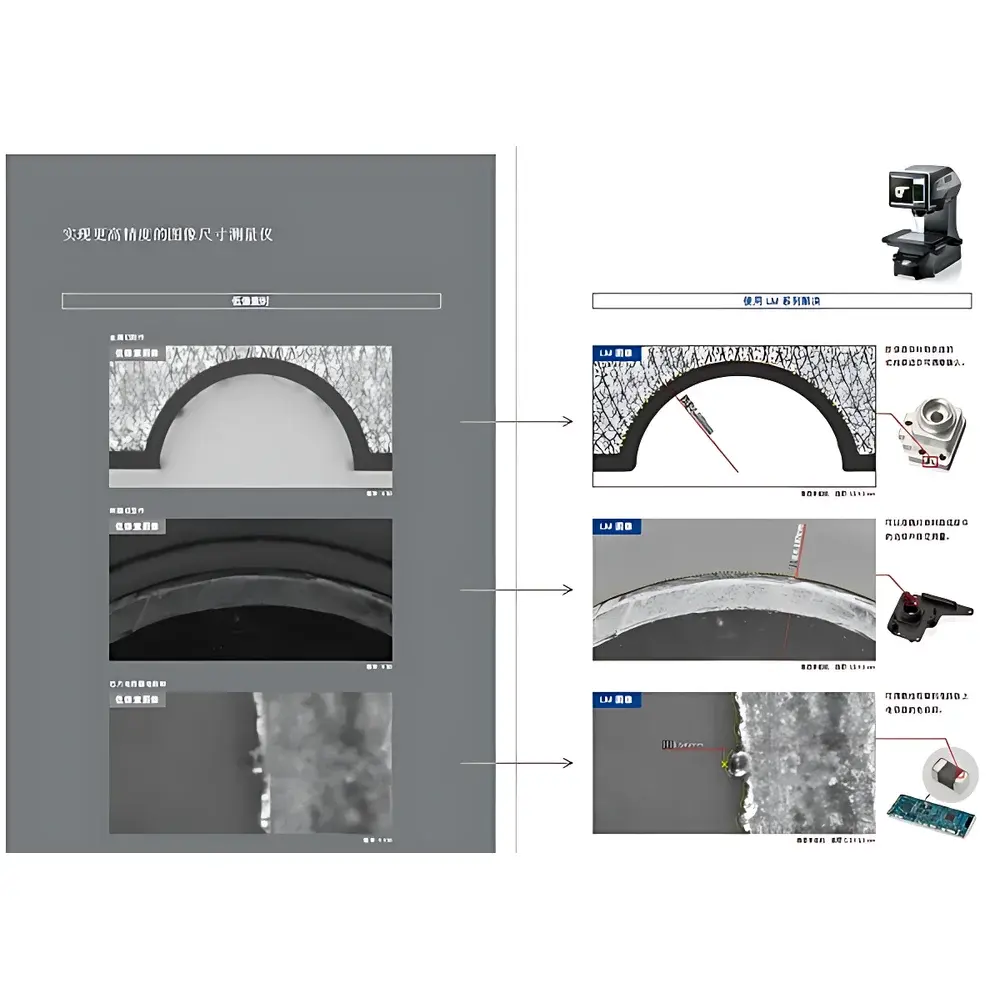
| Illumination Modes | Backlight (silhouette), Top Ring Light, Bottom Ring Light, Gap Ring Light, Coaxial Episcopic Illumination |
Overview
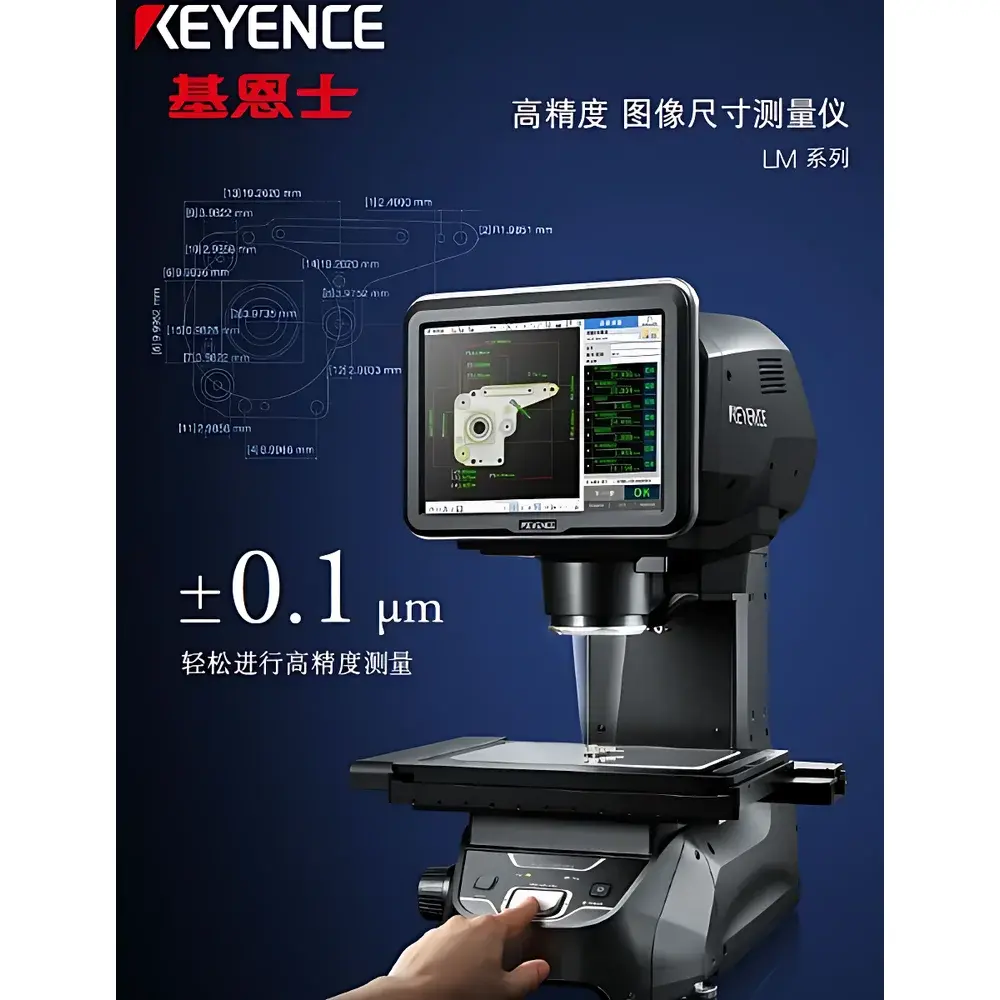
The KEYENCE LM-1100 is a fully automated, high-precision image measuring system engineered for rapid, repeatable geometric metrology of small- to medium-sized mechanical parts in production and quality control environments. Utilizing advanced telecentric optics, high-resolution monochrome imaging, and sub-pixel edge detection algorithms, the LM-1100 operates on the principle of non-contact optical measurement via calibrated 2D projection and Z-axis height inference through multi-angle illumination analysis. Unlike traditional coordinate measuring machines (CMMs) or manual optical comparators, the LM-1100 eliminates operator-dependent alignment and probing—replacing tactile contact with deterministic pixel-based feature extraction. Its compact benchtop footprint and sealed optical path ensure stable performance under typical factory-floor conditions, including ambient temperature fluctuations (±2°C) and moderate vibration. Designed for integration into inline inspection workflows, the system delivers traceable dimensional data compliant with ISO 10360-7 (acceptance and reverification of optical measuring systems) and supports calibration traceability to NIST-traceable standards via optional certified reference artifacts.
Key Features
- Fully automated one-touch operation: Load part → press start → receive full report; no programming or manual focus adjustment required.
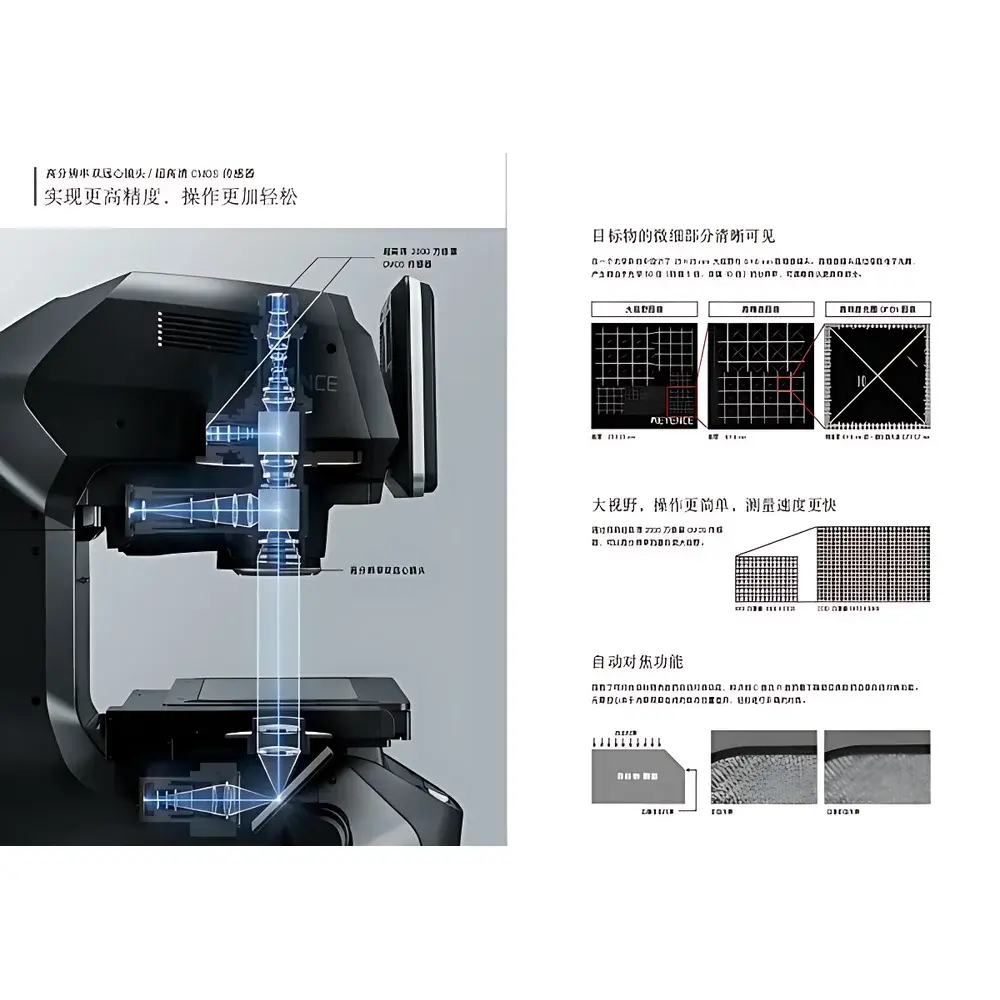
- Multi-spectral illumination architecture: Five independently controllable LED light sources—including coaxial episcopic, dual-ring top/bottom, gap ring, and high-intensity backlight—enable optimal contrast for diverse surface finishes (matte, reflective, transparent, or textured).
- 20-megapixel global-shutter monochrome sensor with telecentric lens assembly ensures distortion-free imaging across the entire 225 × 125 mm field of view, maintaining pixel uniformity and MTF >60% at Nyquist frequency.
- Z-axis height estimation via shadow triangulation and focus-variation fusion, enabling accurate thickness, step height, and coplanarity measurements within the 75 mm vertical range.
- Real-time sub-pixel edge detection engine with adaptive thresholding and noise suppression, achieving consistent 0.7 µm measurement uncertainty (k = 2) across repeated measurements under controlled environmental conditions.
- Integrated linear encoder with 0.1 µm resolution provides closed-loop positional feedback for XY-stage motion, eliminating backlash and thermal drift errors common in open-loop stepper-based systems.
Sample Compatibility & Compliance
The LM-1100 accommodates parts ranging from precision stamped components (e.g., connector terminals, watch gears, medical micro-parts) to machined housings and injection-molded assemblies. Maximum part weight: 5 kg. Compatible with standard DIN/ISO gauge blocks, step gauges, and custom calibration masters. All measurement routines adhere to ISO 14253-1 (Geometrical product specifications — Inspection by measurement of workpieces and measuring equipment) and support audit-ready documentation per ISO 9001:2015 clause 7.1.5. The system’s firmware includes built-in uncertainty budget calculation per GUM (JCGM 100:2008) and generates calibration certificates compliant with ISO/IEC 17025 requirements when used with accredited calibration services.
Software & Data Management
Equipped with KEYENCE’s proprietary LM-SOFT v5.x software, the LM-1100 supports both guided measurement templates (for untrained operators) and scriptable measurement sequences (via Lua-based macro language). All measurement data—including raw images, coordinate sets, GD&T annotations (position, concentricity, profile), and statistical process control (SPC) charts—are stored in an encrypted SQLite database with timestamped audit trails. Export formats include CSV, PDF (with embedded digital signatures), STEP AP214, and XML-based DMIS 4.3 for downstream integration with MES or QMS platforms. Software complies with FDA 21 CFR Part 11 requirements for electronic records and signatures, featuring role-based access control, electronic signature capture, and immutable change logs.
Applications
- Automotive: Verification of brake pad chamfers, fuel injector nozzle orifices, and transmission synchronizer rings.
- Electronics: Dimensional validation of PCB fiducials, SMT component leads, and flex circuit cutouts.
- Medical Devices: Critical feature inspection of surgical blade geometries, catheter hub features, and orthodontic bracket slot tolerances.
- Watchmaking & Precision Mechanics: Gear tooth profile assessment, jewel bearing concentricity, and balance spring anchor point positioning.
- Quality Audits: First-article inspection (FAI) reporting per AS9102, PPAP Level 3 submissions, and supplier scorecard generation.
FAQ
Does the LM-1100 require annual recalibration?
Yes—KEYENCE recommends annual verification using certified reference standards; interval may be extended to 18 months under documented environmental stability and usage logs per ISO/IEC 17025 Clause 6.5.
Can it measure transparent or glossy materials?
Yes—coaxial episcopic and gap ring illumination modes suppress specular reflection, while backlight silhouette imaging enables precise edge detection on glass, PET films, and polycarbonate lenses.
Is GD&T evaluation supported out-of-the-box?
Yes—LM-SOFT includes native support for position, profile, symmetry, circularity, and perpendicularity per ASME Y14.5-2018 and ISO 1101:2017, with tolerance stack-up visualization.
What is the minimum feature size resolvable?
Under optimal lighting and contrast conditions, the system reliably detects edges down to 5 µm width with ≤1 µm repeatability (3σ), limited primarily by optical diffraction and surface texture rather than sensor resolution.
How does it compare to traditional video measuring machines (VMMs)?
Unlike VMMs requiring manual focus, zoom adjustment, and operator-defined search windows, the LM-1100 employs fixed-focus telecentric optics and AI-assisted auto-feature recognition—reducing measurement cycle time by >80% and eliminating inter-operator variability.