KEYENCE LJ-V7000 Series Ultra-High-Speed Laser Profilometer
| Brand | KEYENCE |
|---|---|
| Origin | Japan |
| Manufacturer Type | Original Equipment Manufacturer (OEM) |
| Product Origin | Imported |
| Model | LJ-V7000 |
| Pricing | Available Upon Request |
Overview
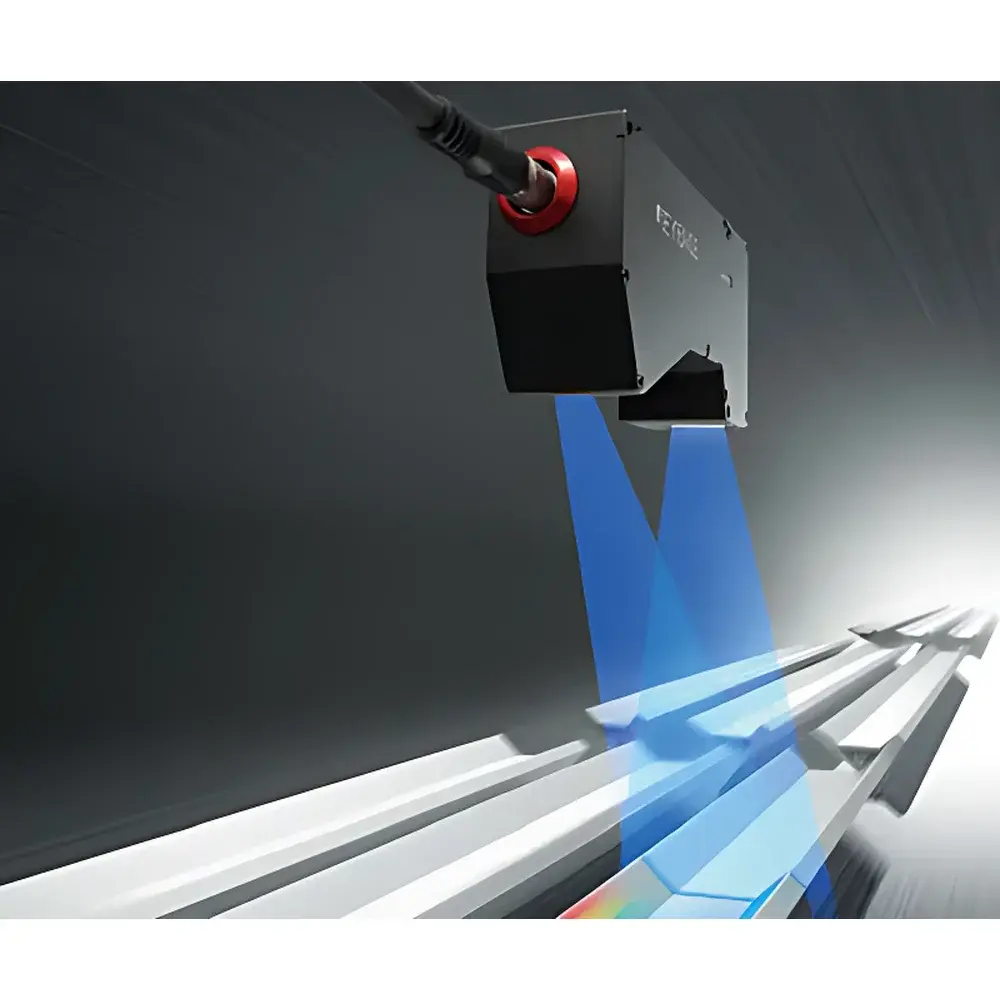
The KEYENCE LJ-V7000 Series Ultra-High-Speed Laser Profilometer is an engineered solution for non-contact, real-time 3D surface topography measurement in high-throughput industrial environments. Based on triangulation-based laser displacement sensing with high-speed CMOS line-scan imaging, the system captures full cross-sectional profiles at up to 64,000 profiles per second—enabling continuous, synchronized measurement of moving parts without motion blur or sampling aliasing. Designed for integration into automated production lines, the LJ-V7000 delivers micron-level vertical resolution and sub-micron repeatability across diverse surface finishes, including highly absorptive black rubber, reflective metallic alloys, and angled or curved geometries. Its optical architecture features a stabilized blue-violet semiconductor laser (405 nm) optimized for reduced speckle noise and enhanced signal-to-noise ratio on low-reflectivity surfaces—a critical capability for quality assurance in automotive sealing, battery electrode coating, and precision metal stamping applications.
Key Features
- Real-time profiling at 64 kHz: Captures 64,000 complete cross-sectional profiles per second, supporting inspection of components moving at linear velocities up to 6.4 m/s with 0.1 mm profile spacing.
- Multi-surface adaptability: Stable measurement performance on challenging surfaces—including matte black elastomers, polished stainless steel, anodized aluminum, and tilted surfaces up to ±30° without recalibration.
- Simultaneous multi-region analysis: Executes up to 16 independent measurement zones in parallel, each configurable with distinct algorithms and tolerances.
- Comprehensive measurement library: 74 built-in geometric and functional evaluation modes—including height, step, angle, radius, roughness (Rz, Ra), coplanarity, gap/flush, and custom edge detection.
- Raw data streaming: Outputs unprocessed 16-bit depth maps at full 64 kHz rate via Gigabit Ethernet for external processing, machine learning model training, or SPC integration.
- Ruggedized industrial design: IP65-rated housing, shock-resistant optics mount, and temperature-compensated calibration ensure long-term stability in factory-floor conditions (10–40 °C, 20–85% RH non-condensing).
Sample Compatibility & Compliance
The LJ-V7000 supports measurement of static and dynamic samples ranging from 0.5 mm to 200 mm in height, with lateral field-of-view options spanning 8 mm to 100 mm (depending on lens configuration). It complies with IEC 61496-1 (Type 3 safety light curtain interface support), meets CE marking requirements under the Machinery Directive 2006/42/EC and EMC Directive 2014/30/EU, and includes optional validation documentation aligned with ISO 9001:2015 and IATF 16949 quality management systems. While not a regulated medical device, its traceable calibration procedures and audit-ready log files support GLP/GMP-aligned manufacturing environments where measurement uncertainty reporting and instrument qualification (IQ/OQ/PQ) are required.
Software & Data Management
The LJ-V7000 operates with KEYENCE’s proprietary LJ-V Software Suite (v3.2+), which provides intuitive graphical programming of measurement routines, real-time pass/fail visualization, and hierarchical data export in CSV, HDF5, and industry-standard STEP AP242 formats. The software supports full audit trail functionality—including user login tracking, parameter change history, and timestamped result logs—meeting foundational requirements for FDA 21 CFR Part 11 compliance when deployed with network authentication and electronic signature controls. Raw profile data can be streamed directly to MES/SCADA platforms via OPC UA or Modbus TCP protocols; SDKs for C++, Python, and .NET enable custom integration with statistical process control (SPC) dashboards or AI-driven defect classification pipelines.
Applications
- Automotive: Real-time verification of gasket compression height, weld bead geometry, and battery tab alignment during high-speed assembly.
- Electronics: Thickness uniformity assessment of printed circuit board solder paste deposits and flex-circuit copper foil etching profiles.
- Medical device manufacturing: Dimensional validation of microfluidic channel depth, catheter tip concentricity, and injection-molded housing coplanarity.
- Energy storage: Electrode coating thickness mapping, separator waviness quantification, and pouch cell edge seal integrity inspection.
- General precision machining: In-line monitoring of turned part runout, grinding wheel wear compensation, and gear tooth profile deviation.
FAQ
What is the minimum measurable feature height resolution?
Typical vertical resolution is 0.1 µm under optimal conditions (stable thermal environment, high-reflectivity reference surface, and 10× signal averaging); actual resolution depends on working distance, lens selection, and surface reflectivity.
Can the LJ-V7000 be used for measuring transparent or semi-transparent materials?
Yes—with appropriate laser power adjustment and use of polarized filters to suppress subsurface scattering; however, measurement accuracy may decrease for materials with refractive index gradients or internal laminations.
Is third-party calibration certification available?
KEYENCE provides NIST-traceable factory calibration reports; accredited third-party calibration (e.g., A2LA-certified labs) is supported through documented procedures and reference artifact kits.
Does the system support synchronization with encoder or PLC triggers?
Yes—via TTL-compatible trigger input with programmable delay (0–100 ms, 1 µs resolution) and quadrature encoder interface for position-based profile acquisition.
How is measurement uncertainty quantified and documented?
Uncertainty budgets follow ISO/IEC 17025 principles and include contributions from optical geometry, temperature drift, electronic noise, and reference standard traceability; formal uncertainty statements are generated per measurement job upon request.