KEYENCE LS-9000 Ultra-High-Speed & High-Precision Laser Micrometer
| Brand | KEYENCE |
|---|---|
| Origin | Japan |
| Manufacturer Type | Original Equipment Manufacturer (OEM) |
| Product Origin | Imported |
| Model | LS-9000 |
| Form Factor | Handheld |
| Measurement Principle | Tri-CMOS Green LED-Based Optical Triangulation |
| Measurement Range | Configurable per application (selectable optics & mounting) |
| Measurement Accuracy | Application-dependent (typically ±0.5 µm to ±2 µm, depending on configuration) |
| Telescope Function | Optional integrated optical sight |
| Telescope Magnification | Optional (e.g., 3× or 5×, model-specific) |
Overview
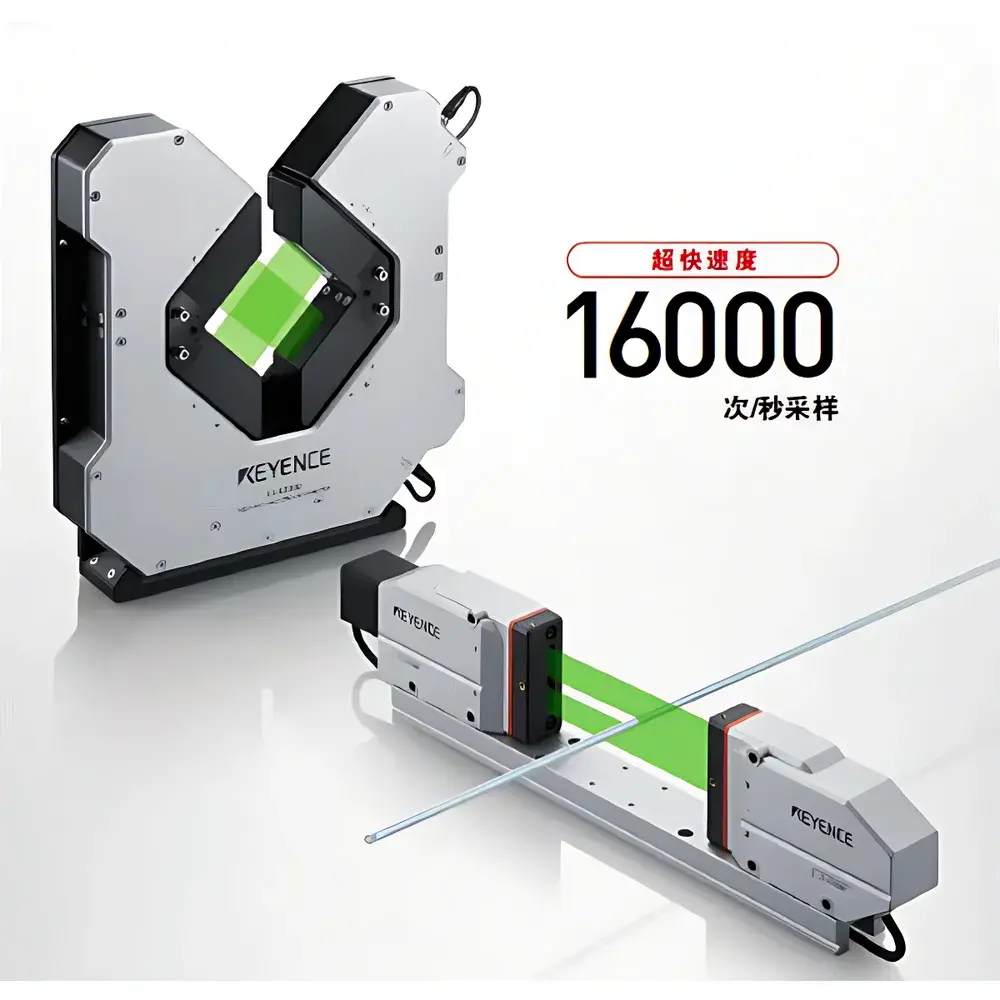
The KEYENCE LS-9000 Ultra-High-Speed & High-Precision Laser Micrometer is an engineered solution for non-contact dimensional metrology in dynamic industrial environments. Unlike conventional laser scanning micrometers relying on rotating polygon mirrors and pulsed semiconductor lasers, the LS-9000 implements KEYENCE’s proprietary Tri-CMOS Green LED optical architecture — a solid-state, mechanically passive measurement principle rooted in high-resolution optical triangulation. This design eliminates all moving parts, including motors, prisms, and mechanical shutters, thereby removing sources of mechanical drift, wear, and vibration-induced uncertainty. The system projects a collimated green LED light sheet onto the target surface; three synchronized CMOS image sensors — dedicated to emitter position monitoring, receiver alignment verification, and high-speed profile acquisition — simultaneously capture spatial data at up to 16,000 profiles per second. Each profile delivers sub-micron lateral resolution and enables real-time calculation of width, thickness, diameter, edge position, and gap metrics with exceptional repeatability under thermal and mechanical stress.
Key Features
- Tri-CMOS optical architecture: Three independent CMOS sensors for simultaneous emitter stability monitoring, receiver alignment correction, and high-fidelity profile capture — enabling real-time tilt and vibration compensation.
- Green LED illumination (520 nm): High-brightness, long-lifetime solid-state source with uniform collimation; no laser safety classification required (Class 1), eliminating regulatory overhead in production settings.
- Zero-moving-parts design: No motors, rotating mirrors, or mechanical actuators — resulting in MTBF exceeding 100,000 hours and immunity to shock, dust, and ambient vibration.
- Ultra-high sampling rate: Up to 16,000 measurements per second (16 kHz) with integrated analog integration amplifiers and pixel-level exposure control — optimized for fast-moving web, wire, or extrusion processes.
- Onboard tilt compensation: Dual-axis inclination sensing via auxiliary CMOS array allows automatic geometric correction of measurement planes without external gyroscopes or external calibration fixtures.
- Modular platform: Compatible with multiple configurations including single-sided (LS-9000D), dual-axis (LS-9030M), compact side-mount (LS-9006M), space-constrained (LS-D1000), and controller-integrated (LS-9501P) variants.
Sample Compatibility & Compliance
The LS-9000 supports opaque, translucent, and reflective surfaces — including metals, plastics, ceramics, rubber, and coated substrates — without requiring surface preparation or contrast enhancement. Its green LED wavelength minimizes specular reflection errors on polished materials and improves signal-to-noise ratio on low-reflectivity targets compared to near-infrared laser systems. All variants comply with IEC 61326-1 (EMC for industrial environments), IEC 60825-1:2014 (laser product safety — Class 1 equivalent), and ISO/IEC 17025 traceability requirements when used with certified calibration artifacts. For regulated manufacturing (e.g., automotive Tier-1, medical device component suppliers), the LS-9000 series supports audit-ready operation under ISO 9001, IATF 16949, and FDA 21 CFR Part 11-compliant software environments via optional KEYENCE LM-X Series controllers.
Software & Data Management
The LS-9000 integrates natively with KEYENCE’s LM-X Series controller firmware and PC-based LM-SOFT suite, providing full access to raw profile data, statistical process control (SPC) dashboards, trend analysis, and export to CSV, XML, or OPC UA. Real-time measurement data includes timestamped X/Y coordinate arrays, calculated dimensions (width, center position, roundness deviation), and confidence metrics derived from signal intensity variance across the CMOS line. Audit trails record operator actions, parameter changes, calibration events, and firmware updates — supporting GLP/GMP documentation requirements. Optional Ethernet/IP and Modbus TCP protocols enable direct PLC integration for closed-loop feedback in automated inspection cells.
Applications
- Real-time diameter monitoring of drawn wire, cable, and fiber during continuous extrusion or drawing processes.
- Thickness profiling of metal foil, battery electrode coatings, and polymer films on high-speed converting lines.
- Edge detection and positional verification of stamped parts, PCBs, and semiconductor wafers in pick-and-place validation.
- Gap and concentricity measurement in assembled components such as bearing housings, hydraulic valves, and fuel injector nozzles.
- In-line quality gate for automotive brake pads, clutch plates, and gasket thickness uniformity.
- Research-grade dimensional stability testing under thermal cycling or mechanical loading conditions.
FAQ
What distinguishes the LS-9000’s Tri-CMOS architecture from traditional laser triangulation systems?
The LS-9000 replaces mechanically scanned laser beams with a static, collimated green LED light sheet and three synchronized CMOS sensors — enabling simultaneous acquisition of geometric reference data and measurement profiles without motion-induced latency or wear.
Is the LS-9000 suitable for use in dusty or humid factory environments?
Yes — all LS-9000 sensor heads meet IP67 ingress protection ratings; the absence of moving parts and sealed optical pathways ensures long-term reliability in harsh industrial settings.
Can measurement data be exported to MES or SPC platforms?
Yes — via native Ethernet/IP, Modbus TCP, or ASCII serial output, and through LM-SOFT’s configurable data export modules compatible with JMP, Minitab, and custom SQL databases.
Does the system require periodic recalibration?
No routine recalibration is required; however, annual verification against NIST-traceable gauge blocks or step gauges is recommended for ISO/IEC 17025 compliance.
How is tilt or angular misalignment compensated during measurement?
An auxiliary CMOS sensor continuously monitors the relative orientation between emitter and receiver optics, feeding real-time correction coefficients into the profile reconstruction algorithm — ensuring accuracy even at ±5° mechanical tilt.