
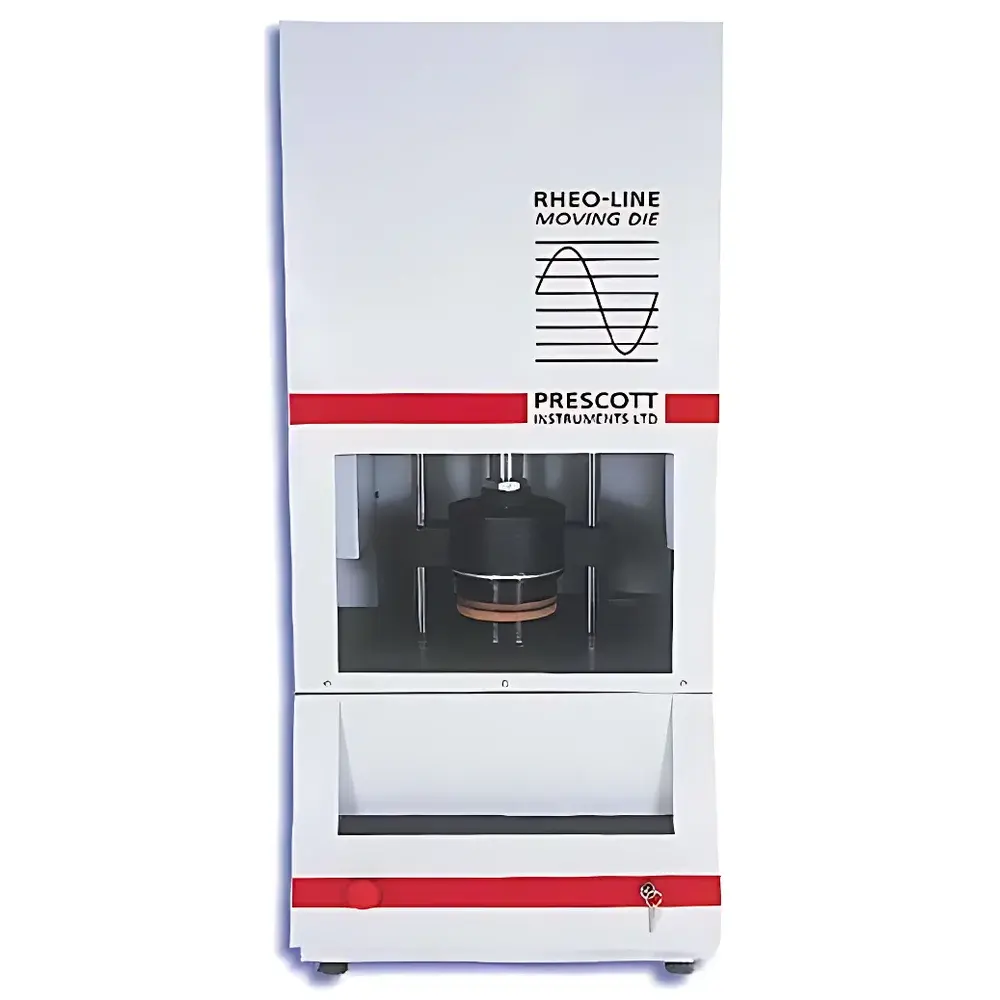
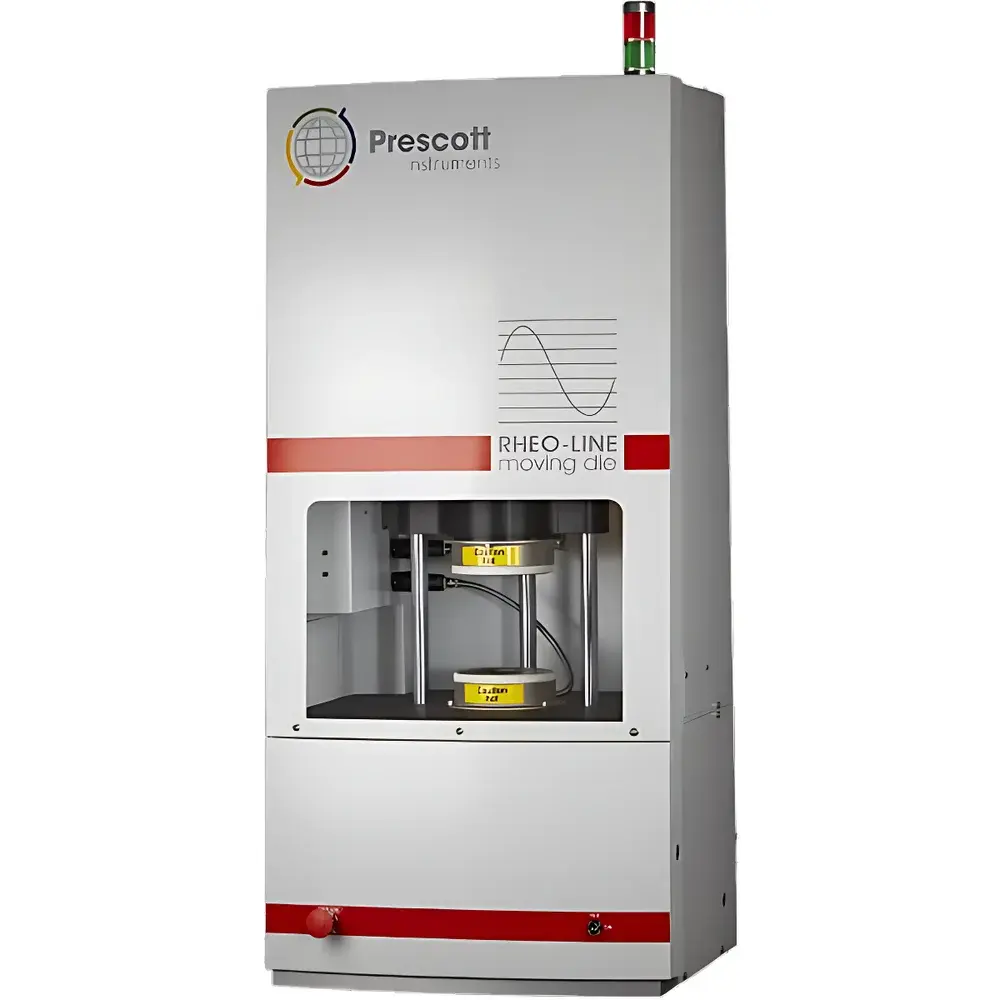
Prescott Rheoline MDR Unrotor Vulcanizometer
| Brand | Prescott |
|---|---|
| Origin | United Kingdom |
| Manufacturer Type | Authorized Distributor |
| Origin Category | Imported |
| Model | Rheoline MDR |
| Price | Upon Request |
| Standard Compliance | ISO 6502, ASTM D5289 |
| Oscillation Frequency | 1.67 Hz |
| Oscillation Amplitude Options | 0.5° (standard), 1.0° or 3.0° (optional) |
| Temperature Range | 35–250 °C |
| Temperature Control | Digital PID |
| Torque Units | in·lb, dN·m |
| Temperature Units | °C, °F |
| Pressure Units (optional) | psi, kg/cm² |
| Time Format | min/sec, min/decimal, sec |
| Output Parameters | Elastic Modulus (G′), Viscous Modulus (G″), Tan δ, Curing Rate, Cavity Pressure (optional) |
| Data Storage | Microsoft Access or SQL database |
| Optional Accessories | Programmable multi-zone heating, Eccentric oscillating die, Cavity pressure transducer, Automated sample loader, Volumetric sample cutter |
| Software | Windows-based proprietary test platform with SPC module (optional), GLP/GMP-compliant audit trail support |
Overview
The Prescott Rheoline MDR Unrotor Vulcanizometer is an advanced, microprocessor-controlled instrument engineered for precise rheometric characterization of uncured and partially cured rubber compounds. Based on the principle of forced oscillatory shear deformation within a closed or open cavity, it measures torque response as a function of time and temperature to quantify vulcanization kinetics—including scorch time (ts₁, ts₂), optimum cure time (t₉₀), minimum and maximum torque (ML, MH), and cure rate index (CRI). Unlike rotor-based systems, the unrotor design eliminates mechanical wear, reduces sample preparation variability, and ensures high reproducibility across repeated tests. Its dual-conical die geometry—comprising a fixed upper die and a lower die oscillating at 1.67 Hz—generates well-defined sinusoidal strain fields compliant with ISO 6502 and ASTM D5289. This enables direct correlation between laboratory-scale measurements and production-line behavior, supporting predictive modeling of service life, compression set resistance, and crosslink density.
Key Features
- Unrotor architecture with precision-machined dual-conical dies for uniform shear distribution and minimal edge effects
- Digital PID temperature control delivering ±0.3 °C stability across the full operating range (35–250 °C)
- Configurable oscillation amplitude (0.5° standard; 1.0° and 3.0° optional) to accommodate low-viscosity elastomers or highly filled compounds
- Modular cavity design supporting both sealed and vented configurations for volatile-rich formulations or ASTM-compliant air-cure simulations
- Integrated torque transduction system calibrated to NIST-traceable standards, reporting in in·lb or dN·m with real-time conversion
- Optional cavity pressure sensor enabling simultaneous monitoring of internal swelling, gas evolution, or filler migration during cure
- Windows-based control software with preloaded test methods aligned to ISO, ASTM, and internal QC protocols
Sample Compatibility & Compliance
The Rheoline MDR accommodates raw, compounded, or reclaimed rubber samples in standard 4.5 g discs (diameter: 18 mm, thickness: ~2 mm), compatible with natural rubber (NR), styrene-butadiene rubber (SBR), ethylene propylene diene monomer (EPDM), nitrile rubber (NBR), silicone (VMQ), and thermoplastic elastomers (TPEs). All test sequences comply with ISO 6502:2017 “Rubber — Determination of vulcanization characteristics using oscillating disc curemeters” and ASTM D5289-22 “Standard Test Method for Rubber Property—Vulcanization Using Moving Die Rheometer”. The system supports GLP and GMP environments through configurable user access levels, electronic signatures, and FDA 21 CFR Part 11–compliant audit trails when paired with the optional SPC module.
Software & Data Management
Control and analysis are executed via a dedicated Windows application featuring real-time graphical display of torque, modulus, tan δ, and curing rate curves. Raw data—including time-stamped torque, temperature, pressure (if equipped), and calculated parameters—is stored in a relational Microsoft Access or SQL Server database, ensuring structured querying, version-controlled backups, and seamless export to CSV, Excel, or LIMS platforms. The optional Statistical Process Control (SPC) package provides X-bar/R charts, capability indices (Cp, Cpk), trend analysis, and automated out-of-specification alerts. All data files retain full metadata: operator ID, calibration status, environmental conditions, and instrument firmware revision.
Applications
- Formulation development: Screening accelerator systems, sulfur donors, and curatives for optimal scorch safety and crosslink efficiency
- Quality assurance: Batch-to-batch consistency verification of incoming polymer stocks and masterbatches
- Process validation: Correlating lab-scale cure profiles with extrusion, injection molding, or calendering cycle times
- Fatigue and aging studies: Monitoring changes in crosslink density after thermal or ozone exposure
- Regulatory submission support: Generating ISO/ASTM-compliant reports for automotive OEM specifications (e.g., SAE J200, GMW15635) and medical device elastomer qualification (ISO 10993-12)
FAQ
What distinguishes the unrotor design from traditional moving-die rheometers?
The absence of a rotating element eliminates mechanical hysteresis, bearing friction, and rotor wear—resulting in superior baseline stability and long-term measurement repeatability.
Can the Rheoline MDR be integrated into an automated laboratory workflow?
Yes—through optional interfaces including RS-232, Ethernet TCP/IP, and OPC UA, enabling bidirectional communication with LIMS, MES, or robotic sample handling systems.
Is temperature calibration traceable to national standards?
Each unit ships with a UKAS-accredited calibration certificate for both temperature and torque sensors, with annual recalibration supported by Prescott’s global service network.
How is data integrity ensured under regulatory audit requirements?
The software enforces role-based permissions, immutable audit logs, electronic signatures, and secure database encryption—fully satisfying FDA 21 CFR Part 11 and EU Annex 11 expectations.
What sample preparation equipment is recommended for consistent disc geometry?
Prescott recommends pairing the MDR with its volumetric sample cutter or a certified hydraulic press (e.g., Carver 3850) using standardized mold cavities per ISO 23529.




