
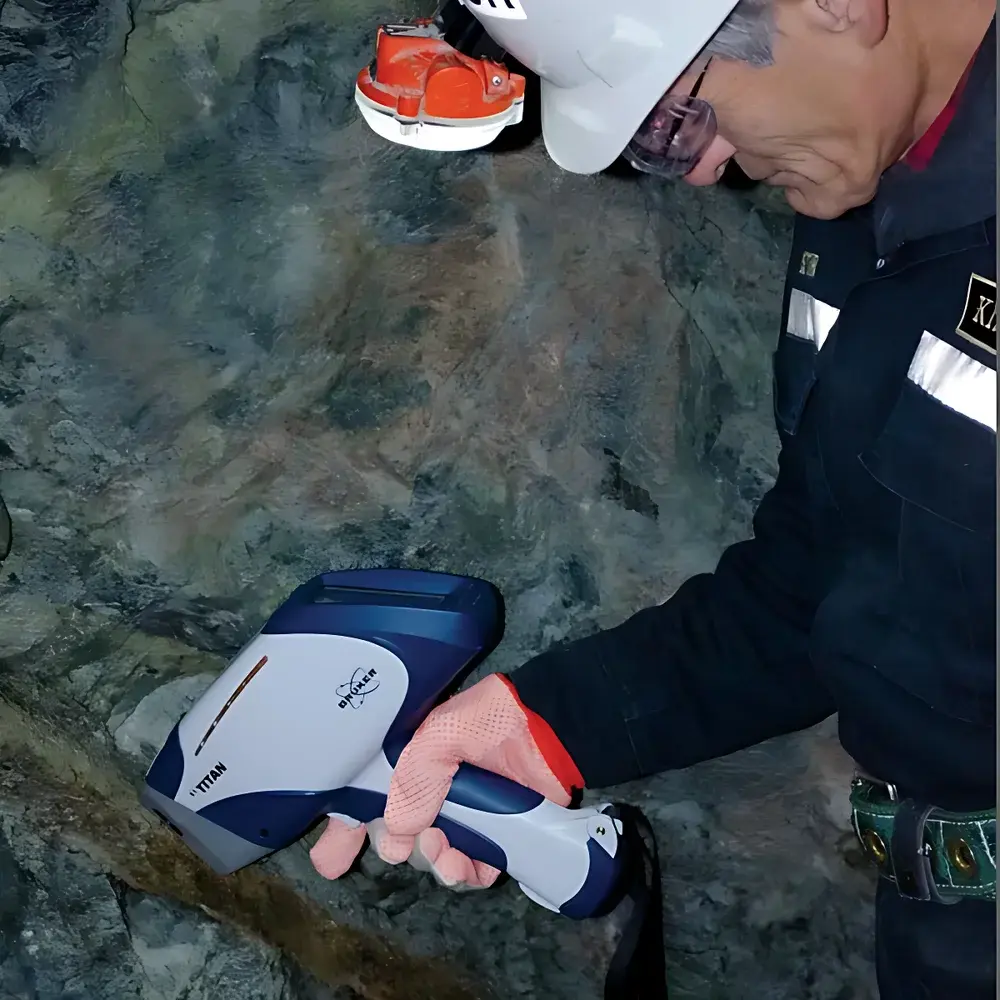
Bruker S1 TITAN Handheld Energy Dispersive X-Ray Fluorescence (ED-XRF) Spectrometer for Ore and Geological Analysis
| Brand | Bruker |
|---|---|
| Origin | Germany |
| Model | S1 TITAN |
| Application | Field-Portable Ore & Geochemical Analysis |
| Elemental Range | Mg–U |
| Detection Limit | 1 ppm (typical, matrix-dependent) |
| Quantification Range | 1 ppm – 99.99 wt% |
| Energy Resolution | <140 eV at Mn Kα (5.9 keV) |
| Detector | Silicon Drift Detector (SDD) |
Overview
The Bruker S1 TITAN is a field-deployable, handheld energy dispersive X-ray fluorescence (ED-XRF) spectrometer engineered for rapid, non-destructive elemental analysis of geological materials in situ. Based on fundamental XRF physics—where primary X-rays from a miniature Rh anode tube excite characteristic secondary X-ray emissions from sample atoms—the instrument quantifies elemental composition by measuring the energy and intensity of fluorescent photons. Its optimized excitation geometry, high-throughput SDD detector, and real-time spectral deconvolution enable reliable detection of light elements (Mg, Al, Si, P, S, Cl) without vacuum or helium purge—a critical capability distinguishing it from conventional portable XRF systems. Designed for rugged outdoor use, the S1 TITAN operates under variable ambient conditions (–10 °C to 50 °C, up to 95% RH non-condensing), meeting IP54 ingress protection standards. It complies with IEC 61000-6-3 (EMC) and IEC 61000-6-2 (immunity), and its X-ray tube output adheres to international radiation safety regulations (IEC 62495, FDA 21 CFR 1020.40).
Key Features
- Light-element capability down to magnesium (Mg), enabled by ultra-thin polymer X-ray window and optimized low-energy excitation
- Silicon Drift Detector (SDD) with <140 eV resolution at Mn Kα, delivering high peak-to-background ratios and improved precision for trace and major element quantification
- Integrated GPS, digital camera, and laser targeting for georeferenced data capture and spatial mapping of elemental distributions
- Ruggedized magnesium alloy housing, MIL-STD-810G compliant for shock, vibration, and drop resistance (1.5 m onto concrete)
- Onboard calibration libraries pre-loaded for ore types (e.g., iron ores, bauxites, copper sulfides, REE-bearing minerals), soils, sediments, and industrial slags
- Battery life exceeding 8 hours per charge (hot-swappable Li-ion packs), supporting full-shift field operation without external power
Sample Compatibility & Compliance
The S1 TITAN accommodates heterogeneous solid samples—including drill cores, rock chips, pulverized ores, tailings, soil cores, filter media, and surface-coated particulates—without requiring pelletization or fusion. Its large-area measurement spot (8 mm diameter) mitigates grain-size effects in coarse-grained lithologies. For regulatory alignment, analytical workflows support ISO 12847 (XRF analysis of ores), ASTM D7349 (soil screening), and USP / (elemental impurities in pharmaceutical excipients, where applicable). Data integrity conforms to ALCOA+ principles; audit trails, electronic signatures, and user-access controls are configurable to meet GLP and GMP requirements per FDA 21 CFR Part 11.
Software & Data Management
The instrument runs Bruker’s proprietary S1 PXRF software v4.x, featuring intuitive touch-screen interface, real-time spectrum visualization, and automated peak identification using fundamental parameter (FP) algorithms. Quantitative analysis employs empirical and FP-based calibrations, with optional matrix-matched standardization for enhanced accuracy in complex geochemical matrices. All spectra, metadata (GPS coordinates, timestamp, operator ID), and reports are exportable in CSV, PDF, and Bruker’s native .spx format. Cloud synchronization via Bruker’s EPOS platform enables centralized data aggregation, statistical process control (SPC) charting, and GIS-integrated grade modeling across exploration grids.
Applications
- Geological exploration: Rapid reconnaissance of anomalous zones, lithological discrimination, and pathfinder element mapping (e.g., As–Sb–Au associations)
- Mine site operations: Real-time grade control of run-of-mine material, truckload assay verification, and stockpile homogenization assessment
- Core logging: High-density elemental profiling along drill core trays to define ore body geometry and alteration halos
- Environmental site assessment: Screening for heavy metals (Pb, Cd, As, Cr) in soils, sediments, and leachates per EPA Method 6200
- Resource recovery: Characterization of mine waste streams (slags, dusts, flotation concentrates) for metal reclamation feasibility studies
- Regulatory compliance: Monitoring of tailings pond effluents and reclaimed land for residual contaminants during closure and rehabilitation phases
FAQ
Does the S1 TITAN require helium or vacuum for light-element analysis?
No. Its optimized X-ray tube, thin polymer window, and high-sensitivity SDD enable robust Mg–Cl detection in air mode.
Can it quantify sulfur in sulfide ores accurately?
Yes—when calibrated with sulfide reference materials, it achieves repeatability ≤3% RSD for S in pyrite- and chalcopyrite-rich matrices.
Is spectral data export compatible with third-party geochemical software?
Yes. Raw spectra (.spx) and quantitative results (CSV) integrate with common platforms including ArcGIS, Leapfrog Geo, and PetroDB.
How is measurement reproducibility ensured across operators and sites?
Through standardized operating procedures (SOPs) embedded in method files, inter-laboratory validation against certified reference materials (CRMs) such as NIST SRM 278, and routine daily performance checks using built-in check sources.
What regulatory documentation accompanies the instrument for audit readiness?
Each unit ships with Factory Acceptance Test (FAT) report, radiation safety certification, EU Declaration of Conformity (CE), and IQ/OQ documentation templates aligned with ISO/IEC 17025 laboratory accreditation requirements.
Related Products





