
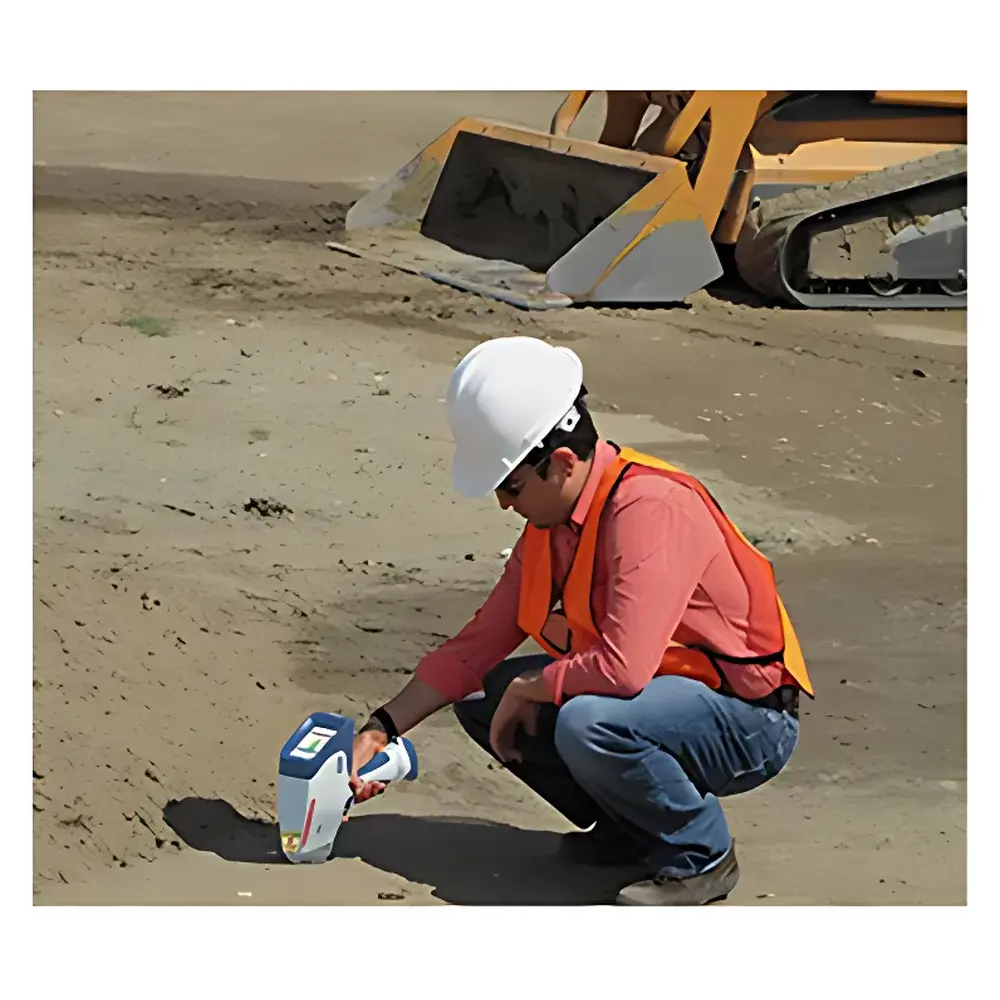
Bruker S1 TITAN Handheld XRF Spectrometer for Soil Heavy Metal Analysis
| Brand | Bruker |
|---|---|
| Origin | Germany |
| Model | S1 TITAN |
| Instrument Type | Multi-element Handheld XRF Analyzer |
| Application | Field and Laboratory Soil Heavy Metal Screening |
| Element Range | ≥40 elements (S–U, including Pb, As, Cd, Hg, Cr, Ni, Cu, Zn, etc.) |
| Detection Principle | Energy-Dispersive X-ray Fluorescence (ED-XRF) |
| Compliance | Meets ISO 12847, ASTM D6313, EPA Method 6200 |
| Portability | Battery-powered, IP54-rated ruggedized housing |
| Regulatory Support | Audit-trail capable software compliant with GLP/GMP documentation requirements |
Overview
The Bruker S1 TITAN is a field-deployable, energy-dispersive X-ray fluorescence (ED-XRF) spectrometer engineered for rapid, non-destructive quantification of heavy metals and major/minor elements in soil matrices. Designed for environmental site assessment, regulatory compliance monitoring, and emergency response, the instrument operates on fundamental ED-XRF physics: primary X-rays excite atoms in the sample, inducing characteristic secondary (fluorescent) X-ray emission; spectral deconvolution enables simultaneous multi-element identification and concentration estimation. Its high-resolution silicon drift detector (SDD), optimized X-ray tube geometry, and real-time spectrum processing deliver reliable detection limits—typically sub-10 ppm for Pb, As, Cd, and Cr in homogenized soil samples—without chemical digestion or lab turnaround. The system is calibrated for soil-specific matrix effects using certified reference materials (CRMs) traceable to NIST and BAM standards, ensuring metrological integrity across heterogeneous field conditions.
Key Features
- Ruggedized industrial design rated IP54 for dust and splash resistance, validated for operation in ambient temperatures from –10 °C to 50 °C
- Integrated GPS, Bluetooth, and Wi-Fi modules enabling geotagged data logging and remote instrument control
- Real-time spectral acquisition with automatic peak deconvolution and interference correction (e.g., As Kα/Pb Lα overlap)
- Pre-loaded soil-specific calibrations for major contaminants (Pb, As, Cd, Hg, Cr, Ni, Cu, Zn) aligned with China’s GB 15618–2018 and EU CLP classification thresholds
- Onboard elemental library covering >40 elements—from sulfur (S) to uranium (U)—with customizable calibration curves for site-specific matrices
- Battery life exceeding 8 hours per charge (Li-ion), supporting continuous field deployment without external power
- Touchscreen interface with multilingual OS (English, Chinese, Spanish, German) and intuitive workflow-guided measurement protocols
Sample Compatibility & Compliance
The S1 TITAN accommodates diverse solid-phase environmental samples: air-dried or sieved soils (<2 mm particle size), sediments, sludges, mining tailings, construction debris, and filter media. Sample preparation follows standardized protocols—minimal grinding, homogenization, and light compaction in reusable XRF cups—to minimize bias from particle size effects and heterogeneity. The analyzer complies with ISO 12847 (soil analysis by XRF), ASTM D6313 (XRF screening of contaminated soils), and EPA Method 6200 (field portable XRF). Its software supports audit trails, electronic signatures, and user access controls required under GLP and ISO/IEC 17025-accredited laboratories. Data export formats include CSV, XML, and PDF reports compatible with national environmental information platforms.
Software & Data Management
Bruker’s proprietary S1 PX software provides full instrument control, spectral visualization, quantitative analysis, and reporting. It features embedded statistical tools for precision evaluation (RSD <5% for triplicate measurements), limit-of-detection (LOD) calculation per element, and trend mapping via GIS integration. All measurement metadata—including operator ID, timestamp, GPS coordinates, atmospheric pressure, and tube operating parameters—is automatically embedded and encrypted. The system supports 21 CFR Part 11-compliant electronic records when deployed in regulated environments, with configurable retention policies and role-based permissions. Cloud synchronization enables centralized data aggregation across multi-site monitoring programs.
Applications
- Rapid screening of brownfield sites prior to redevelopment, identifying hotspots requiring confirmatory ICP-MS analysis
- Regulatory compliance monitoring at industrial facilities subject to discharge permits (e.g., electroplating, smelting, battery recycling)
- Post-remediation verification of soil excavation and backfill operations
- Field validation of phytoremediation efficacy through longitudinal metal concentration tracking
- Emergency response during chemical spills or illegal dumping incidents, delivering actionable data within minutes
- Academic and governmental research on geochemical dispersion patterns in mining-impacted watersheds
FAQ
Does the S1 TITAN require sample digestion or acid leaching before analysis?
No—analysis is performed directly on solid, air-dried samples. Digestion is only necessary for regulatory submission where total metal content must be confirmed by laboratory-based methods.
How does the instrument handle inter-element matrix effects in complex soil matrices?
It applies fundamental parameter (FP) algorithms combined with empirical calibrations derived from >200 soil CRMs, correcting for absorption, enhancement, and particle size effects.
Can the S1 TITAN distinguish between different oxidation states (e.g., Cr(III) vs. Cr(VI))?
No—ED-XRF identifies elemental concentration only, not speciation. Speciation analysis requires complementary techniques such as HPLC-ICP-MS.
Is factory recalibration required annually?
While routine performance verification using check standards is recommended daily, full recalibration is typically needed only after hardware service or significant environmental exposure.
What training and technical support options are available for new users?
Bruker offers on-site operator certification, method development workshops, and remote troubleshooting via secure VNC connection, backed by ISO 9001-certified service centers across Asia-Pacific.
Related Products







