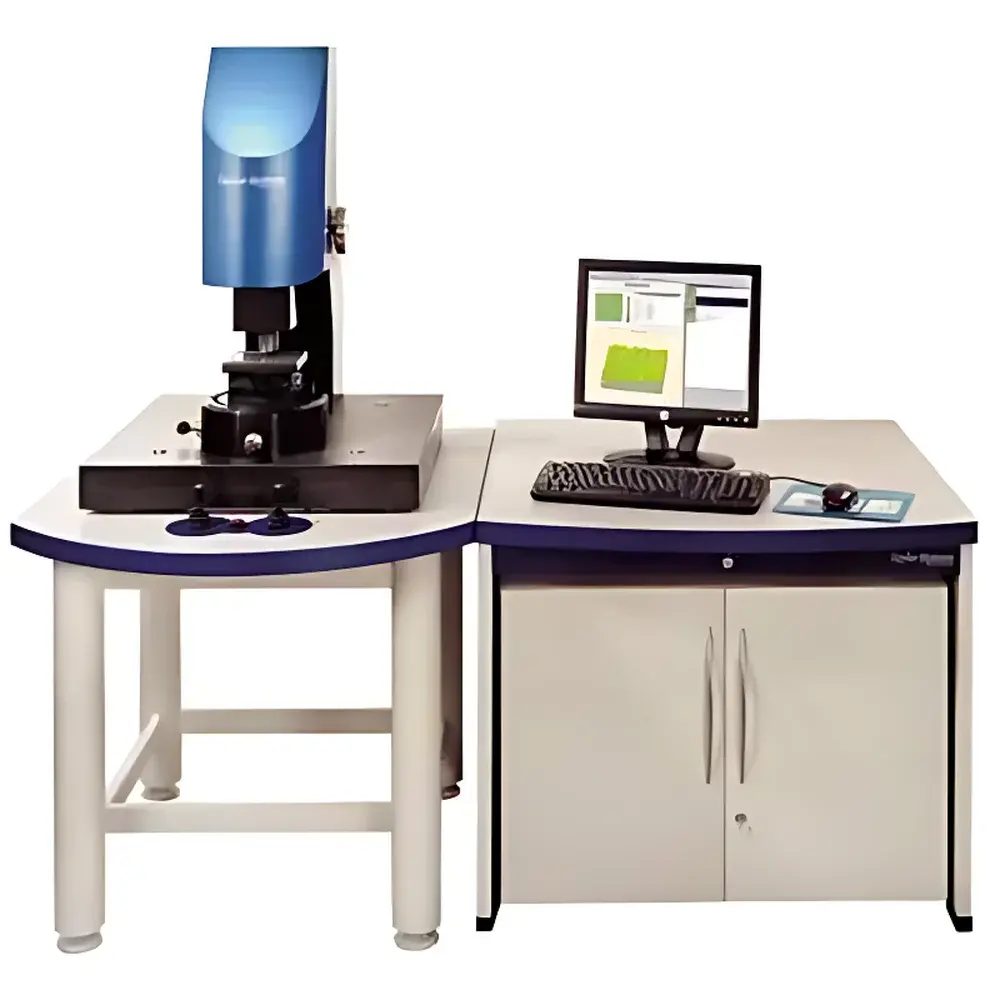
Talysurf CCI White-Light Interferometric Surface Profilometer
| Origin | UK |
|---|---|
| Manufacturer Type | Authorized Distributor |
| Origin Category | Imported Instrument |
| Model | Talysurf CCI |
| Pricing | Available Upon Request |
| Product Type | Non-Contact Profilometer / Surface Roughness Analyzer |
Overview
The Talysurf CCI is a high-precision, non-contact white-light interferometric surface profilometer engineered for nanoscale topographic characterization of functional and optical surfaces. It operates on Coherence Correlation Interferometry (CCI)—a proprietary algorithm-enhanced variant of scanning white-light interferometry (SWLI) that delivers sub-angstrom vertical resolution without reliance on phase-shifting or fringe-order ambiguity resolution. Unlike conventional phase-shifting interferometers (PSI), the CCI method dynamically correlates coherence envelopes across multiple axial positions, enabling robust measurement of discontinuous, steep-slope, and low-reflectivity surfaces—including patterned wafers, MEMS actuators, diffractive optical elements, and polished metallic or dielectric coatings. Its core function is to generate traceable 3D surface topography data compliant with ISO 25178-2 (Geometrical Product Specifications – Surface Texture) and ASTM E2942-20 (Standard Guide for Measurement of Surface Topography Using Optical Interference Microscopy). Designed for integration into R&D labs and production metrology environments, the system supports quantitative analysis of areal surface parameters (Sa, Sq, Sdr, Vmp, Vvc, etc.) as defined in ISO 25178-601–607.
Key Features
- Proprietary Coherence Correlation Interferometry (CCI) engine delivering enhanced noise immunity and measurement stability on challenging surfaces
- Vertical resolution down to 0.01 nm (0.1 Å) — validated via calibrated step-height standards traceable to NPL and NIST
- Full-field acquisition at 1024 × 1024 pixel resolution (1,048,576 data points per frame), enabling statistically representative areal analysis
- Typical measurement time of 10–20 seconds per field-of-view, balancing speed with metrological integrity
- RMS repeatability of ≤ 0.03 Å (3 pm) under controlled environmental conditions (ISO 25178-701-compliant vibration and temperature management)
- Modular objective turret supporting magnifications from 2.5× to 100×, enabling lateral resolution from ~0.4 µm to ~0.1 µm
- Integrated motorized XYZ stage with sub-micron positioning accuracy for automated stitching of large-area maps (up to 100 mm × 100 mm)
Sample Compatibility & Compliance
The Talysurf CCI accommodates a broad spectrum of sample geometries and material classes without contact-induced deformation or contamination risk. It is routinely deployed for characterizing silicon wafers (including EUV mask substrates), sapphire and fused silica optics, thin-film solar cells, medical implant coatings (e.g., TiN, hydroxyapatite), and microfluidic channel structures. The instrument meets essential regulatory and quality framework requirements: full compliance with ISO/IEC 17025 metrological traceability protocols; software audit trail functionality aligned with FDA 21 CFR Part 11 for electronic records and signatures; and built-in calibration verification routines per ISO 25178-602. All measurement reports include metadata on environmental conditions (temperature, humidity), calibration certificate status, and uncertainty budgets per GUM (JCGM 100:2008).
Software & Data Management
Controlled by MountainsMap® 8.0 (certified by Digital Surf), the Talysurf CCI’s software suite provides comprehensive data acquisition, filtering, parameter calculation, and reporting tools. It supports ISO 25178-2 parameter sets, custom parameter scripting (via Python API), and automated report generation in PDF, CSV, and XML formats. Raw interferograms and height maps are stored in standardized HDF5 format for long-term archival and third-party interoperability. The system includes role-based user access control, electronic signature workflows, and full GLP/GMP audit trail logging—including operator ID, timestamp, parameter changes, and data export events—ensuring compliance during internal audits or regulatory inspections.
Applications
- Semiconductor manufacturing: trench depth, line edge roughness (LER), via profile metrology on 300 mm wafers
- Data storage: magnetic layer topography, slider air-bearing surface (ABS) characterization
- Optics fabrication: surface flatness of laser mirrors, wavefront error mapping of aspheric lenses
- MEMS/MOEMS: actuator displacement, membrane deflection, stiction assessment
- Advanced materials: grain boundary analysis in polycrystalline thin films, wear scar volumetric quantification
- Medical devices: surface texture of orthopedic implants per ISO 14644-1 and ISO 10993-1 biocompatibility guidance
FAQ
What distinguishes CCI from conventional white-light interferometry?
CCI uses dynamic coherence envelope correlation rather than static fringe contrast detection, improving measurement fidelity on low-coherence or multi-layered samples.
Can the Talysurf CCI measure transparent or semi-transparent thin films?
Yes—through spectral reflectance modeling and multi-surface reconstruction algorithms embedded in MountainsMap.
Is the system compatible with cleanroom Class 100/ISO 5 environments?
Yes—optional vibration-isolated granite base and HEPA-filtered enclosure kits are available for certified cleanroom integration.
Does the software support automated pass/fail decision logic based on GD&T tolerances?
Yes—custom inspection templates can embed geometric tolerancing rules (per ASME Y14.5 or ISO GPS) with real-time go/no-go flagging.
How is traceability maintained for calibration artifacts?
Certified step-height standards (e.g., NIST SRM 2160) are measured quarterly using documented SOPs; calibration certificates are linked directly to measurement sessions in the audit log.