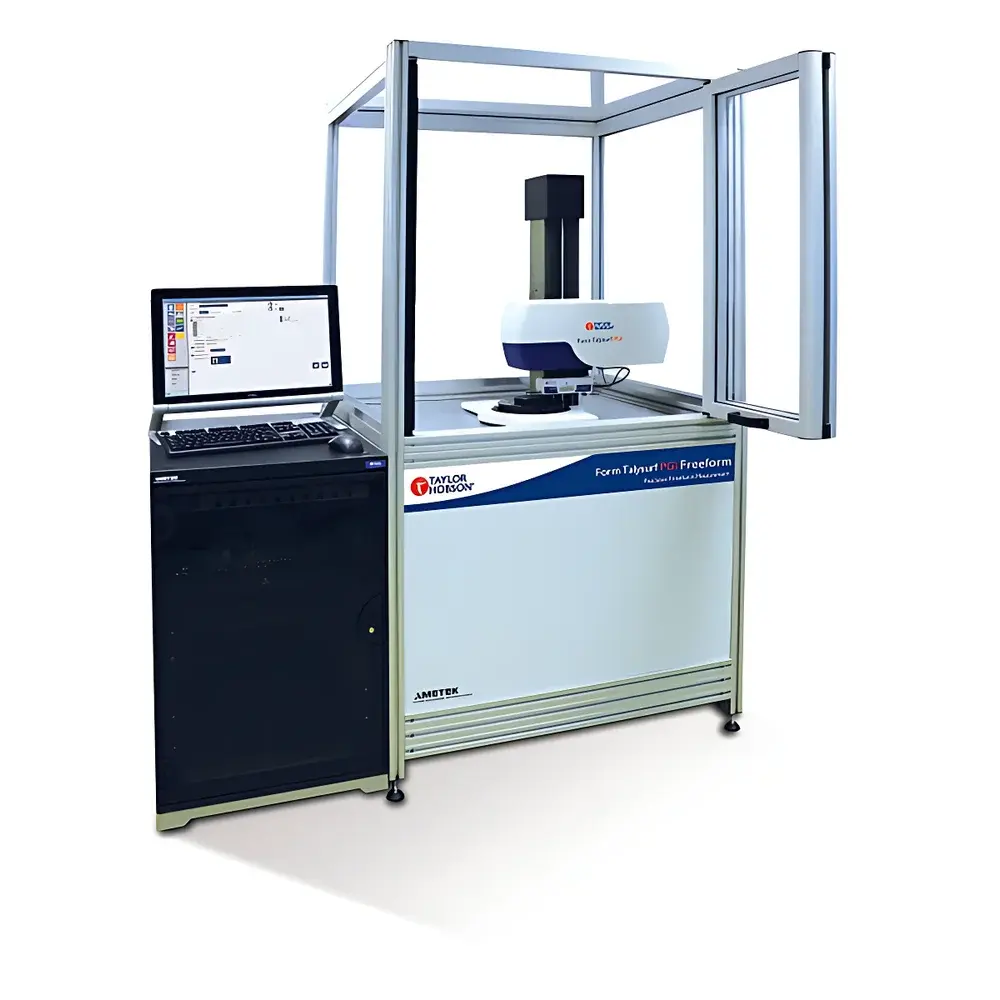
Taylor Hobson Form Talysurf PGI Freeform Contact Profilometer
| Brand | Taylor Hobson |
|---|---|
| Origin | United Kingdom |
| Model | PGI Freeform |
| Type | Contact Profilometer / Surface Roughness Tester |
| Measurement Principle | Stylus-based Scanning Interferometry with Radial & Grid Scan Modes |
| Vertical Range | 28 mm |
| Vertical Resolution | 0.8 nm |
| Tilt Capability | ±50° |
| Form Error Accuracy | <150 nm PV (as per ISO 5436-1 and ISO 25178-2) |
| Compliance | ASTM E1155, ISO 10360, ISO 25178, ISO 5436-1, USP <1058> for metrological validation |
Overview
The Taylor Hobson Form Talysurf PGI Freeform is a high-precision, contact-based profilometric measurement system engineered specifically for the metrology of complex optical and precision mechanical surfaces. It operates on the principle of high-resolution stylus scanning interferometry, combining radial and grid-based scanning trajectories to reconstruct full 3D topography with sub-nanometer vertical resolution. Unlike conventional profilometers limited to rotationally symmetric geometries, the PGI Freeform integrates advanced motion control, thermally stable granite base architecture, and finite-element-optimized kinematics to deliver traceable form measurements across freeform, aspheric, toroidal, and NURBS-defined surfaces. Its design reflects over four decades of Taylor Hobson’s expertise in surface metrology, calibrated against national standards (NPL-UK) and validated under ISO/IEC 17025-accredited procedures. The system serves as a primary reference instrument in R&D labs, optical manufacturing QA/QC environments, and metrology centers requiring compliance with ISO 10360-2 (CMM verification), ISO 25178-2 (areal surface texture), and ISO 5436-1 (profile measurement standards).
Key Features
- Stylus-based scanning platform with 28 mm vertical range and 0.8 nm RMS vertical resolution, enabling high-fidelity capture of steep slopes and deep features.
- Dual-scan capability: programmable radial scans for axisymmetric optics (e.g., aspheres, ellipsoids) and orthogonal grid scans for non-axisymmetric freeforms (e.g., Zernike-polynomial surfaces, B-spline patches).
- ±50° tilt stage with high-stiffness air-bearing rotary axis, supporting accurate measurement of off-axis segments and highly inclined facets without repositioning.
- Thermally compensated granite base and low-noise linear motor drives ensure mechanical stability and repeatability better than 150 nm PV form error across full measurement volume.
- Integrated calibration routines compliant with ISO 25178-601 (calibration of areal instruments) and traceable to NPL reference artifacts.
- Modular sensor head design accommodating interchangeable diamond styli (2 µm–12.5 µm radius), skidless or skid-type configurations, and optional temperature-compensated force control (0.1–5 mN).
Sample Compatibility & Compliance
The PGI Freeform accommodates substrates ranging from fused silica and silicon carbide to BK7 glass, sapphire, and metal-coated optics—provided surface hardness exceeds 600 HV and roughness Ra < 5 µm. It supports measurement of toroidal lenses, double-conic surfaces, hybrid aspheric-cylindrical elements, and parametric surfaces defined via Zernike coefficients or NURBS data imported from CAD (STEP, IGES, or ASCII point cloud). All measurement workflows adhere to GLP/GMP documentation requirements, with audit-trail-enabled software logging operator actions, environmental conditions (temperature, humidity), calibration status, and uncertainty budgets per GUM (JCGM 100:2008). System validation conforms to ASTM E1155 (floor flatness), ISO 10360-2 (volumetric accuracy), and ISO 25178-70 (metrological characteristics of areal instruments).
Software & Data Management
The proprietary FormSurf™ software provides full metrological workflow integration—from scan planning and adaptive sampling density control to GD&T-compliant form analysis (PV, RMS, SF, Zernike decomposition, slope error mapping). Raw profile and areal datasets are stored in vendor-neutral HDF5 format with embedded metadata (traceability ID, calibration certificate number, environmental logs). Export options include STEP AP210 (for CAD comparison), CSV (for statistical process control), and XML-based Metrology Data Exchange Format (MDEF) compatible with enterprise MES and LIMS platforms. Software architecture complies with FDA 21 CFR Part 11 requirements, supporting electronic signatures, role-based access control, and immutable audit trails for regulated industries.
Applications
- Verification of freeform mirrors in astronomical instrumentation and EUV lithography systems.
- GD&T evaluation of molded plastic aspheres used in automotive HUDs and AR waveguides.
- Process validation for single-point diamond turning (SPDT) and ion-beam figuring (IBF) of IR optics.
- Reverse engineering of legacy optical components via high-density point-cloud acquisition and NURBS surface fitting.
- Inter-laboratory comparison studies under EURAMET calibration guidelines (EURAMET cg-19).
- Uncertainty budgeting per ISO/IEC 17025 for accredited calibration laboratories issuing ISO 17025 certificates.
FAQ
What surface types can the PGI Freeform measure beyond standard spheres and aspheres?
It measures toroids, double-conics, elliptical cylinders, Zernike-defined surfaces, NURBS patches, and arbitrary point clouds—provided they fall within the 28 mm vertical range and ±50° tilt envelope.
Is the system suitable for in-process metrology on the shop floor?
While optimized for lab-grade stability, it may be deployed in temperature-controlled production cells (±0.5°C) with active vibration isolation; however, routine recalibration per ISO 10360-2 is required after relocation.
Does the software support automated pass/fail reporting against GD&T tolerances?
Yes—FormSurf™ enables rule-based tolerance assignment per ASME Y14.5 and ISO 1101, with configurable reporting templates compliant with IATF 16949 and ISO 9001 quality management systems.
Can measurement uncertainty be quantified per ISO/IEC 17025 requirements?
Yes—the software generates full uncertainty budgets incorporating stylus geometry, thermal drift, motion error, and environmental contributions, aligned with GUM Supplement 1 (JCGM 101:2008).