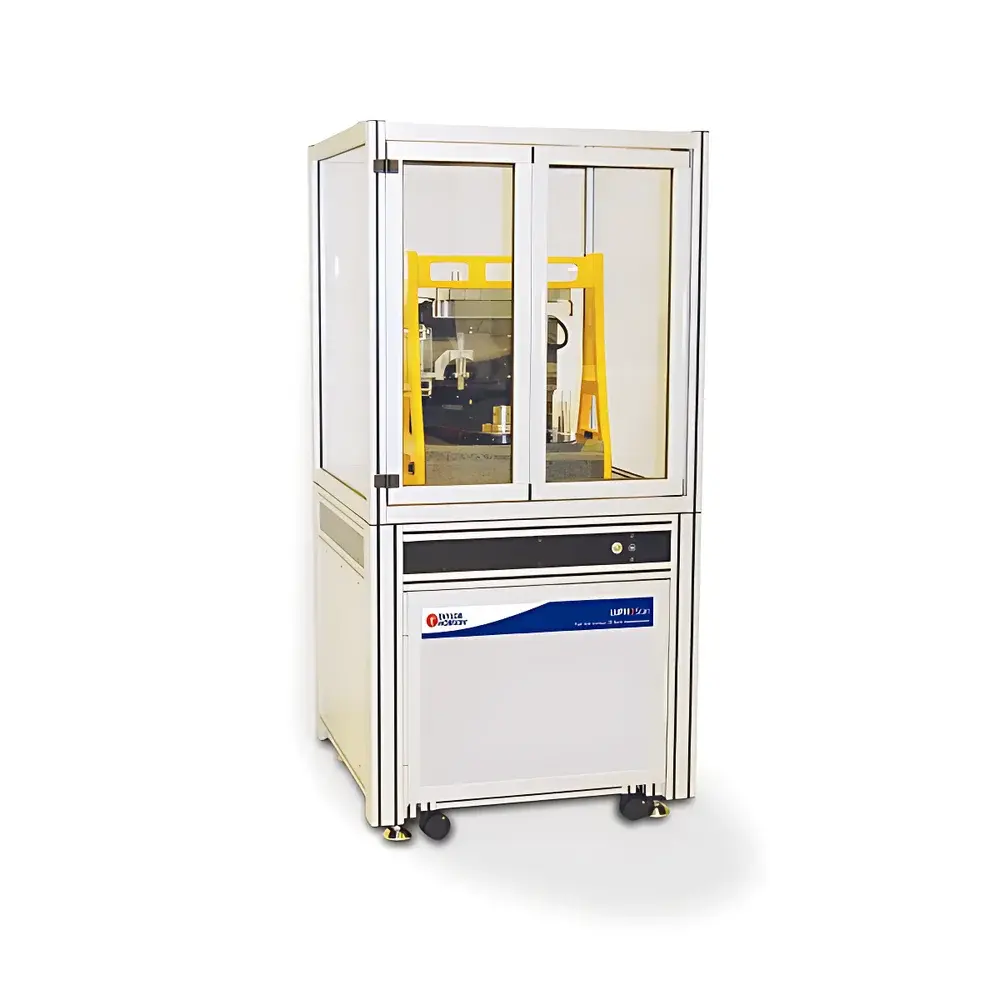
Taylor Hobson LuphoScan120/260/420 Non-Contact 3D Aspheric Optical Surface Profilometer
| Brand | Taylor Hobson |
|---|---|
| Origin | United Kingdom |
| Model | LuphoScan120 / LuphoScan260 / LuphoScan420 |
| Measurement Principle | Multi-Wavelength Interferometry (MWLI®) |
| Maximum Workpiece Diameter | 120 mm / 260 mm / 420 mm |
| Vertical Resolution | < 0.1 nm (sub-nanometer) |
| Shape Accuracy | ≤ ±50 nm (traceable to NPL/PTB standards) |
| Scan Speed | Full 3D topography of 30 mm spherical surface < 2 min |
| Surface Compatibility | Transparent optics (fused silica, CaF₂, BK7), polished metals, ground surfaces, coated substrates |
| Software Platform | Form Talysurf® with LuphoScan Module (ISO 10110-5, ISO 14999-1, ISO 25178 compliant) |
| Regulatory Compliance | Supports GLP/GMP audit trails, 21 CFR Part 11 electronic signature readiness, full measurement traceability per ISO/IEC 17025 |
Overview
The Taylor Hobson LuphoScan120/260/420 is a high-precision, non-contact 3D optical profilometer engineered specifically for the metrology of rotationally symmetric aspheric, spherical, planar, and freeform optical surfaces. At its core lies Multi-Wavelength Interferometry (MWLI®) — a proprietary interferometric scanning technology that eliminates phase ambiguity by synthesizing synthetic wavelengths from multiple laser sources. This enables unambiguous, absolute height measurement over large depth ranges without mechanical retrace or z-stepping, delivering sub-nanometer vertical resolution and shape accuracy within ±50 nm across full-aperture measurements. Unlike conventional stylus profilometers or single-wavelength interferometers, the LuphoScan platform operates without physical contact, eliminating surface damage risk and enabling repeatable characterization of fragile, coated, or ultra-smooth optical components — including molded aspheres, diamond-turned mirrors, and diffractive optical elements (DOEs). Its rigid granite base, active vibration isolation, and thermally stable reference sensor architecture ensure long-term stability and environmental robustness in production metrology labs and ISO Class 5 cleanrooms.
Key Features
- Multi-Wavelength Interferometry (MWLI®) sensor technology for absolute, unambiguous 3D topography acquisition across transparent, reflective, and semi-transparent surfaces
- Three scalable configurations (LuphoScan120, LuphoScan260, LuphoScan420) supporting maximum workpiece diameters of 120 mm, 260 mm, and 420 mm respectively
- High-speed full-aperture scanning: completes 3D shape measurement of a 30 mm diameter spherical surface in under 2 minutes; 130 mm sphere in under 5.5 minutes
- Advanced surface adaptability — accurately measures surfaces with inflection points, flat apices, steep slopes (>80°), and discontinuous features such as segmented optics and annular lenses
- Integrated reference sensor and kinematically mounted metrology frame for thermal drift compensation and long-term repeatability (≤ 0.5 nm/h drift under controlled lab conditions)
- Modular hardware expansion via LuphoSwap interface — supports add-on modules for lens thickness, wedge, centration error, and decenter measurement
Sample Compatibility & Compliance
The LuphoScan system accommodates a broad spectrum of optical materials and geometries, including fused silica, sapphire, CaF₂, BK7, ZnSe, and aluminum-coated mirrors. It reliably measures both polished and ground surfaces, as well as anti-reflection or high-reflectivity coated substrates, without requiring neutral density filters or surface preparation. All measurements adhere to international optical metrology standards: ISO 10110-5 (surface form tolerances), ISO 14999-1 (interferometric testing of optical components), and ISO 25178 (areal surface texture). The system’s calibration protocol follows UKAS-accredited procedures traceable to the National Physical Laboratory (NPL) and Physikalisch-Technische Bundesanstalt (PTB). Data integrity is maintained through full audit trail logging, electronic signature support aligned with FDA 21 CFR Part 11 requirements, and compliance-ready reporting for GLP and GMP environments.
Software & Data Management
The LuphoScan operates under the Form Talysurf® software platform, extended with the dedicated LuphoScan module. This environment provides comprehensive analysis tools for aspheric deviation mapping, Zernike polynomial fitting (up to 36th order), slope error calculation, power spectral density (PSD) analysis, and residual error visualization. Raw interferograms are stored in vendor-neutral HDF5 format, ensuring long-term data portability and third-party interoperability. Batch processing, automated report generation (PDF/HTML/XLSX), and customizable pass/fail criteria enable seamless integration into automated quality control workflows. All user actions — including parameter changes, calibration events, and report exports — are timestamped and logged with operator ID, satisfying ISO/IEC 17025 documentation requirements.
Applications
The LuphoScan is deployed in precision optics manufacturing, R&D laboratories, and national metrology institutes for verifying critical parameters of high-value optical components. Primary use cases include: verification of molded aspheric lenses for automotive LiDAR and smartphone camera modules; certification of off-axis parabolic mirrors for synchrotron beamlines; validation of freeform ophthalmic lenses per ANSI Z80.10; and process feedback for deterministic polishing of astronomical telescope segments. It also supports advanced applications such as metrology of diffractive optical surfaces (e.g., kinoforms and micro-lens arrays), toroidal surfaces, and hybrid refractive-diffractive elements where traditional null-testing methods fail.
FAQ
What surface types can the LuphoScan measure without coating or preparation?
It measures bare fused silica, BK7, CaF₂, sapphire, ZnSe, and polished aluminum — including AR-coated, HR-coated, and metallic substrates — using MWLI®’s inherent contrast independence.
Does the system support measurement of discontinuous or segmented optics?
Yes — via optional software extensions, it analyzes rectangular optics, annular lenses, stair-stepped diffractives, and conical surfaces using adaptive region-of-interest (ROI) segmentation and multi-pass stitching algorithms.
How is traceability ensured for ISO/IEC 17025 accreditation?
Each system ships with NPL-traceable calibration artifacts, documented uncertainty budgets, and software-embedded calibration certificates updated after every sensor recalibration event.
Can LuphoScan integrate into automated factory metrology cells?
Yes — it supports Ethernet/IP and OPC UA protocols for PLC synchronization, robotic part loading handshaking, and MES-level data export via RESTful API.
Is thermal drift compensated during long-duration scans?
Yes — the integrated reference sensor continuously monitors thermal expansion of the metrology frame and applies real-time correction to all height data points.