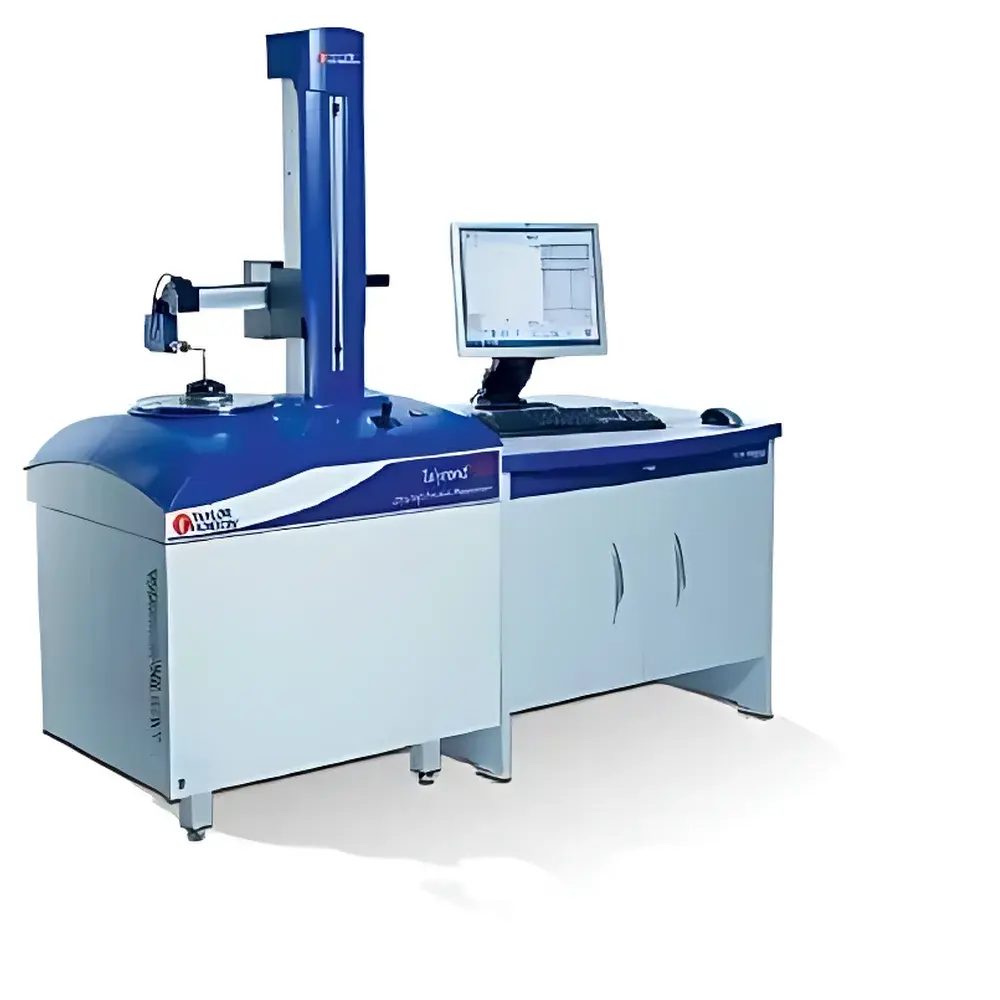
Taylor Hobson Talyrond 565/585 Cylindricity Measuring Instrument
| Origin | UK |
|---|---|
| Manufacturer Type | Authorized Distributor |
| Origin Category | Imported |
| Model | TR 565 / TR 585 |
| Quotation | Upon Request |
| Max. Workpiece Weight | 75 kg |
| Max. Measurement Height | 300 / 500 / 900 mm (configurable) |
| Max. Measurement Diameter | Ø 400 mm (expandable to Ø 485 mm) |
| Radial Error Limit | ±(0.015 µm + 0.0003 × H µm), H in mm (1–50 UPR filter) |
| Resolution | 0.5 nm |
| Maximum Data Points | 18,000 per trace |
| Calibration | Patented spherical artifact-based probe curvature compensation |
Overview
The Taylor Hobson Talyrond 565 and 585 are high-precision, multi-function geometric metrology systems engineered for comprehensive cylindricity, roundness, surface roughness, and profile measurement on rotationally symmetric components. Unlike conventional single-purpose roundness testers, these instruments implement a unified metrological architecture grounded in ultra-stable air-bearing spindles, high-resolution capacitive sensors, and synchronous multi-axis data acquisition. The system operates on the principle of rotational scanning with axial translation—where the workpiece rotates at constant angular velocity while the stylus traverses vertically along its axis—enabling simultaneous capture of radial deviation, surface topography, and form error in a single setup. This integrated approach supports true manufacturing process simulation: measurements replicate actual machining or grinding conditions, including part orientation, fixturing constraints, and thermal equilibrium states, thereby ensuring metrological traceability to production intent. Designed and assembled in Leicester, UK, the Talyrond 565/585 complies with ISO 1101 (Geometrical Product Specifications), ISO 4287 (Surface Roughness), and ISO 12181 (Roundness), and is validated under UKAS-accredited calibration protocols.
Key Features
- Triple-mode measurement capability: simultaneous acquisition of roundness, cylindricity, and surface texture (Ra, Rz, Rq, etc.) without repositioning or recalibration
- Modular height configuration: selectable vertical columns supporting 300 mm, 500 mm, or 900 mm measurement envelopes—optimized for small precision bearings up to large hydraulic cylinders
- Patented spherical calibration artifact and algorithmic probe-tip radius compensation, correcting stylus-induced convolution errors in profile analysis
- Sub-nanometer resolution: 0.5 nm vertical resolution enabled by differential capacitive transducers and low-noise signal conditioning
- High-density sampling: up to 18,000 data points per full 360° rotation, supporting rigorous harmonic decomposition (up to 50 UPR) and spectral form analysis
- Rigid granite base with active vibration isolation and temperature-stabilized spindle housing (±0.1°C control), minimizing environmental drift during long-duration scans
Sample Compatibility & Compliance
The Talyrond 565/585 accommodates cylindrical, conical, and stepped components weighing up to 75 kg and spanning diameters from Ø 10 mm to Ø 485 mm (with optional extension kit). Fixturing includes precision collets, V-blocks, and custom chucks compatible with ISO 7388-1 tooling interfaces. All measurement routines adhere to international standards for geometric tolerancing and surface characterization—including ISO 1101 (form tolerances), ISO 12180 (cylindricity), ISO 4288 (roughness assessment), and ASTM E1240 (profilometry validation). The system supports GLP/GMP-compliant operation through audit-trail-enabled software logging, electronic signatures, and secure user-role management aligned with FDA 21 CFR Part 11 requirements.
Software & Data Management
Helmholtz™ Metrology Suite v6.x provides full instrument control, real-time visualization, and advanced post-processing. It features automated program generation via graphical workflow builder, harmonics analysis (FFT-based decomposition), GD&T evaluation per ASME Y14.5–2018, and export-ready reporting in PDF, CSV, and STEP AP242 formats. Optional modules include 3D Surface Reconstruction, RTA (Roughness Texture Analysis), Groove Analysis, and Wall Thickness Mapping—each validated against NIST-traceable reference standards. Data integrity is maintained via encrypted local storage, automatic backup scheduling, and integration with enterprise MES/QMS platforms via OPC UA and RESTful API interfaces.
Applications
- Aerospace: turbine shafts, bearing races, and fuel nozzle bodies requiring tight cylindricity control (≤ 0.5 µm) and surface finish verification
- Automotive: piston pins, CV joint housings, and transmission gears where combined form and roughness affect wear life and NVH performance
- Medical device manufacturing: orthopedic implant stems, dental abutments, and surgical instrument barrels demanding ISO 13485-aligned measurement documentation
- Hydraulic & powertrain components: pump plungers, cylinder liners, and valve spools subjected to stringent leakage-path geometry specifications
- Research laboratories: validation of additive manufacturing processes (e.g., DED, LPBF) for internal bore geometry fidelity and as-built surface integrity
FAQ
What distinguishes the Talyrond 565 from the 585 model?
The Talyrond 565 is optimized for high-speed production floor deployment with standard 300 mm column and simplified automation interface; the 585 offers extended vertical travel (up to 900 mm), enhanced thermal stability package, and full 3D reconstruction capability.
Can the system measure non-circular profiles such as cam lobes or eccentric shafts?
Yes—using the optional Profile Mode with angular encoder synchronization, it captures non-rotational symmetry features within ±0.1 arc-second angular resolution.
Is third-party calibration support available outside the UK?
Taylor Hobson maintains certified service partners across North America, EMEA, and APAC regions, all operating under UKAS-equivalent accreditation frameworks.
How is traceability maintained for the spherical calibration artifact?
Each calibration sphere is supplied with a UKAS-certified certificate (Ref: ISO/IEC 17025) specifying sphericity, diameter, and material homogeneity—revalidated annually per manufacturer’s maintenance schedule.
Does the system support automated pass/fail decision logic based on GD&T callouts?
Yes—Helmholtz™ enables rule-based tolerance checking with configurable alarms, statistical process control (SPC) charting, and direct integration into factory-level SPC dashboards.