
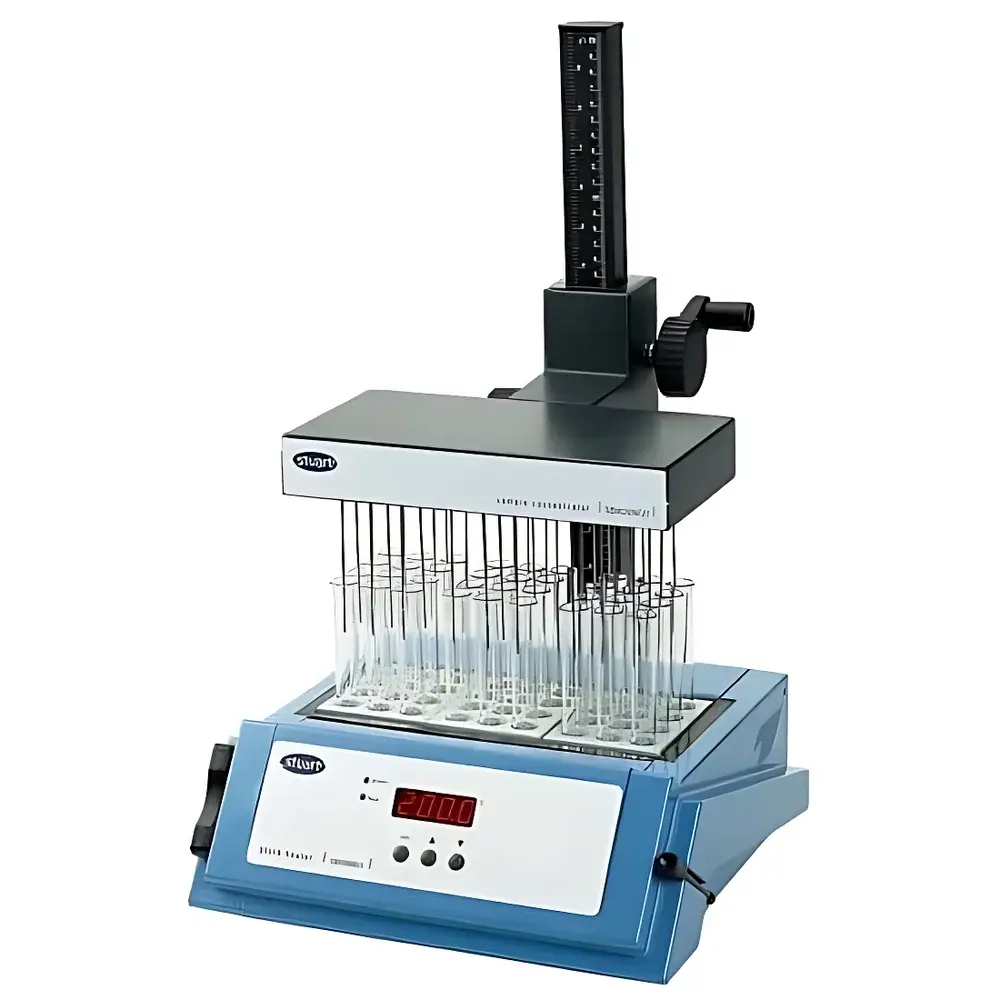
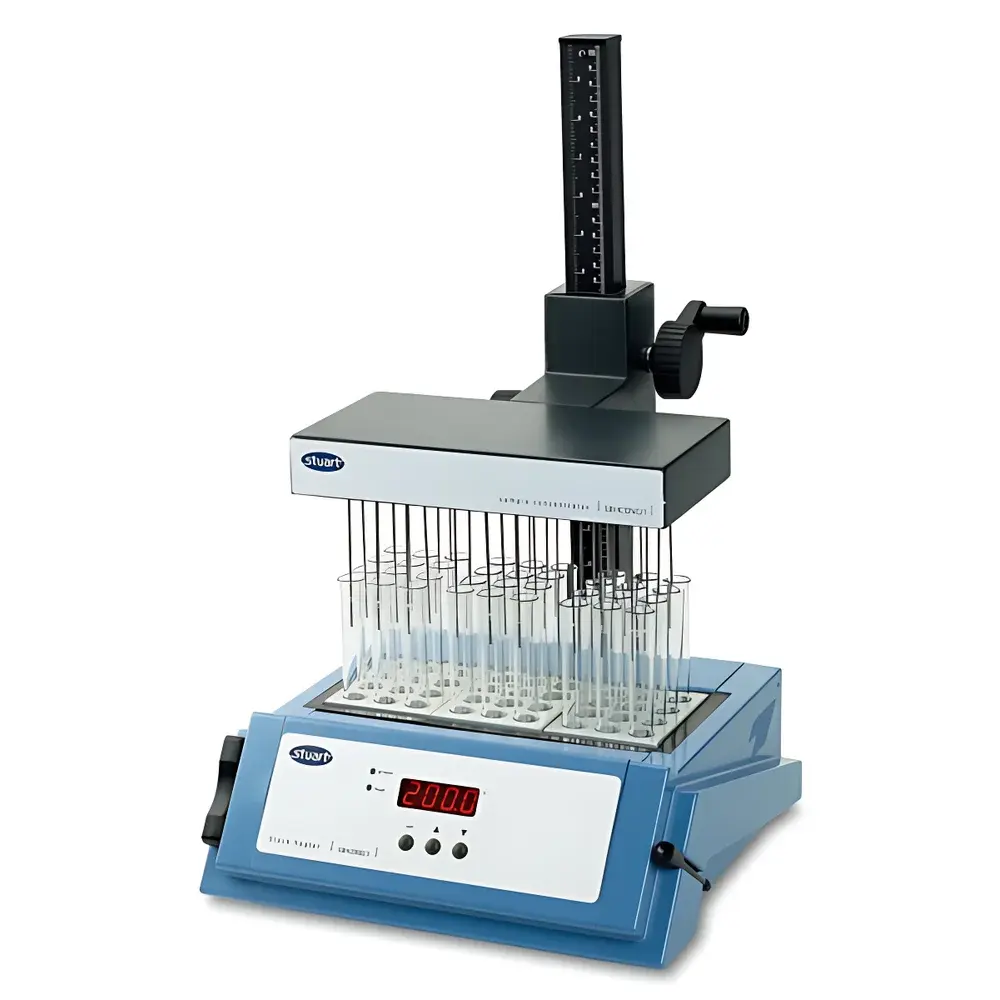
Stuart SBHCONC/1 Dry-Block Nitrogen Evaporator
| Brand | Stuart |
|---|---|
| Origin | United Kingdom |
| Model | SBHCONC/1 |
| Instrument Type | Nitrogen Blow-Down Concentrator |
| Compatible Dry Blocks | SBH130D/3 and SBH200D/3 |
| Needle Options | 76 mm (F7209, FSC4NCS) and 127 mm (F7210, FSC4NCL), PTFE-coated available |
| Compliance | Designed for GLP-compliant sample preparation workflows |
Overview
The Stuart SBHCONC/1 Dry-Block Nitrogen Evaporator is an engineered solution for parallel, solvent-free concentration of multiple liquid samples under controlled thermal and gas-flow conditions. It operates on the principle of gentle nitrogen gas dispersion across sample surfaces within a precisely regulated dry-block heating environment—eliminating reliance on water baths and minimizing cross-contamination risk. Unlike open-vessel evaporation or vacuum-based concentrators, the SBHCONC/1 delivers reproducible, low-temperature concentration by combining conductive heating (via interchangeable aluminum or stainless-steel blocks) with laminar nitrogen flow delivered through adjustable stainless-steel or PTFE-coated needles. This architecture ensures consistent heat transfer and efficient solvent removal—particularly critical for thermolabile analytes in environmental, clinical, pharmaceutical, and food safety laboratories where sample integrity and throughput are equally prioritized.
Key Features
- Modular dry-block design compatible exclusively with Stuart SBH130D/3 (130°C max) and SBH200D/3 (200°C max) heating units—enabling precise temperature control from ambient +5°C to 200°C with ±0.5°C stability.
- Adjustable-height stainless-steel gas delivery needles (76 mm and 127 mm options) mounted on a rigid support frame; vertical positioning fine-tuned via micrometer-style knobs for optimal gas-to-surface distance across varying tube geometries.
- PTFE-coated needle variants (FSC4NCS/FSC4NCL) certified for compatibility with aggressive solvents including concentrated HCl, HF, and organic acids—extending service life and preventing metal leaching during acidic digestions or trace-metal analyses.
- Gas distribution manifold with individual flow control per needle channel; supports regulated nitrogen supply at 0.5–5 L/min per port, ensuring uniform gas velocity without turbulence-induced splashing or aerosol formation.
- Compact footprint (240 × 180 × 270 mm) and plug-and-play integration—no external compressors or vacuum pumps required; connects directly to standard lab-grade nitrogen cylinders or centralized gas networks.
Sample Compatibility & Compliance
The SBHCONC/1 accommodates standard 12–16 mm OD glass or polypropylene tubes, microcentrifuge vials (0.5–15 mL), and custom-format vessels via user-selectable block inserts. Its design aligns with ISO 17025:2017 requirements for method validation in accredited testing labs, and supports audit-ready documentation when paired with Stuart’s optional digital temperature loggers (e.g., SBH-LOG-USB). For regulated environments—including those adhering to USP , FDA 21 CFR Part 11, or EU GMP Annex 11—the system enables manual entry of batch IDs, operator initials, and run parameters into laboratory notebooks, satisfying traceability mandates without proprietary software dependency.
Software & Data Management
The SBHCONC/1 is a hardware-only platform with no embedded firmware or onboard display—intentionally designed for operational simplicity and long-term reliability. Temperature setpoints and duration are managed externally via the host dry-block unit’s interface (SBH130D/3 or SBH200D/3), both of which feature real-time PID-controlled readouts, programmable ramp/soak profiles, and USB data export for CSV-formatted temperature logs. No drivers or cloud connectivity are required; all calibration records, maintenance logs, and usage histories remain under full institutional control—reducing cybersecurity exposure and simplifying IT validation in regulated QC/QA settings.
Applications
- Pre-concentration of environmental water extracts (e.g., EPA Method 525.3) prior to GC-MS analysis of pesticides and endocrine disruptors.
- Final volume adjustment in clinical toxicology workflows involving urine or plasma samples processed via solid-phase extraction (SPE).
- Residue analysis in food matrices following QuEChERS extraction—particularly for volatile compounds such as acrylamide or furans.
- Sample cleanup in elemental speciation studies (e.g., As(III)/As(V), Cr(III)/Cr(VI)) where acid digestion residues must be reduced without oxidation state alteration.
- Routine QC of pharmaceutical impurity standards requiring precise final dilution volumes under inert atmosphere.
FAQ
Is the SBHCONC/1 compatible with non-Stuart heating blocks?
No—mechanical and thermal interface specifications are proprietary to Stuart’s SBH130D/3 and SBH200D/3 dry blocks; third-party blocks lack the precision alignment pins and gas manifold coupling required for safe operation.
Can the nitrogen flow rate be monitored or logged in real time?
The system does not include integrated mass flow sensors; however, calibrated rotameters or digital flow meters (e.g., Brooks 5850E) may be installed upstream of the manifold for verification and SOP documentation.
What maintenance is required for long-term accuracy?
Annual verification of block temperature uniformity (per ASTM E220) and needle alignment using NIST-traceable thermocouples is recommended; PTFE-coated needles should be inspected for coating integrity before use with corrosive media.
Does the SBHCONC/1 meet CE or UKCA marking requirements?
Yes—certified to EN 61010-1:2010+A1:2013 (Safety Requirements for Electrical Equipment for Measurement, Control, and Laboratory Use) and carries valid UKCA/CE declarations issued by Stuart’s UK-based Notified Body.



