
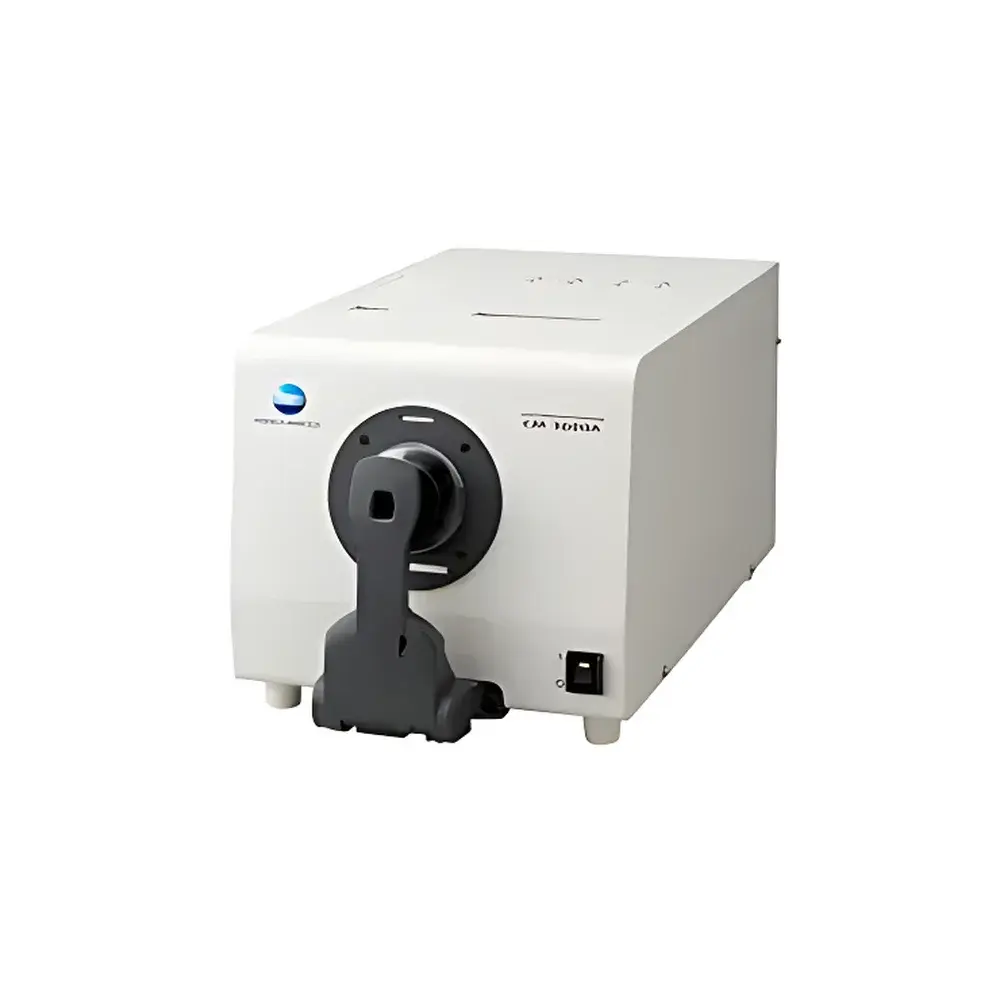
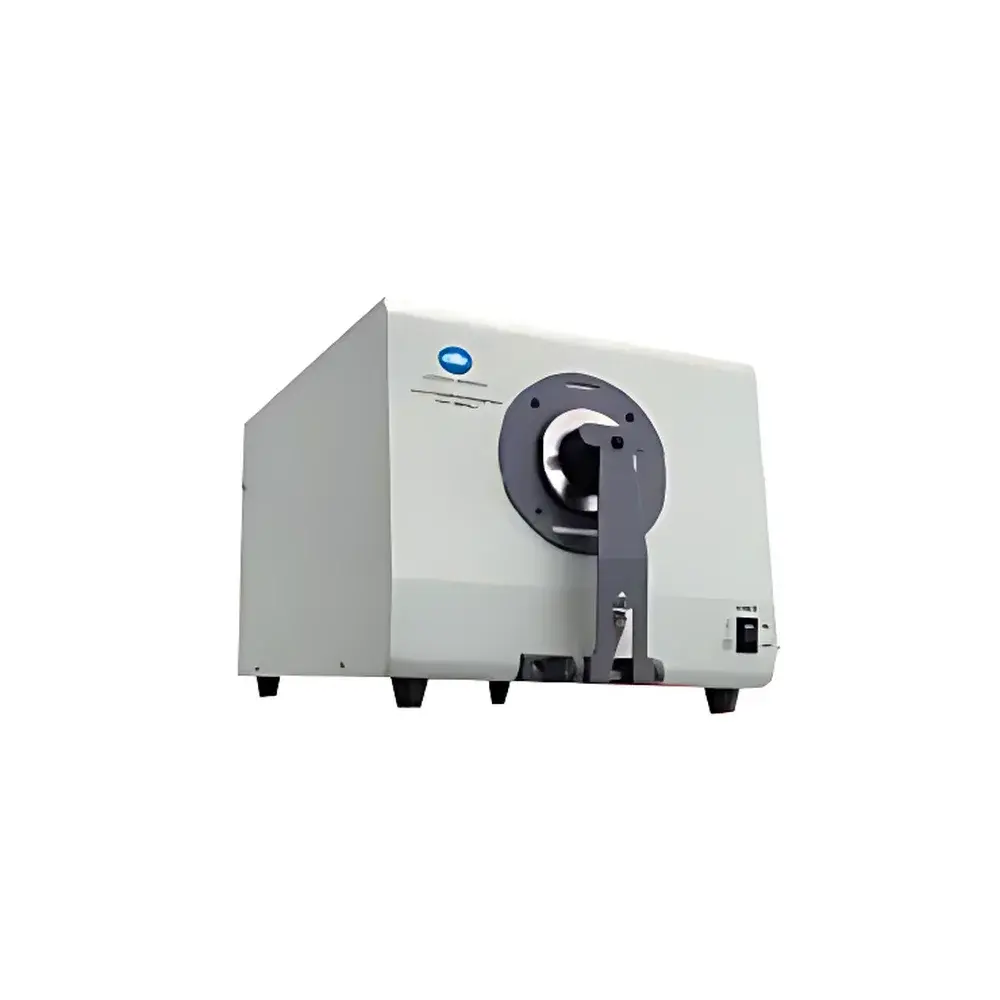
Konica Minolta CM-3600A Benchtop Spectrophotometer
| Brand | Konica Minolta |
|---|---|
| Origin | Japan |
| Model | CM-3600A |
| Product Type | Spectrophotometric Colorimeter |
| Instrument Type | Benchtop |
| Optical Geometry | d/8° integrating sphere (SCI & SCE simultaneous) |
| Light Source | Pulsed Xenon Lamp |
| Spectral Range | 360 nm – 740 nm |
| Wavelength Interval | 10 nm |
| FWHM | ~10 nm |
| Reflectance Measurement Range | 0–200% (0.01% resolution) |
| Repeatability | ΔE*ab ≤ 0.02 (after white calibration, 30 measurements at 10 s intervals) |
| Inter-instrument Agreement | ΔE*ab ≤ 0.15 (LAV/SCI, BCRA Series II avg.) |
| Temperature Drift | ≤ 0.05 ΔE*ab /°C |
| Measurement Apertures | Φ25.4 mm (LAV), Φ8 mm (MAV), Φ4 mm (SAV), all interchangeable |
| Transmission Geometry | d/0° (diffuse illumination, normal detection) |
| Transmission Aperture | ~Φ17 mm |
| Sample Dimensions (Transmission) | ≤133 mm width, ≤50 mm thickness |
| Interface | USB 1.1 |
| Power Supply | AC 100–240 V, 50/60 Hz |
| Operating Environment | 13–33 °C, ≤80% RH (non-condensing) |
| Dimensions (CM-3600A) | 244 × 205 × 378 mm |
| Weight | 11.5 kg |
Overview
The Konica Minolta CM-3600A is a high-precision benchtop spectrophotometer engineered for metrologically rigorous color measurement in R&D laboratories, QC/QA departments, academic institutions, and third-party testing facilities. It operates on the principle of diffuse/8° (d/8°) geometry with dual-mode simultaneous spectral acquisition—capturing both Specular Component Included (SCI) and Specular Component Excluded (SCE) reflectance data within a single 4-second cycle. This eliminates mechanical mode switching, ensuring consistent measurement area registration and minimizing operator-induced variability. The instrument employs a pulsed xenon lamp as its broadband light source, delivering stable, repeatable irradiance across the full visible and near-UV spectrum (360–740 nm). Its double-row silicon photodiode array coupled with a plane holographic grating enables high-fidelity spectral sampling at 10 nm intervals with ~10 nm full-width-at-half-maximum (FWHM) resolution—meeting the spectral bandwidth requirements defined in ISO 7724-1, CIE No. 15, ASTM E1164, and JIS Z8722 Condition C.
Key Features
- Simultaneous SCI/SCE measurement without physical aperture or mirror reconfiguration—ensuring spatial registration stability and reducing throughput time by up to 60% versus legacy sequential systems.
- Integrated UV control architecture: two independent UV emission cycles (with and without UV component) enable accurate fluorescence correction using either 400 nm or 420 nm cutoff filters; UV adjustment requires only one reference measurement of a certified fluorescent standard, eliminating iterative filter alignment.
- Unified platform for reflectance, regular transmission, and diffuse transmission measurements—supporting opaque solids, transparent liquids, translucent polymers, and laminated materials under standardized d/0° geometry per ISO 9050 and DIN 5033-7.
- Inter-instrument compatibility with the CM-3600d series: identical optical path design and data structure allow seamless migration of historical spectral libraries, calibration records, and tolerance sets without software recalibration or database conversion.
- Thermally stabilized optical bench and temperature-compensated detector electronics ensure drift performance within ±0.05 ΔE*ab/°C—critical for long-duration batch monitoring in non-climate-controlled production labs.
Sample Compatibility & Compliance
The CM-3600A accommodates diverse sample formats through three user-swappable apertures: Large Area View (Φ25.4 mm), Medium Area View (Φ8 mm), and Small Area View (Φ4 mm), each with corresponding viewing ports (Φ30 mm, Φ11 mm, Φ7 mm). Transmission measurements support specimens up to 133 mm wide and 50 mm thick, with a fixed ~Φ17 mm illuminated area. All reflectance modes comply with ISO 7724-1, CIE Publication 15:2018, ASTM E1164-22, DIN 5033-7, and JIS Z8722 Condition C for d/8° geometry. Transmission measurements conform to ISO 9050 (glazing), ISO 13468-2 (plastics), and ASTM D1003 (haze and luminous transmittance). The system supports GLP-compliant audit trails when operated with Konica Minolta’s SpectraMagic NX software under validated Windows environments.
Software & Data Management
Controlled via SpectraMagic NX v2.x (Windows 10/11 compatible), the CM-3600A provides full spectral data export in CSV, CIE XYZ, L*a*b*, L*C*h*, ΔE*ab/ΔE00, and custom tolerance formats. Software features include multi-sample statistical reporting (mean, SD, CPK), pass/fail decision logic with configurable tolerances per CMC, BFD, or STEP metrics, and automated report generation compliant with ISO/IEC 17025 documentation requirements. Raw spectral files (.spc) retain full metadata—including instrument ID, calibration timestamp, aperture selection, UV filter status, and environmental sensor logs—enabling retrospective traceability. When deployed in regulated environments, SpectraMagic NX supports 21 CFR Part 11-compliant electronic signatures, role-based access control, and immutable audit trails for all measurement, calibration, and configuration events.
Applications
The CM-3600A serves as a primary reference instrument in paint formulation labs verifying metamerism under multiple illuminants (D65, A, F2, etc.), textile quality assurance validating dye lot consistency across woven and knitted substrates, plastic extrusion lines monitoring color shift during thermal cycling, pharmaceutical packaging validation for opacity and tint uniformity, and food-grade polymer film certification per FDA 21 CFR 177.1520. Its fluorescence capability supports security ink verification, optical brightener quantification in paper manufacturing, and UV-stabilizer efficacy testing in automotive clearcoats. Academic users apply it to pigment dispersion studies, thin-film interference analysis, and spectral modeling of biological tissues.
FAQ
Does the CM-3600A require annual factory recalibration to maintain traceability?
No—its built-in self-diagnostic routines and NIST-traceable white calibration tile (certified per ISO 13655) enable in-house verification. However, periodic inter-laboratory comparison against a master unit or accredited reference material is recommended every 12 months per ISO/IEC 17025 Clause 6.5.
Can spectral data from the CM-3600A be imported into third-party color formulation software?
Yes—CSV exports contain full 360–740 nm reflectance/transmittance values at 10 nm intervals, compatible with Datacolor MATCHTEXT, X-Rite Formulation Software, and BASF ChromaTool.
Is the d/0° transmission geometry suitable for measuring haze in polymeric films?
Yes—the instrument meets ASTM D1003 requirements for total luminous transmittance and haze measurement when used with the optional haze compensation module and calibrated diffuser.
How does the CM-3600A handle measurement of textured or curved surfaces?
The LAV aperture (Φ25.4 mm) averages micro-topography effectively; for highly irregular geometries, a contact-type sample holder with vacuum stabilization is recommended to minimize air gaps and specular misregistration.
What is the expected lifetime of the pulsed xenon lamp?
Rated for ≥1 million flashes under standard operating conditions (1.5 s cycle time); lamp replacement is field-serviceable and requires no optical realignment.




