
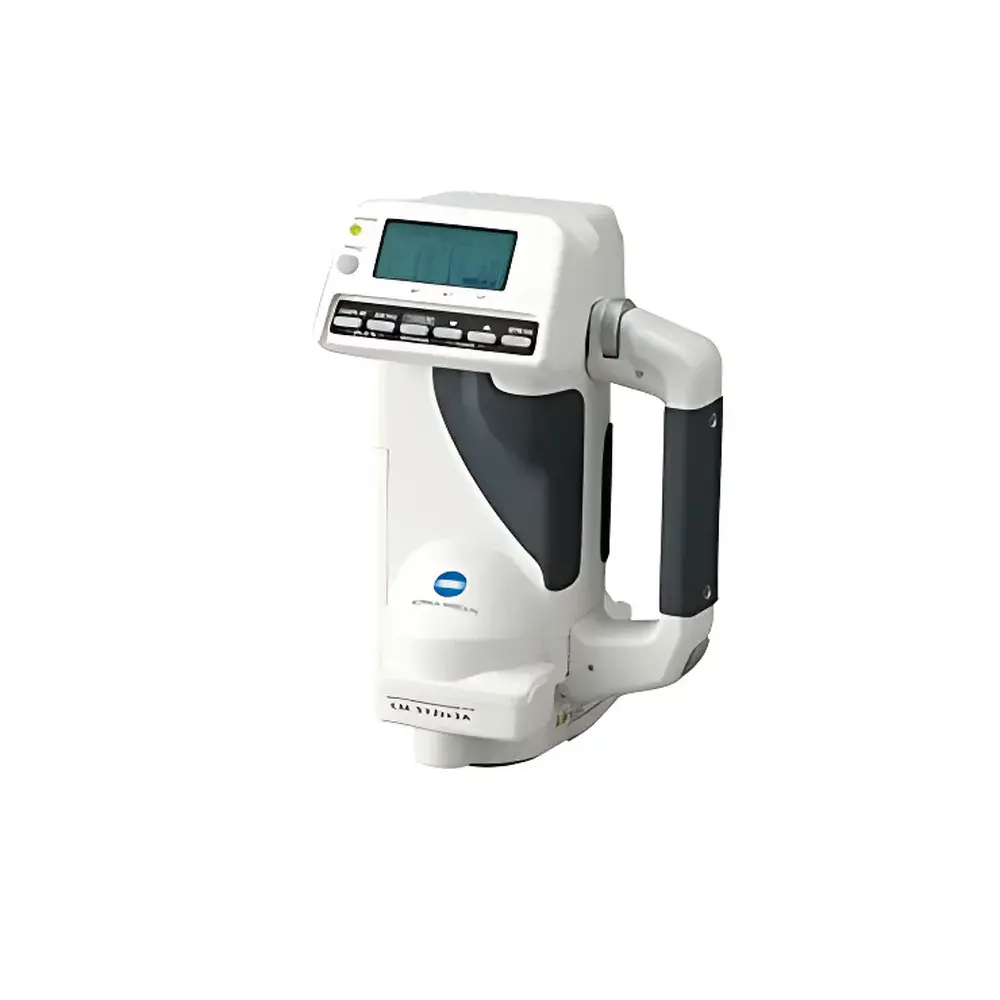

Konica Minolta CM-512m3 Multi-Angle Spectrophotometer
| Brand | Konica Minolta |
|---|---|
| Origin | Japan |
| Model | CM-512m3 |
| Type | Portable Spectrophotometer |
| Optical Geometry | d/8° integrating sphere with multi-angle annular illumination (25°, 45°, 75°) / 0° vertical reception |
| Light Source | Triple pulsed xenon lamp |
| Spectral Range | 400–700 nm |
| Spectral Interval | 20 nm |
| Reflectance Range | 25°: 0–300% |
| 45° & 75° | 0–200% |
| Repeatability | ΔE*ab ≤ 0.05 (after white calibration, 30 measurements at 10 s intervals) |
| Measurement Aperture | Φ12 mm / Φ20 mm |
| Minimum Measurement Interval | 3 s (at 23°C on white calibration tile) |
| Display | L*a*b*, L*C*h*, ΔE*ab, ΔE00, CMC (l:c), FF value, line chart |
| Observer | 2° and 10° standard observer |
| Illuminants | A, C, D50, D65, F2, F6, F7, F8, F10, F11, F12 |
| Memory Capacity | 440 data sets (standards + samples) |
| Interface | RS-232C, IrDA |
| Power | 4 × AA alkaline or Ni-MH batteries / AC adapter |
| Operating Temp. | 0–40°C, ≤85% RH (non-condensing) |
| Dimensions | 164 × 115 × 257 mm |
| Weight | ~1.4 kg (without batteries) |
Overview
The Konica Minolta CM-512m3 Multi-Angle Spectrophotometer is a portable, industrial-grade spectrophotometric instrument engineered for precise color evaluation of effect finishes—particularly metallic, pearlescent, and goniochromatic coatings widely used in automotive OEM, refinish, and high-end consumer electronics applications. Unlike conventional 45°/0° or d/8° instruments, the CM-512m3 implements a proprietary multi-angle illumination geometry: three discrete annular light sources positioned at 25°, 45°, and 75° relative to the sample normal illuminate the surface simultaneously, while reflected radiance is collected vertically at 0° via a silicon photodiode array. This configuration replicates human visual assessment under directional lighting conditions—where 25° approximates highlight perception, 45° corresponds to mid-tone evaluation (the industry-standard viewing angle for solid-color paints), and 75° captures shadow or low-angle reflectance behavior. The instrument operates across the visible spectrum (400–700 nm) at 20 nm resolution, delivering spectral reflectance curves and CIE-compliant tristimulus values (L*a*b*, L*C*h*) under multiple standard illuminants and observers. Its integrated surface temperature sensor enables concurrent thermal measurement, supporting correlation of chromatic shift with thermal drift—a critical consideration for red-rich pigments sensitive to ambient or substrate temperature variations.
Key Features
- Triple-angle annular illumination (25°, 45°, 75°) with single-direction 0° vertical reception ensures angularly resolved color data aligned with visual inspection protocols.
- Pre-flash optimization adjusts pulse energy dynamically—using 2% pre-illumination to determine optimal xenon flash intensity—enhancing repeatability for low-reflectance substrates and minimizing photothermal loading.
- Integrated temperature sensor records surface temperature synchronously with spectral acquisition, enabling traceable correction of thermal-induced ΔE*ab shifts per ASTM E308 Annex A4 guidelines.
- On-device graphical display renders ΔE*ab trend line charts and pass/fail status against user-defined tolerances—enabling real-time go/no-go decisions without external software or PC connectivity.
- Dual aperture configuration (Φ12 mm for localized analysis; Φ20 mm for averaging heterogeneous surfaces) supports both defect isolation and bulk finish evaluation.
- Robust mechanical design includes 18-directional ring illumination symmetry, eliminating orientation-dependent bias during handheld operation in production environments.
- RS-232C serial interface and IrDA wireless support bidirectional communication with host systems, enabling automated data logging, SPC integration, and remote firmware updates.
Sample Compatibility & Compliance
The CM-512m3 is validated for use on non-transmissive, opaque surfaces including coated metal panels, plastic injection-molded parts, powder-coated extrusions, and textured composites. Its d/8° integrating sphere architecture with multi-angle excitation accommodates specular components as defined in ISO 7724-1 and ASTM E308. Instrument compliance extends to GLP-relevant operational requirements: full audit trail capability (via CM-S100w software), user-accessible calibration verification routines, and secure password-protected parameter locking. While not FDA 21 CFR Part 11 certified out-of-box, its data export structure (CSV, TXT) and timestamped measurement logs support validation under pharmaceutical or medical device color control workflows when deployed with compliant IT infrastructure.
Software & Data Management
Data capture and analysis are supported by two dedicated software suites: CM-S20w (basic calibration and report generation) and CM-S100w (advanced color formulation, statistical process control, and database management). CM-S100w provides full traceability—including operator ID, timestamp, environmental metadata (temperature, humidity), instrument serial number, and calibration history—for each stored measurement. Export formats comply with ISO 12647-2 and ISO 13655 spectral data exchange standards. Memory capacity supports up to 440 entries—comprising reference standards, batch samples, and tolerance limits—with automatic overwrite protection for critical master standards. All data fields are editable only within authorized user roles, satisfying internal QA documentation requirements.
Applications
Primary deployment domains include automotive paint shop quality assurance (OEM and after-market), where angular color consistency directly impacts perceived finish quality and brand identity. It is routinely applied in supplier qualification audits for metallic basecoats and clearcoat combinations, as well as in R&D labs developing next-generation effect pigments. Additional use cases span aerospace composite finishing, luxury watch case anodizing, cosmetic packaging metallization, and architectural aluminum cladding verification. In manufacturing, its portability and immediate pass/fail feedback reduce reliance on centralized lab testing—cutting cycle time and enabling 100% inline inspection at critical gating points.
FAQ
What distinguishes the CM-512m3 from standard 45°/0° colorimeters?
It employs simultaneous triple-angle illumination (25°, 45°, 75°) with vertical 0° reception—capturing angular color dependency essential for effect finishes, whereas 45°/0° devices measure only one geometric condition.
Can the CM-512m3 measure transparent or translucent materials?
No—it is designed exclusively for opaque, reflective surfaces. Translucent or backlit samples require transmission-capable instrumentation such as the CM-700d series.
Is temperature compensation automated during measurement?
The instrument records surface temperature concurrently but does not apply real-time spectral correction; users must correlate temperature readings with empirical ΔE*ab drift models or implement post-acquisition adjustment in CM-S100w.
How is calibration traceability maintained?
Factory calibration is NIST-traceable via Konica Minolta’s ISO/IEC 17025-accredited metrology lab. Users perform daily white calibration using supplied CM-A138 tile; calibration validity is logged and auditable in CM-S100w.
Does the device support custom illuminant definitions?
No—only the 11 predefined CIE illuminants (A, C, D50, D65, F2–F12) are available. Custom spectral power distributions require external spectral modeling tools.




