
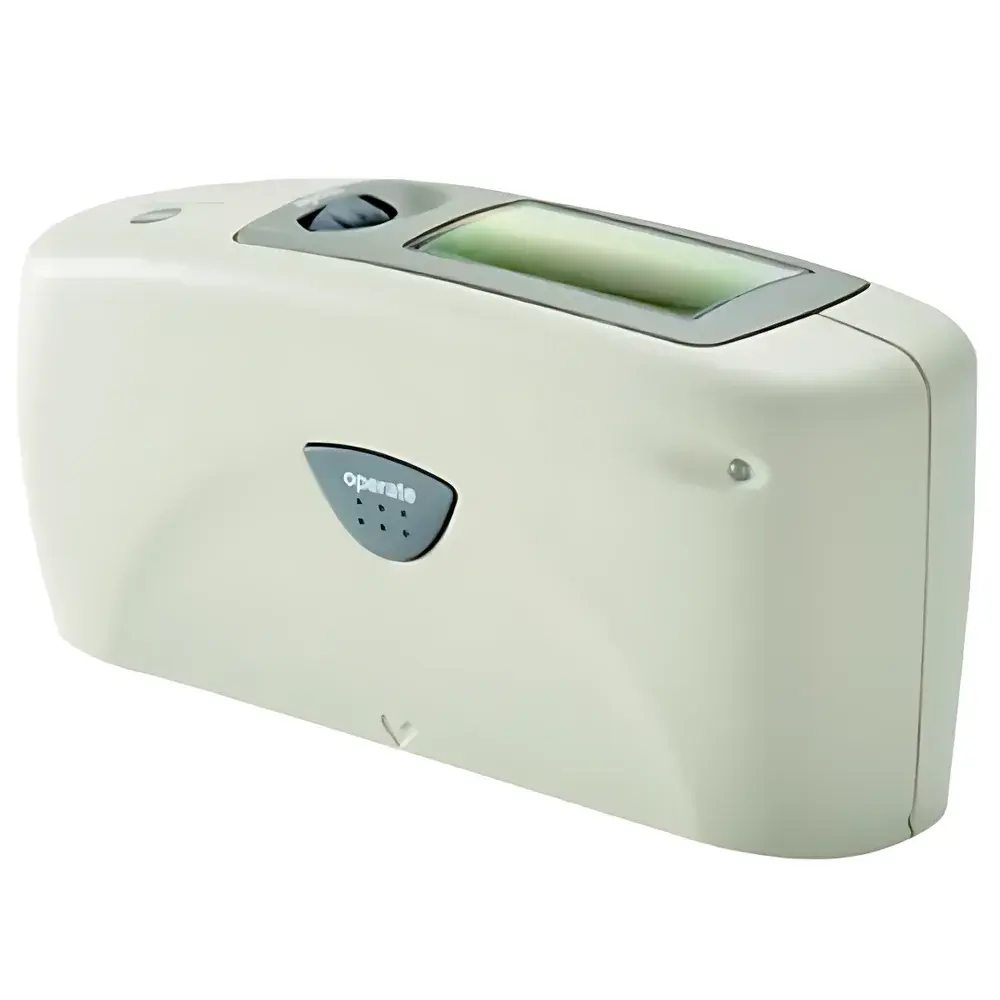
Konika-Minolta Multi Gloss 268A / Uni Gloss 60A / 60CT / 60S Portable Gloss Meter
| Brand | Konica Minolta |
|---|---|
| Origin | Japan |
| Instrument Type | Portable |
| Measurement Angles | 20°, 60°, 85° (Multi Gloss 268A) |
| Repeatability | 0.0–99.9 GU: ±0.2 GU |
| 100–2,000 GU | ±0.2% of reading |
| Inter-instrument Agreement (60CT) | 0.0–19.9 GU: ±0.2 GU |
| Spot Size (60S) | 2 mm × 4 mm |
| Spot Size (60A) | 9 mm × 15 mm |
| Display | Full-color LCD |
| Power | Single AA alkaline battery (~4,000 measurements) |
| Compliance | ISO 2813, ASTM D523, DIN 67530, JIS Z8741 (except GM-60S) |
| Software | smart-lab Gloss & smart-chart |
| Languages | 10 selectable UI languages |
Overview
The Konica Minolta Multi Gloss 268A and Uni Gloss series (60A, 60CT, 60S) are precision portable gloss meters engineered for reliable, traceable surface reflectance measurement across industrial quality control, R&D, and production environments. These instruments operate on the principle of specular reflectance—measuring the ratio of reflected to incident light flux at defined geometric angles under standardized illumination (CIE standard illuminant D65). The Multi Gloss 268A supports triple-angle measurement (20°, 60°, and 85°), enabling comprehensive characterization of high-gloss (e.g., automotive clear coats), medium-gloss (plastic housings), and low-gloss (matte finishes, textured polymers) surfaces in a single device. In contrast, the Uni Gloss variants are optimized for dedicated 60° assessment—a widely adopted reference geometry for general-purpose gloss evaluation per ISO 2813 and ASTM D523. All models conform to international metrological requirements for angular tolerance, beam divergence, and detector spectral response, ensuring data compatibility across global supply chains and third-party audit frameworks.
Key Features
- Triple-angle capability (20°/60°/85°) on Multi Gloss 268A enables full gloss profile mapping—critical for validating coating uniformity and detecting orange peel or haze effects in OEM automotive interiors.
- Uni Gloss 60CT delivers enhanced inter-instrument agreement (±0.2 GU at 0–19.9 GU), minimizing measurement variance when multiple units are deployed across supplier labs, internal QC stations, and customer acceptance testing sites.
- Uni Gloss 60S features a micro-spot aperture (2 mm × 4 mm), permitting accurate gloss quantification on curved components (e.g., instrument panel bezels), engraved markings, or narrow extrusions where conventional 9 mm × 15 mm apertures (Uni Gloss 60A) would average over heterogeneous regions.
- Full-color LCD with high-luminance backlight ensures legibility under ambient factory lighting or outdoor daylight conditions—improving operator efficiency during shift-based inspections.
- Single AA alkaline battery provides >4,000 consecutive measurements per charge—eliminating downtime associated with proprietary rechargeable packs and supporting extended field use without external power.
- Integrated USB interface enables direct connection to Windows-based PCs for real-time streaming or batch transfer—fully compatible with both legacy and modern OS versions (Windows 10/11).
Sample Compatibility & Compliance
These gloss meters accommodate non-porous, planar, and moderately curved surfaces—including painted metal, injection-molded thermoplastics (PP, ABS, PC), powder-coated substrates, anodized aluminum, and ceramic glazes. Surface roughness must remain below 0.8 µm Ra to avoid diffuse scattering artifacts that compromise specular signal integrity. All models except GM-60S are certified compliant with ISO 2813:2014, ASTM D523-14, DIN 67530:1993, and JIS Z8741:2016—ensuring alignment with GLP/GMP documentation requirements and facilitating inclusion in FDA 21 CFR Part 11–compliant quality systems when paired with smart-lab Gloss audit-trail functionality. Calibration is performed using NIST-traceable ceramic standards supplied with each unit; annual verification against accredited reference materials is recommended per ISO/IEC 17025 guidelines.
Software & Data Management
The bundled smart-lab Gloss and smart-chart software suite transforms raw gloss values into auditable quality intelligence. smart-lab Gloss supports live online measurement mode with configurable sampling intervals, automatic timestamping, and user-defined ID tagging—enabling synchronized multi-station data capture during line audits. smart-chart generates export-ready reports in PDF or Excel formats, incorporating pass/fail logic against user-specified upper/lower specification limits (USL/LSL), statistical process control (SPC) charts (X-bar & R), and time-series trend visualization. Both applications maintain immutable audit trails—including operator login, calibration event logs, parameter changes, and report generation timestamps—satisfying FDA 21 CFR Part 11 electronic record requirements when deployed on validated IT infrastructure. Data files are stored in open CSV format, ensuring long-term archival accessibility independent of software version upgrades.
Applications
- Automotive: Validation of interior trim gloss consistency (door panels, center consoles) across Tier-1 supplier deliveries and final assembly line release gates.
- Consumer Electronics: Verification of matte vs. glossy finish differentiation on smartphone housings, laptop lids, and wearable device enclosures.
- Packaging: Monitoring varnish gloss stability on folding cartons and metallized films to prevent batch-to-batch visual mismatch.
- Architectural Coatings: Assessing weathering-induced gloss loss in exterior façade paints after accelerated QUV exposure testing.
- Medical Device Manufacturing: Controlling surface reflectivity of polymer housings (e.g., diagnostic analyzers) to meet ergonomic and glare-reduction specifications.
FAQ
What standards do these gloss meters comply with?
All models except GM-60S meet ISO 2813, ASTM D523, DIN 67530, and JIS Z8741. GM-60S complies with ISO 2813 and ASTM D523 but excludes JIS due to its specialized micro-aperture optical path.
Can I use one device for both high-gloss and low-gloss materials?
Yes—the Multi Gloss 268A’s 20° angle is optimal for high-gloss surfaces (>70 GU), while its 85° angle provides resolution down to 0.1 GU for matte finishes; Uni Gloss 60CT further extends low-end accuracy for cross-lab correlation.
Is smart-chart software compatible with networked lab environments?
Yes—smart-chart supports shared network folders and SQL Server backends for centralized database deployment, enabling enterprise-wide gloss data aggregation and dashboard integration.
How often should calibration be performed?
Daily verification using the included black/white ceramic standards is recommended before critical measurements; full recalibration by an accredited service provider is advised annually or after physical shock events.
Does the device support GLP-compliant data export?
Yes—when used with smart-lab Gloss configured for electronic signatures and audit-log retention, exported reports satisfy GLP Annex 11 and 21 CFR Part 11 requirements for regulated industries.




