
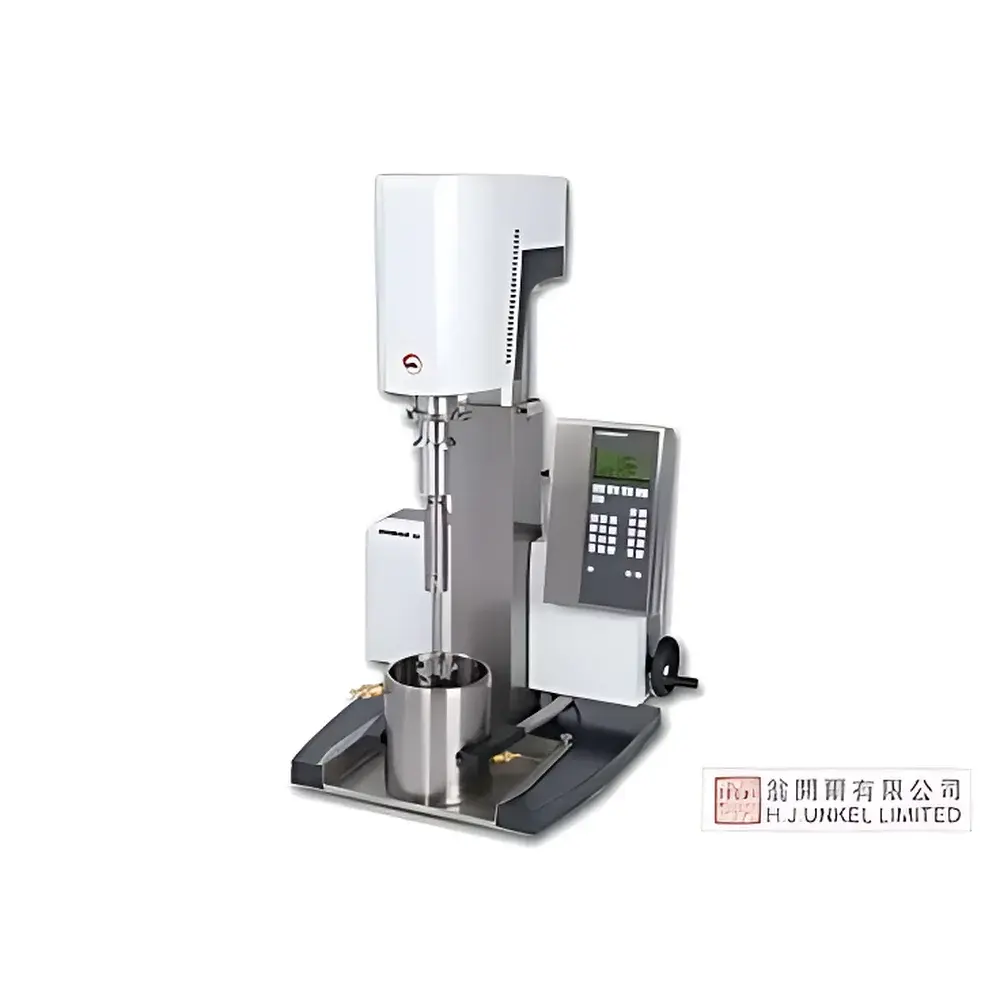
VMA DISPERMAT DS Laboratory Disperser
| Brand | VMA |
|---|---|
| Origin | Germany |
| Model | DISPERMAT DS |
| Power | 1.5 kW |
| Speed Range | 0–20,000 rpm |
| Sample Volume | 0.05–10 L |
| Maximum Torque | 1.5 N·m |
| Drive Type | Integrated Frequency Inverter |
| Control Interface | Touch-enabled HMI with Real-time Parameter Display (RPM, Torque, Input Power, Material Temperature, Time, Tip Speed, Dispersion Head Height) |
| Safety Features | Motorized Height Adjustment, Cup Clamp with Safety Lock, Overload Protection (Temperature / Speed / Torque / Power), Power Calibration Function |
| Data Management | WINDISP-Pro Software Suite with Continuous Logging, Graphical Process Visualization, Floating Data Cursor, Comparative Dispersion Curve Analysis, Exportable Database (CSV/Excel), Bidirectional External Interface for Temperature Integration |
| Compliance | Designed to Support GLP/GMP Documentation Requirements |
Overview
The VMA DISPERMAT DS is a high-precision, benchtop laboratory disperser engineered for reproducible dispersion, wet grinding, and homogenization of suspensions, pastes, and viscous formulations. Based on the Couette shear principle, it delivers controlled hydrodynamic stress through high-speed rotor-stator interaction—enabling consistent particle deagglomeration, pigment dispersion, nanoparticle stabilization, and emulsion formation. Its integrated frequency inverter allows precise speed ramping and maintenance across the full 0–20,000 rpm range, while real-time torque monitoring ensures process stability even during viscosity transitions. The unit’s rigid cast-aluminum frame, low-center-of-gravity design, and motorized height adjustment system minimize mechanical vibration and operator-induced variability—critical for method transfer between R&D and scale-up environments.
Key Features
- Integrated 1.5 kW brushless motor with built-in frequency inverter for smooth, stepless speed control and dynamic load compensation
- Motorized vertical adjustment with precision cup clamp and mechanical safety lock—ensuring repeatable immersion depth and eliminating manual alignment errors
- Real-time multi-parameter display: rotational speed (rpm), torque (N·m), input power (W), material temperature (°C), elapsed time (s), tip speed (m/s), and dispersion head position (mm)
- Dual-mode operation: standard high-shear dispersion using interchangeable dispersing discs (e.g., toothed, saw-tooth, or flat blades); optional compatibility with APS sealed grinding systems or basket mill modules for wet media milling
- Comprehensive electronic protection suite: thermal cutoff, overspeed limiter, torque overload shutdown, and power deviation alarm—all configurable via HMI
- Onboard power calibration function traceable to internal reference standards, supporting ISO/IEC 17025-aligned instrument qualification protocols
Sample Compatibility & Compliance
The DISPERMAT DS accommodates sample volumes from 50 mL to 10 L in standard cylindrical beakers or jacketed vessels (with external chiller integration). It handles Newtonian and non-Newtonian fluids—including high-viscosity polymer melts (up to ~50,000 mPa·s), thixotropic coatings, ceramic slurries, battery electrode pastes, and pharmaceutical suspensions. All wetted parts comply with USP Class VI and EU 10/2011 food-contact regulations. When operated with validated WINDISP-Pro software and configured audit trail settings, the system meets data integrity requirements under FDA 21 CFR Part 11, EU Annex 11, and ICH GCP/GLP guidelines. Full electronic records—including raw sensor timestamps, parameter setpoints, and operator IDs—are retained with immutable hash-verified logs.
Software & Data Management
WINDISP-Pro serves as the native control and analysis platform. It captures all operational parameters at ≥10 Hz sampling rate, generating time-stamped CSV datasets with synchronized graphical overlays (e.g., torque vs. time, power consumption vs. dispersion stage). Key capabilities include: floating data cursors for instant value interrogation; side-by-side curve comparison for formulation screening; automated dispersion endpoint detection via torque inflection analysis; and export-ready reporting templates compliant with internal SOPs or regulatory submissions. The bidirectional RS485/Ethernet interface supports external temperature controllers, allowing closed-loop thermal management during exothermic dispersion cycles—essential for heat-sensitive APIs or lithium-ion cathode slurries.
Applications
- R&D of water-based and solvent-borne coatings, inks, and adhesives—optimizing pigment loading, rheology modifiers, and stabilizer selection
- Pre-formulation studies for oral suspensions, topical gels, and injectable nanosuspensions under QbD principles
- Electrode slurry development for Li-ion, solid-state, and sodium-ion batteries—ensuring homogeneous conductive network formation
- Ceramic and metal oxide nanoparticle dispersion for additive manufacturing feedstocks and functional thin-film precursors
- Quality control testing of batch-to-batch consistency in production-scale dispersion processes via method transfer validation
FAQ
What dispersion mechanisms does the DISPERMAT DS employ?
It operates primarily via high-shear hydrodynamic cavitation and turbulent eddy generation between the rotating disc and vessel wall—complemented by optional wet grinding using APS or basket mill attachments.
Is the system compatible with temperature-controlled vessels?
Yes—via its bidirectional interface, WINDISP-Pro can synchronize with external chillers or heating circulators to maintain ±0.5 °C stability during extended dispersion runs.
How is data integrity ensured for regulated environments?
With audit trail enabled, every parameter change, start/stop event, and calibration action is timestamped, user-identified, and cryptographically hashed—meeting ALCOA+ criteria for electronic records.
Can the DISPERMAT DS be integrated into automated lab workflows?
It supports Modbus TCP and OPC UA protocols through optional communication modules, enabling orchestration within LIMS or MES platforms.
What maintenance intervals are recommended for long-term reliability?
Motor bearings require inspection every 2,000 operating hours; torque sensor calibration is advised annually or after 500 dispersion cycles—both documented in the included IQ/OQ protocol templates.



