
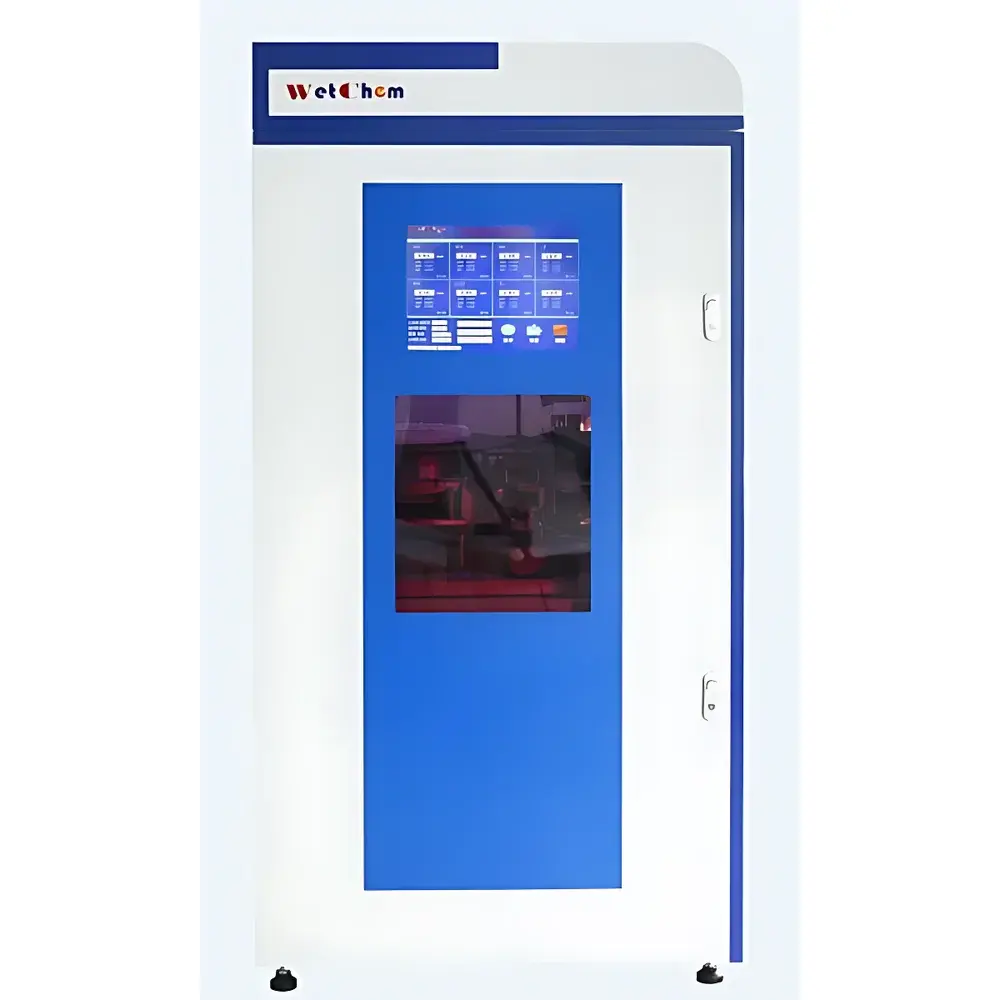
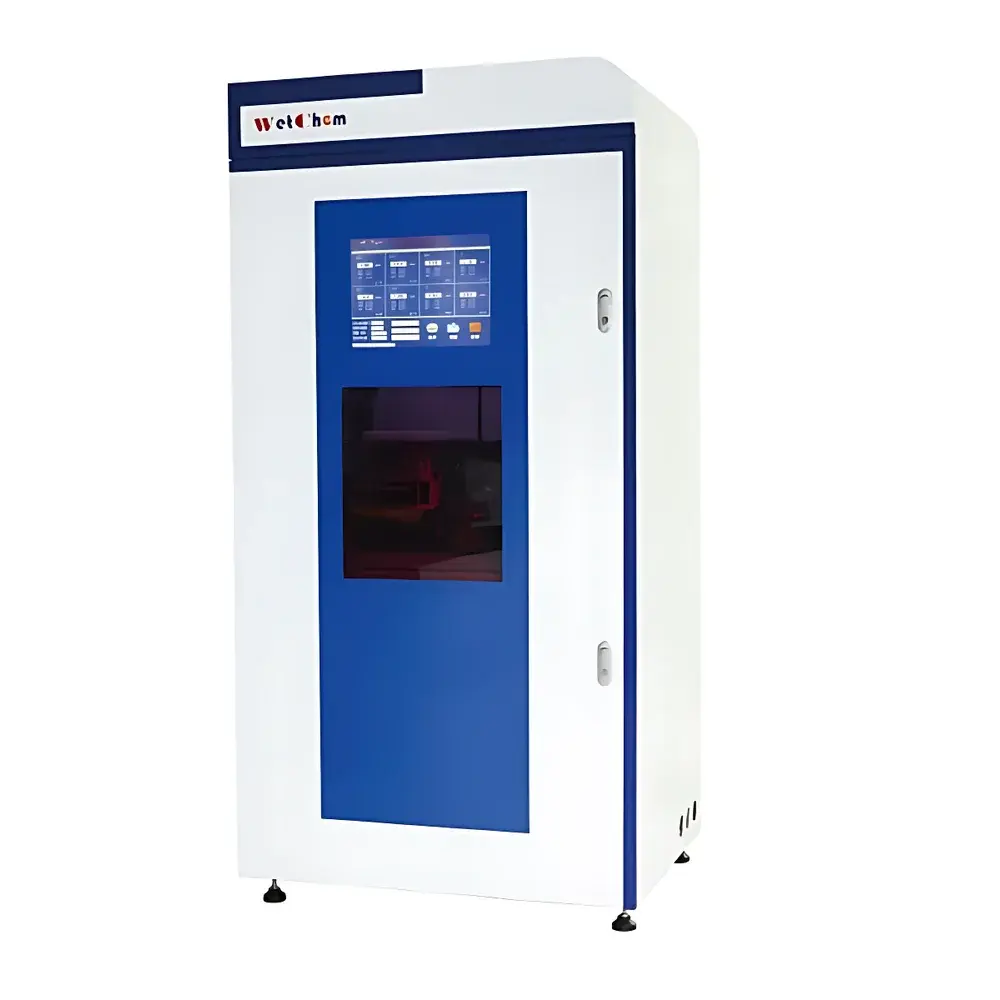
WetChem WetChem Online Discrete Analyzer
| Origin | Guangdong, China |
|---|---|
| Manufacturer Type | Authorized Distributor |
| Origin Category | Domestic (China) |
| Model | WetChem |
| Price Range | USD 98,000 – 140,000 |
| Instrument Type | Online Water Quality Analyzer |
| Analyte Categories | Inorganic ions (e.g., sulfide, sulfate, ammonia-nitrogen, nitrate, nitrite, phosphate, silicate, chloride, fluoride, alkalinity, Cr(VI)) |
Overview
The WetChem Online Discrete Analyzer is an automated, benchtop-integrated water quality monitoring system engineered for high-precision, multi-parameter chemical analysis in continuous or scheduled online operation. Unlike conventional flow-injection or segmented-flow analyzers, the WetChem platform employs discrete sampling and direct-read spectrophotometric detection—each sample is dispensed into a dedicated, optically calibrated cuvette where reagent addition, mixing, reaction incubation, and absorbance measurement occur in sequence under programmable thermal and timing control. This architecture eliminates cross-sample contamination, ensures stoichiometric consistency, and supports method-specific reaction kinetics—including temperature-sensitive assays (e.g., phenol-hypochlorite for ammonia-nitrogen) and redox-based determinations (e.g., diphenylcarbazide for hexavalent chromium). Designed for deployment at wastewater treatment plants, river monitoring stations, estuarine observatories, and industrial effluent outfalls, the system meets operational requirements for long-term unattended operation, regulatory data integrity, and trace-level quantification in complex matrices.
Key Features
- Multi-parameter discrete analysis: Simultaneous quantification of ≥8 chemical parameters per cycle without hardware modification—enabled by independent cuvette positioning, sequential reagent dispensing, and wavelength-switching photometry (340–900 nm).
- Background subtraction technology: Real-time blank correction using sample-derived reference cuvettes; accommodates salinity fluctuations up to 35 ppt, making it suitable for tidal estuaries and brackish water applications.
- Dedicated cuvette-based reaction: One sample → one cuvette → one measurement cycle; eliminates carryover via integrated ultrasonic + chemical wash station with programmable rinse cycles and optical verification of cleanliness.
- Auto-retention on exceedance: Integrated sample retention module triggers upon violation of user-defined thresholds—no external autosampler or cold storage required.
- Method scalability: New analytical protocols (e.g., EPA 365.4 for phosphate, ISO 15681-2 for orthophosphate, APHA 4500-NH₃ F for ammonia) can be deployed via software update without hardware retrofitting.
- Micro-volume reagent consumption: Typical reagent usage ≤100 µL per test; reduces chemical procurement frequency, waste volume, and disposal cost while maintaining method accuracy per ISO 5667-3 and ISO 8466-1.
- Sealed waste containment: Negative-pressure vented waste reservoir with acid-gas scrubbing capability; compliant with OSHA HAZCOM and IEC 61000-6-4 electromagnetic compatibility standards.
Sample Compatibility & Compliance
The WetChem analyzer accepts raw, filtered (≤80 µm), or centrifuged aqueous samples across pH 4–11 and turbidity ≤500 NTU. It is validated for use with municipal wastewater, surface water, groundwater, seawater-influenced estuaries, and industrial process streams. All onboard methods adhere to internationally recognized performance criteria: detection limits conform to EPA Method Detection Limit (MDL) protocols; precision meets ISO 5725-2 repeatability requirements (RSD ≤5% at 3× MDL); linearity is verified per ASTM D5173 over ≥3 orders of magnitude. The system supports audit-ready data generation aligned with GLP and GMP principles, including full electronic records of instrument status, calibration history, reagent lot tracking, and operator actions—fully compatible with FDA 21 CFR Part 11-compliant LIMS integration.
Software & Data Management
Control and data acquisition are managed via WetChem Control Suite v4.x—a Windows-based application supporting remote configuration, method scheduling, real-time QC charting (Shewhart X-bar/R charts), and automated report generation in PDF/CSV/XLSX formats. All measurements include embedded metadata: timestamp, cuvette ID, reagent batch, temperature log, photometric baseline drift compensation value, and flagging for outlier rejection (Dixon’s Q-test). Raw spectral scans (absorbance vs. wavelength) are stored for retrospective validation. Data export interfaces include Modbus TCP, OPC UA, and HTTP REST API for seamless integration into SCADA, EMS, or cloud-based environmental dashboards (e.g., AWS IoT SiteWise, Azure IoT Central).
Applications
- Real-time compliance monitoring at NPDES and EU Urban Wastewater Treatment Directive (UWWTD) discharge points
- Dynamic nutrient load assessment in eutrophic lakes and coastal zones
- Process control feedback loops in biological nutrient removal (BNR) and tertiary filtration systems
- Reference-grade intercomparison between online sensors and laboratory benchtop analyzers (e.g., ICP-MS, HPLC)
- Long-term trend analysis for TMDL implementation and climate-driven water quality shifts
- Emergency response screening during chemical spills or algal bloom events
FAQ
What regulatory standards does the WetChem analyzer support?
It supports method validation per EPA, ISO, APHA, and DIN standards applicable to each measured parameter—including EPA 300.0 (anions), EPA 353.2 (nitrate/nitrite), ISO 11908 (COD), and ISO 11905-1 (total nitrogen).
Can the system operate unattended for extended periods?
Yes—designed for 30-day continuous operation with automatic reagent replenishment alerts, cuvette health diagnostics, and remote firmware updates.
Is method validation documentation provided?
Each delivered system includes a Factory Acceptance Test (FAT) report, Certificate of Conformance, and parameter-specific Method Validation Packages (MVPs) covering accuracy, precision, LOD/LOQ, and matrix spike recovery.
How is calibration maintained during long-term deployment?
Calibration is performed using NIST-traceable standard solutions; drift correction is applied via daily bracketing calibrations and internal reference cuvettes with stable optical density.
Does the system support hazardous reagent handling?
Yes—integrated fume extraction, leak-detection sensors, and fail-safe valve sequencing prevent exposure during reagent delivery, especially for carcinogenic reagents (e.g., o-tolidine for nitrite, cadmium reduction columns for nitrate).







