
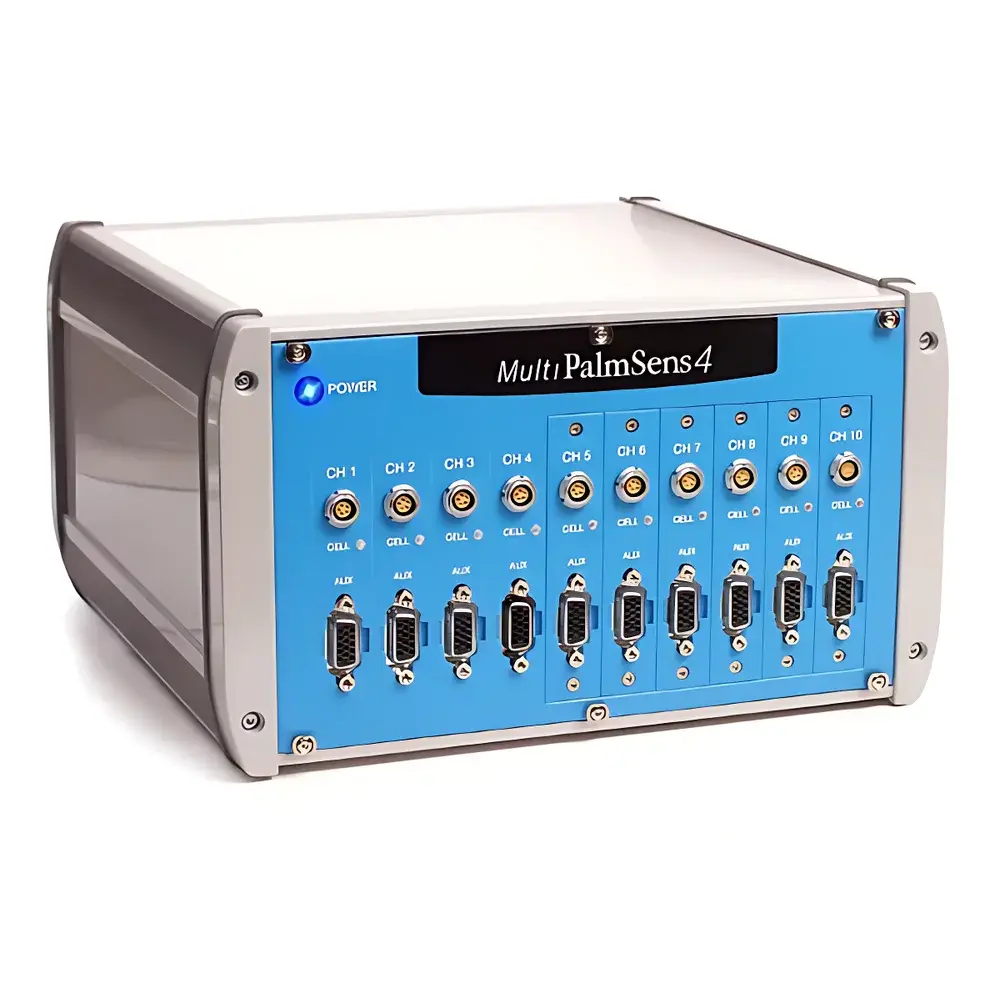
MultiPalmSens4 Multi-Channel Electrochemical Workstation with Integrated EIS Capability
| Brand | PalmSens |
|---|---|
| Origin | Netherlands |
| Model | MultiPalmSens4 |
| Channel Count | 4–10 configurable channels |
| Current Range | ±30 mA |
| Current Accuracy | ≤ 0.1% of full scale |
| Potential Accuracy | 0.01% of full scale |
| Potentiostatic Range | ±10 V |
| EIS Frequency Range | 10 μHz to 1 MHz |
| ADC Resolution | 18-bit (76.3 µV potential resolution, 5 fA current resolution at 100 pA range) |
| Data Acquisition Rate | up to 150,000 points/s |
| Onboard Memory per Channel | 8 GB |
| Compliance | CE, RoHS, ISO/IEC 17025-compatible operation environment |
Overview
The MultiPalmSens4 is a modular, high-fidelity multi-channel electrochemical workstation engineered for precision potentiostatic/galvanostatic control and advanced electrochemical impedance spectroscopy (EIS). Based on PalmSens’ proven PSTrace architecture and optimized for laboratory-scale parallel electrochemistry, it operates on the principle of controlled potential/current application across multiple working electrodes while maintaining galvanic isolation between channels. Each channel implements true independent analog front-end circuitry—including low-noise bipolar power supplies, high-input-impedance electrometers (>1 TΩ || 10 pF), and synchronized 18-bit ADC/DAC—enabling simultaneous acquisition without crosstalk. The system supports both single-cell and multi-electrode configurations, including shared reference and counter electrode setups in identical electrolyte environments—ideal for sensor array characterization, battery electrode screening, corrosion monitoring, and biosensor development where statistical reproducibility and inter-channel comparability are critical.
Key Features
- Scalable architecture: Base unit includes 4 fully isolated electrochemical channels; expandable to 10 channels via hot-swappable module slots.
- Full-spectrum EIS capability: Frequency range from 10 µHz to 1 MHz with programmable AC amplitude (1 mVrms to 0.25 Vrms) and phase resolution < 0.1°.
- High-resolution signal conditioning: 18-bit analog-to-digital conversion yields 76.3 µV potential resolution and as low as 5 fA current resolution (at 100 pA range); DC potential accuracy ≤ 0.01% FS, current accuracy ≤ 0.1% FS.
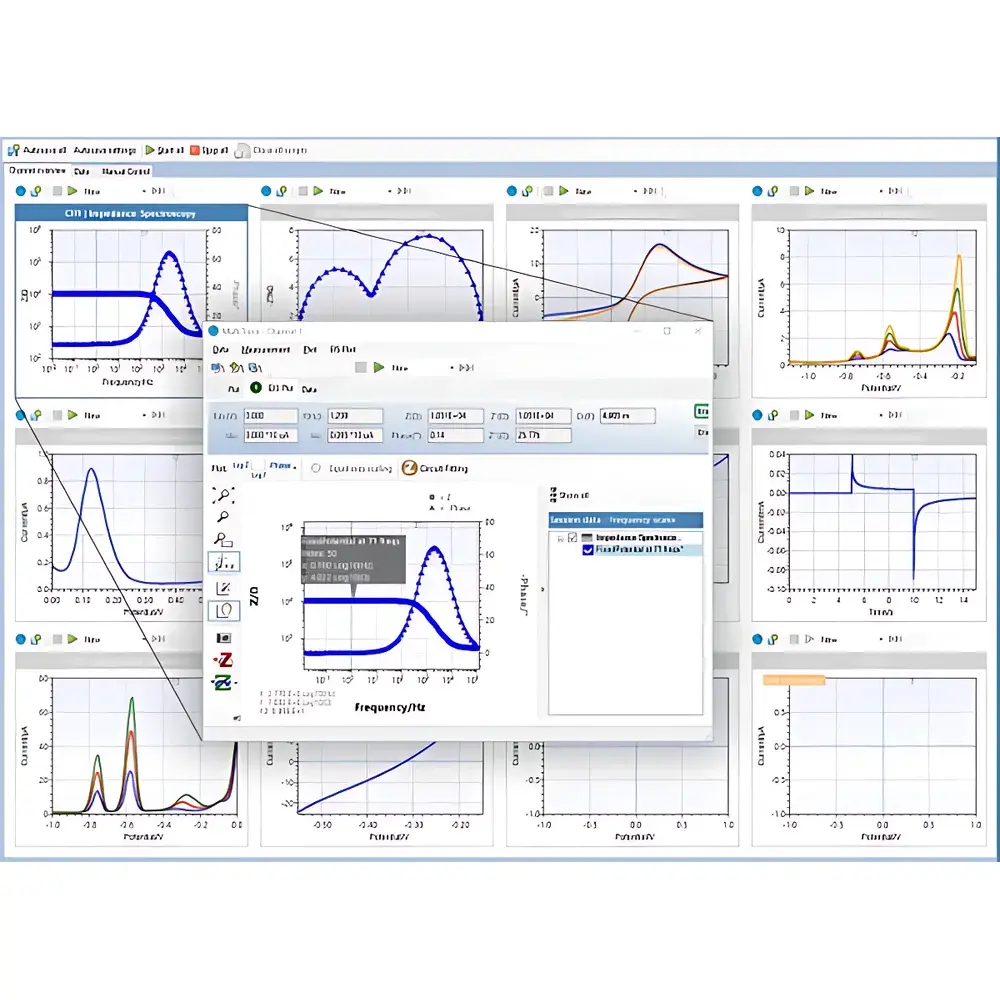
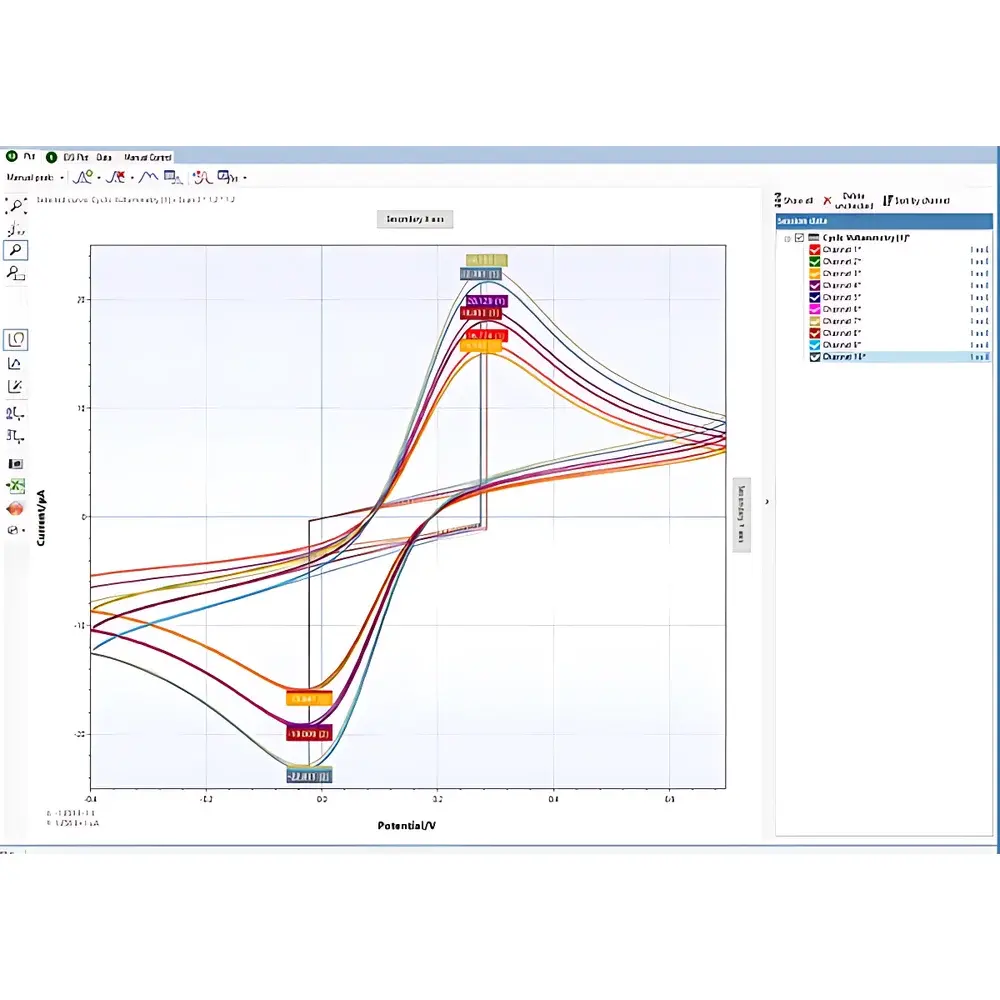
- Dual operational modes: Synchronized multi-channel acquisition (identical method applied across all active channels) or fully autonomous per-channel control with independent timing, waveform definition, and data file management.
- Onboard non-volatile memory: 8 GB per channel enables real-time data buffering during long-duration experiments (e.g., accelerated aging studies or low-frequency EIS), eliminating USB bandwidth bottlenecks.
- Integrated electrochemical method library: Supports >30 standardized techniques—including CV, LSV, DPV, SWV, NPV, CA, CP, OCP, ZRA, EIS, GEIS, and hybrid modes—with parameter validation aligned with ASTM E2917 and ISO 13885-1 conventions.
Sample Compatibility & Compliance
The MultiPalmSens4 accommodates standard three-electrode cells (WE/RE/CE), two-electrode configurations, and multi-working-electrode arrays within a single electrolyte bath—provided electrical isolation between WE terminals is maintained. It complies with CE marking requirements and adheres to electromagnetic compatibility (EMC) Directive 2014/30/EU and Low Voltage Directive 2014/35/EU. While not a GMP-certified instrument per se, its deterministic firmware behavior, audit-trail-capable software logging (via MultiTrace), and support for user-defined method templates make it suitable for GLP-regulated environments. Data integrity meets ALCOA+ principles when used with validated export workflows to Origin or Excel—particularly relevant for academic publication, patent support, or preclinical sensor qualification under ISO 15197:2013.
Software & Data Management
MultiTrace software—built upon the PSTrace foundation—provides dual-mode experiment orchestration: “Group Mode” applies identical protocols across selected channels with synchronized start/stop and consolidated .mtd data files; “Independent Mode” assigns unique methods, sampling rates, and storage paths per channel. All sessions record metadata (timestamp, firmware version, calibration history, user ID) and support scripting (Python API via PyPalmSens) for automated sequence execution (e.g., cyclic stability testing with incremental voltage sweeps). EIS data undergo real-time Kramers–Kronig validation and include built-in equivalent circuit fitting using Randles, transmission line, and custom topologies—with χ² minimization and confidence interval estimation. Raw current/potential waveforms, FFT spectra, and Nyquist/Bode plots export in CSV, TXT, or proprietary .mtd format; no proprietary viewer required for ASCII exports.
Applications
- Battery R&D: Parallel evaluation of cathode/anode material libraries under identical cycling conditions; SEI growth kinetics via low-frequency EIS (10–100 mHz).
- Corrosion science: Multi-electrode noise resistance mapping in chloride-containing media; localized pitting onset detection using zero-resistance ammetry (ZRA) coupled with OCP monitoring.
- Biosensor development: High-throughput screening of immobilized enzyme layers or aptamer-functionalized electrodes using DPV/SWV with internal reference correction.
- Electrocatalysis: Comparative HER/OER activity assessment across catalyst arrays with iR-compensated EIS and Tafel analysis.
- Environmental electroanalysis: Simultaneous heavy metal speciation (e.g., Pb²⁺, Cd²⁺, Cu²⁺) via anodic stripping voltammetry (ASV) using disposable screen-printed electrode arrays.
FAQ
Can all 10 channels perform EIS simultaneously at different frequencies?
Yes—each channel executes independent frequency sweeps or multi-sine EIS protocols with no timing or signal coupling constraints.
Is hardware calibration traceable to NIST standards?
PalmSens provides factory calibration certificates (traceable to national metrology institutes); users may perform two-point gain/offset verification using certified reference resistors and voltage sources.
Does the system support analog input/output for external device synchronization?
Yes—D-Sub 15 auxiliary port delivers four isolated digital I/O lines, ±10 V analog output (18-bit), 0–10 V analog input (12-bit), and dedicated EIS excitation monitoring outputs.
How is data security handled during long-term unattended operation?
Onboard 8 GB/channel memory ensures uninterrupted capture even during host PC disconnection; optional network-enabled remote monitoring via secure SSH tunneling is available through third-party integration.
Are method files compatible across PalmSens instrument generations?
MultiTrace maintains backward compatibility with PSTrace v5.x method definitions; legacy EmStat III/IV scripts require minor syntax updates for channel addressing syntax.
Related Products





