
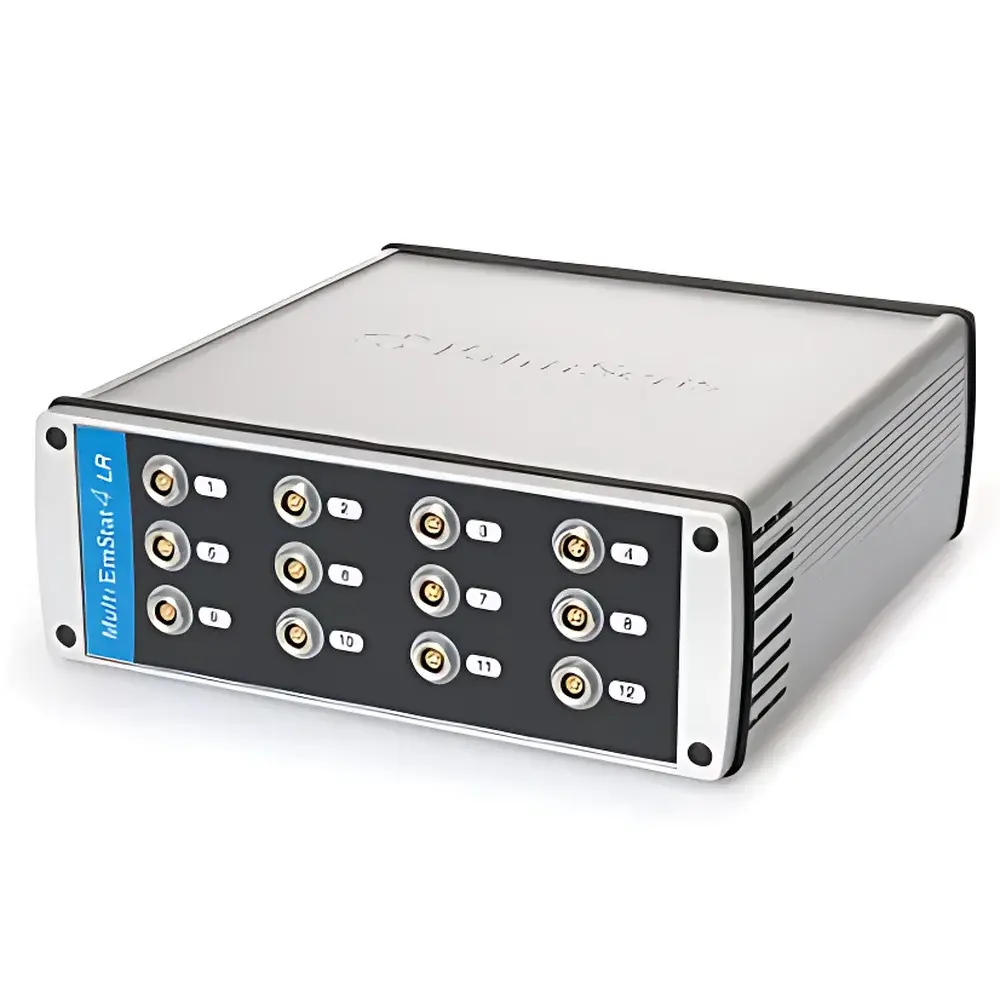
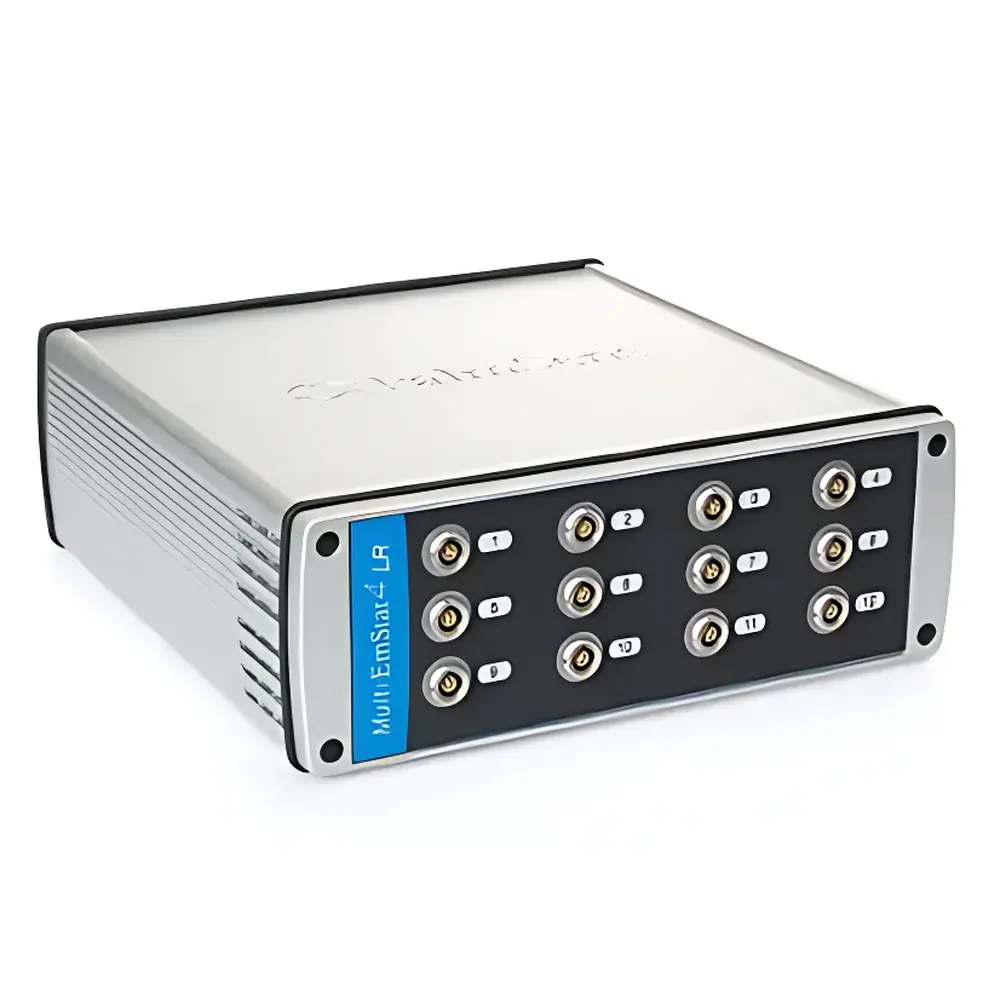
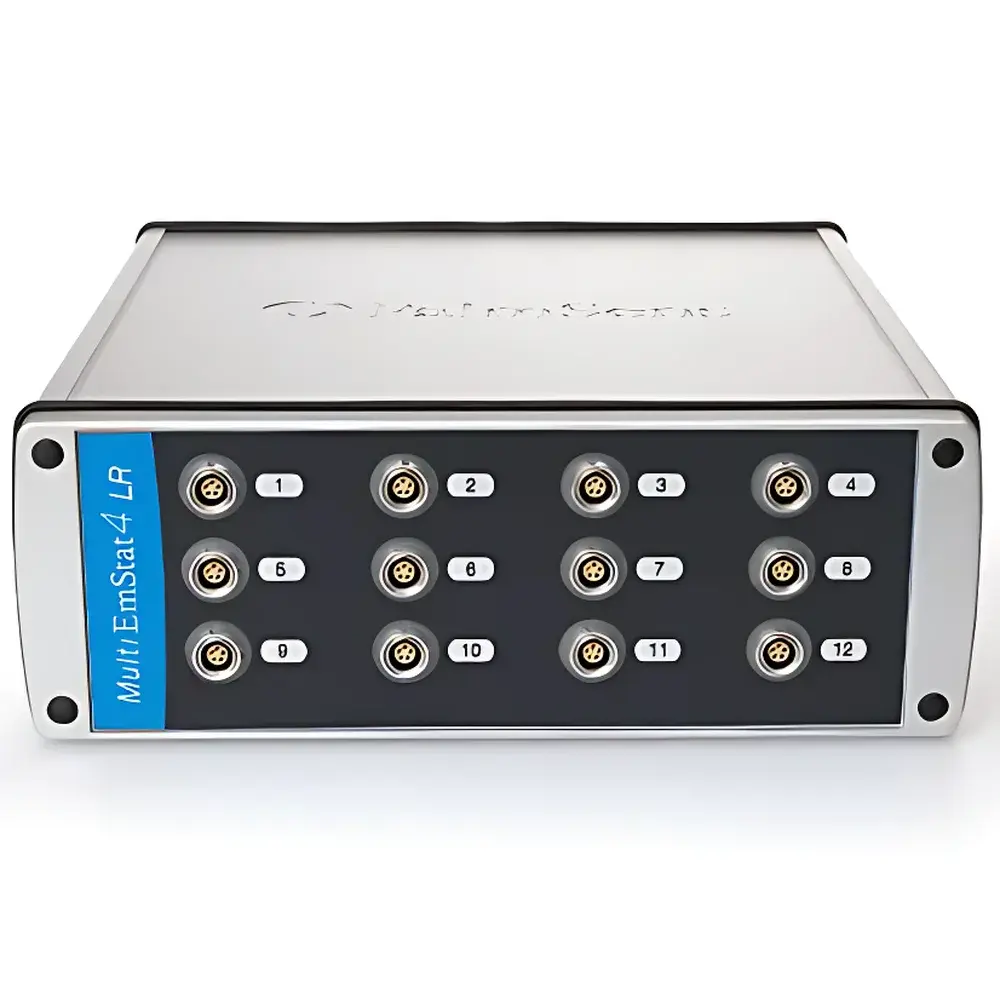
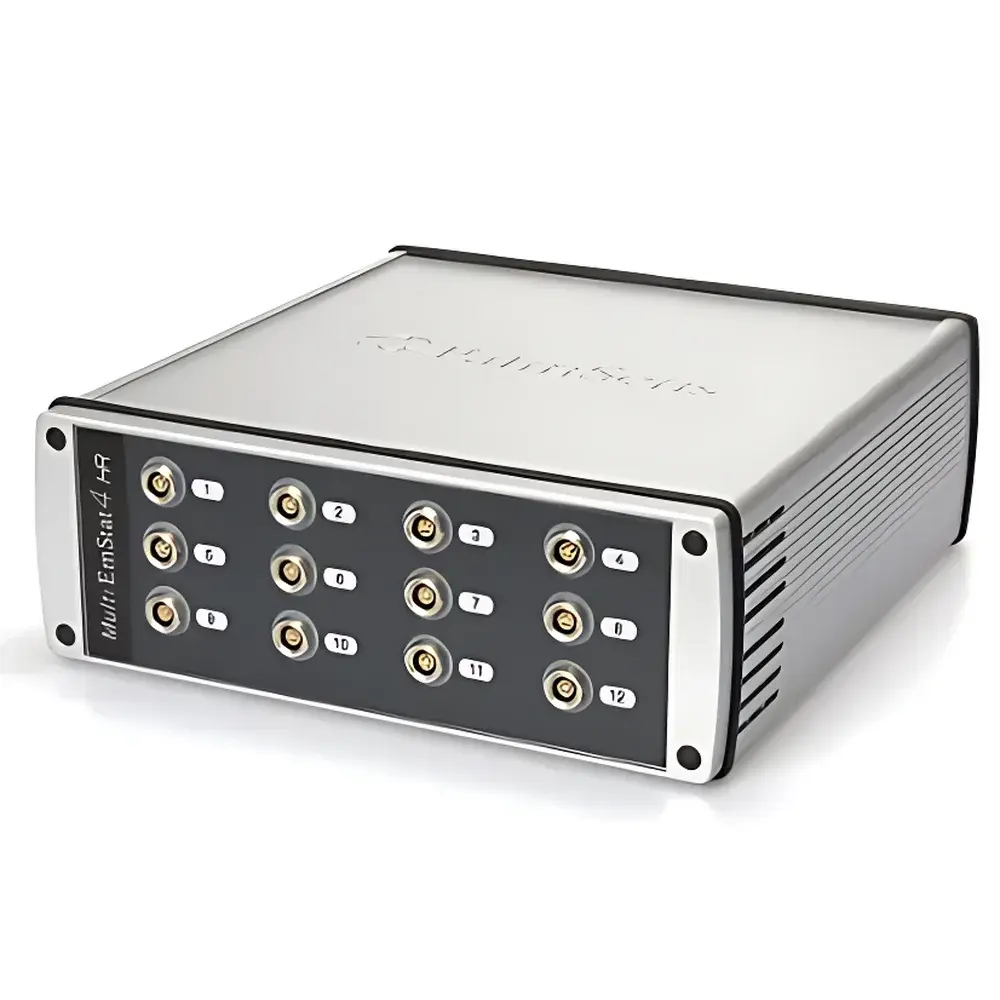
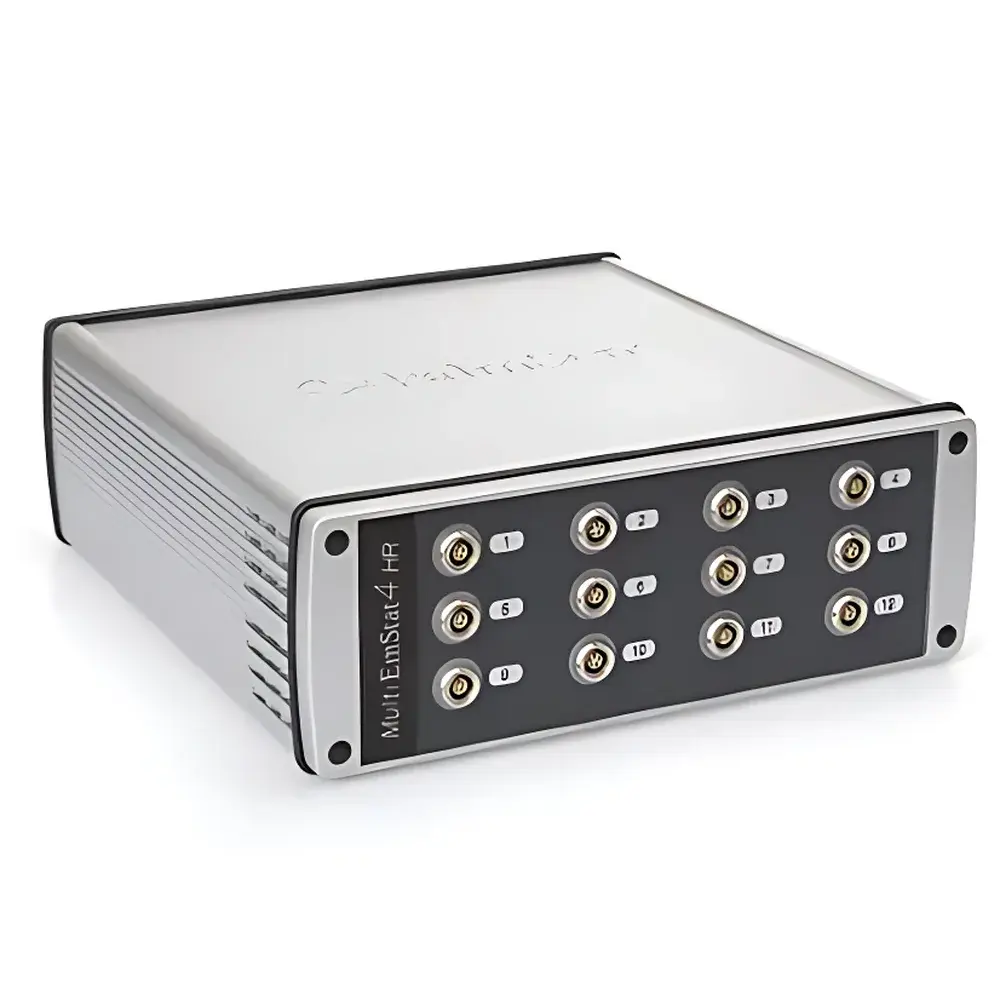
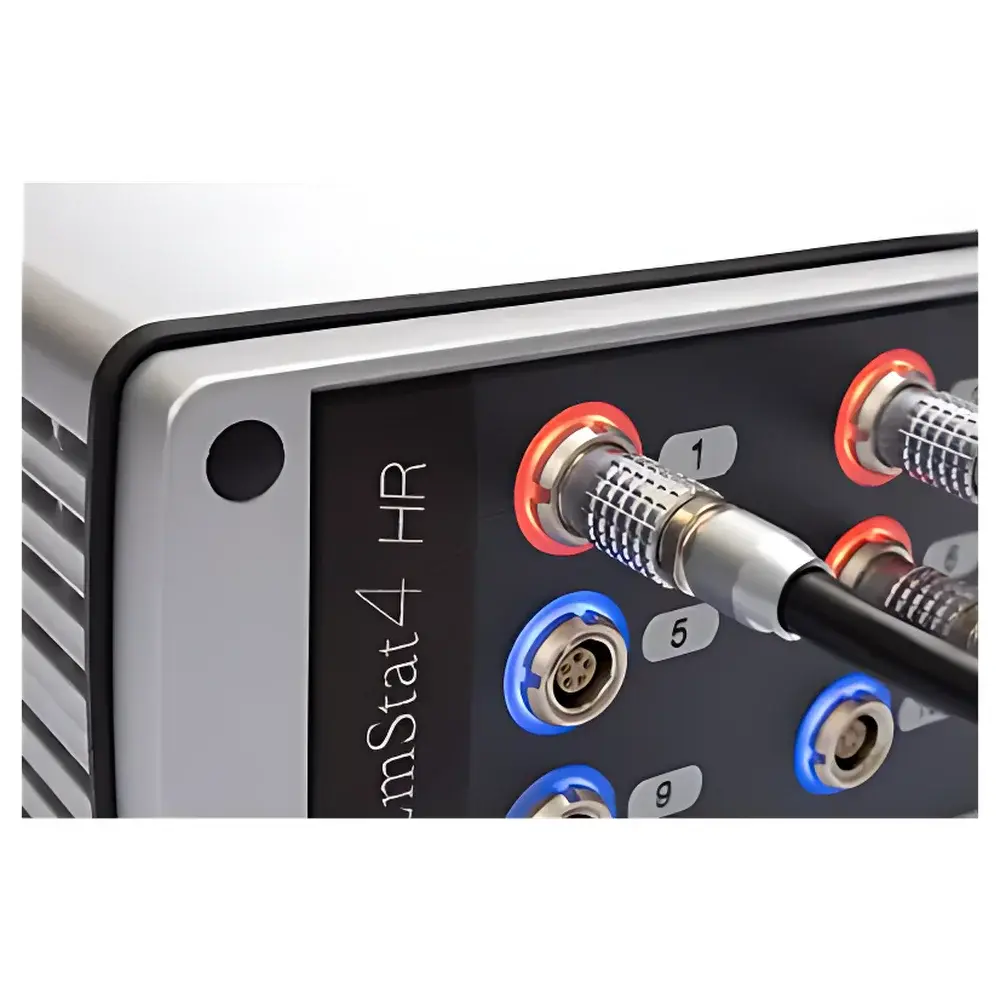
PalmSens MultiEmStat4 Multi-Channel Electrochemical Workstation
| Brand | PalmSens |
|---|---|
| Origin | Netherlands |
| Model | MultiEmStat4 |
| Channel Count | 4 / 8 / 12 (configurable) |
| Current Range | ±30 mA |
| Current Accuracy | ≤ 0.2% |
| Potential Accuracy | ≤ 0.2% |
| Potentiostatic Range | ±3 V |
| EIS Frequency Range | 10 µHz to 200 kHz |
Overview
The PalmSens MultiEmStat4 is a high-performance, modular multi-channel electrochemical workstation engineered for precision potentiostatic, galvanostatic, and electrochemical impedance spectroscopy (EIS) measurements. Built on a robust digital architecture with synchronized analog front-ends per channel, it enables true parallel operation—each channel operates with independent control of potential, current, and timing parameters without cross-talk or shared resource contention. Its core measurement principle relies on four-quadrant bipotentiostatic/galvanostatic feedback control, supporting both two-electrode and three-electrode configurations. Designed for research-grade electroanalysis and industrial QC environments, the MultiEmStat4 meets the stringent demands of corrosion monitoring, battery electrode screening, biosensor development, and electrocatalysis studies where reproducibility, temporal resolution, and channel scalability are critical.
Key Features
- True independent multi-channel operation: 4-, 8-, or 12-channel configurations available in Low-Resolution (LR) and High-Resolution (HR) variants, each with dedicated DAC/ADC, current-to-voltage converters, and programmable gain amplifiers.
- Simultaneous or asynchronous control modes: Select between “All Channels Identical” (synchronized waveform execution across all working electrodes sharing one counter and reference electrode) or “Per-Channel Independent” (fully decoupled experiments with unique method definitions, sampling rates, and trigger conditions).
- High-fidelity EIS capability: 10 µHz–200 kHz frequency range with phase accuracy < 0.3° and magnitude error < 0.1% over full current range; supports multi-sine and single-sine acquisition with automatic amplitude optimization.
- Comprehensive method library: Native support for 25+ standardized electrochemical techniques—including CV, LSV, DPV, SWV, NPV, CA, CP, OCP, ZRA, CC, MA, PAD, LSP, MP—with real-time parameter validation and method chaining.
- Open software ecosystem: Includes MultiTrace — a Windows-based application featuring Office-style ribbon interface, multi-tab data visualization, color-coded scan overlays, and auto-aligned curve superposition for comparative analysis.
- Full SDK access: Free, documented C#/.NET and Python SDK with source examples enables integration into custom LabVIEW, MATLAB, or Python-based automation frameworks; supports remote triggering, real-time data streaming, and dynamic method generation.
Sample Compatibility & Compliance
The MultiEmStat4 accommodates standard electrochemical cells (e.g., conventional three-electrode beakers, microfluidic flow cells, and screen-printed electrode arrays) via BNC and banana-jack terminals. All channels comply with IEC 61000-4-3 (EMC immunity) and CE/FCC safety directives. For regulated environments, MultiTrace supports audit-trail-enabled operation (user login, method versioning, timestamped raw data export) aligned with GLP and ISO/IEC 17025 documentation requirements. While not pre-certified for FDA 21 CFR Part 11, its deterministic data logging, immutable binary file format (.mtd), and optional digital signature module facilitate validation under GMP or pharmaceutical QA protocols.
Software & Data Management
MultiTrace v5.x provides dual-mode instrument control, offline data reprocessing, and advanced post-acquisition analysis. Data files store raw time-series points, metadata (instrument ID, firmware version, calibration timestamps), and full method definitions—enabling full experimental traceability. Built-in equivalent circuit fitting uses non-linear least-squares (Levenberg–Marquardt) with customizable R-C-L elements and distributed element models (e.g., transmission line, constant phase elements). Scripting functionality allows automated sequence execution (e.g., “OCP → CV → EIS → DPV”) with conditional branching based on real-time threshold detection. Export options include native .csv (Excel-compatible), OriginLab (.opj) templates, and HDF5 for large-scale dataset archiving. All curves and methods can be saved as reusable templates with embedded comments and SOP references.
Applications
- Battery R&D: Parallel evaluation of cathode/anode materials using identical cycling protocols across multiple electrodes to assess batch uniformity and degradation kinetics.
- Corrosion science: Simultaneous monitoring of localized pitting onset across spatially distributed microelectrodes in chloride-containing electrolytes.
- Biosensor validation: High-throughput screening of antibody-immobilized electrodes using DPV and EIS to quantify binding affinity and surface coverage heterogeneity.
- Electrocatalyst discovery: Rapid polarization curve acquisition (LSV) and Tafel analysis across 12 catalyst-coated electrodes under identical mass-transport conditions.
- Environmental electroanalysis: Field-deployable multi-analyte detection (e.g., Pb²⁺, Cd²⁺, Cu²⁺) via ASV using disposable screen-printed arrays with integrated reference systems.
FAQ
Can all channels perform EIS simultaneously with different frequencies?
Yes—each channel executes its own EIS sequence independently, including custom frequency lists, amplitude settings, and DC bias points.
Is hardware synchronization between channels possible for time-critical transient measurements?
The MultiEmStat4 supports external TTL triggering and internal master-slave clock distribution for sub-millisecond inter-channel alignment.
Does the SDK support real-time data streaming during long-term OCP monitoring?
Yes—the SDK exposes low-latency event-driven callbacks for live plotting, alarm thresholds, and database ingestion without interrupting acquisition.
Are calibration certificates traceable to NIST or EURAMET standards provided?
PalmSens delivers factory calibration reports with uncertainty budgets; users may request ISO/IEC 17025-accredited calibration through authorized partners.
Can MultiTrace import third-party EIS data for comparative circuit modeling?
Yes—it accepts common formats (Gamry .DTA, BioLogic .MPT, CHI .txt) and maps imported spectra to its built-in fitting engine with user-defined model constraints.





