
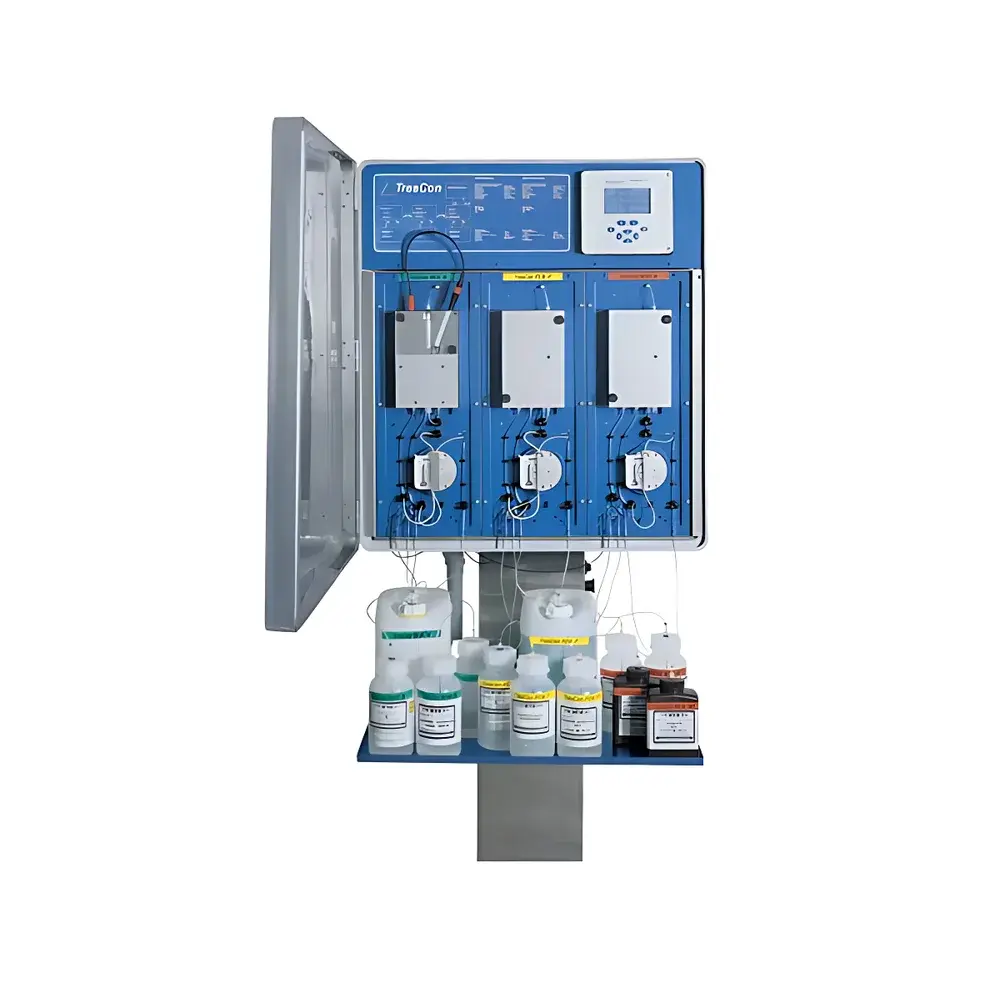
WTW TresCon Ammonia Nitrogen and Total Phosphorus Combined Online Analyzer
| Brand | WTW |
|---|---|
| Origin | Germany |
| Model | TresCon (NH₄-N + TP) |
| Instrument Type | Online Analyzer |
| Measurement Principle | Ammonia Gas-Sensing Electrode (NH₄-N) |
| Measurement Range | NH₄-N: 0.1–1000 mg/L |
| TP | 0.01–3.00 mg/L (standard), up to 6.00 mg/L with external dilution module |
| Accuracy | NH₄-N: ±5% of reading ±0.2 mg/L (<1.0 mg/L) |
| TP | ±3% of reading ±0.05 mg/L |
| Detection Limit | NH₄-N: 0.1 mg/L |
| TP | 0.01 mg/L |
| Minimum Cycle Time | 3 min (per parameter, configurable) |
| Sample Throughput | Up to 2 independent sample streams (expandable via multi-channel inlet manifold) |
| Compliance | Designed for continuous operation in accordance with EN ISO 15839, ASTM D1426 (ammonia), and ISO 6878 (total phosphorus) |
Overview
The WTW TresCon Ammonia Nitrogen and Total Phosphorus Combined Online Analyzer is an industrial-grade, modular water quality monitoring system engineered for unattended, long-term deployment in municipal and industrial wastewater treatment plants, surface water surveillance stations, and effluent compliance monitoring points. It implements two distinct, physically isolated analytical methodologies within a single chassis: selective ammonia gas-sensing electrode detection for ammonium nitrogen (NH₄-N), and standardized molybdenum blue colorimetric spectrophotometry for total phosphorus (TP). Unlike single-parameter analyzers or hybrid instruments relying on shared optical paths or reagent lines, the TresCon architecture maintains strict functional separation between NH₄-N and TP measurement modules—eliminating cross-contamination risk, minimizing inter-parameter interference, and enabling simultaneous, independent quantification at sub-minute temporal resolution. Its modular backbone supports integration of up to three analytical units (e.g., NH₄-N + TP + NO₃⁻ or pH/conductivity), allowing flexible adaptation to evolving regulatory reporting requirements without hardware replacement.
Key Features
- Independent dual-module design: 0A110 Ammonia Module and 0P510 Total Phosphorus Module operate autonomously with dedicated fluidic pathways, calibration routines, and temperature-controlled reaction zones.
- Ammonia measurement via gas-diffusion amperometry: Sample alkalization and membrane-separated NH₃ diffusion ensure immunity to turbidity, color, chloride, sulfide, and variable pH (pH 6.0–9.5 operational range).
- Total phosphorus digestion and detection: Integrated high-temperature UV/persulfate digestion (120 °C, 30 min) followed by molybdenum antimony blue complex formation and 880 nm absorbance measurement.
- Active thermal management: Peltier-cooled reagent storage compartment (4 °C ± 1 °C) for TP reagents; precision thermostatic control (±0.2 °C) of NH₃ electrode chamber and colorimetric cuvette.
- Intelligent cycle optimization: Adaptive sampling interval adjustment based on concentration drift rate—reducing reagent consumption by up to 40% during stable conditions while maintaining 3-minute minimum response latency.
- Self-diagnostic fluidics: Pressure-sensing peristaltic pump monitoring detects tubing occlusion, leakage, or low-level sampling; automatic air bubble rejection and zero-point validation prior to each measurement.
Sample Compatibility & Compliance
The TresCon analyzer accepts raw influent, secondary effluent, tertiary treated water, and surface water samples with suspended solids ≤ 100 mg/L (pre-filtration recommended above this threshold). It complies with EN ISO 15839 for performance verification of online water quality sensors, and its measurement protocols align with ASTM D1426-22 (ammonia) and ISO 6878:2004 (total phosphorus). All calibration and maintenance events are timestamped and logged with operator ID, method version, and QC reference values—enabling full traceability under GLP and GMP frameworks. When paired with WTW’s IQ SensorNet 2.0 platform, data integrity meets FDA 21 CFR Part 11 criteria, including electronic signature enforcement and immutable audit trails.
Software & Data Management
Instrument control, method configuration, and real-time data visualization are managed through WTW’s web-based TresCon Control Center (TCC) software, accessible via secure HTTPS from any modern browser. TCC supports multi-user role-based access (admin, operator, viewer), customizable alarm thresholds (high/low, rate-of-change), and automated report generation in PDF/CSV formats compliant with EU Water Framework Directive Annex V templates. Raw absorbance, electrode potential, temperature, and pressure logs are stored locally on encrypted SD card (≥1 year retention) and synchronizable to cloud-based LIMS via Modbus TCP or OPC UA. Firmware updates include cryptographic signature validation to prevent unauthorized modification.
Applications
- Real-time compliance monitoring at WWTP inlet and final discharge points per EU Urban Wastewater Treatment Directive (91/271/EEC) and US EPA NPDES permit limits.
- Process optimization in biological nutrient removal (BNR) systems—correlating NH₄-N depletion kinetics with TP removal efficiency across aerobic/anoxic zones.
- Early-warning detection of sewer infiltration events via rapid NH₄-N spikes in stormwater-impacted flows.
- Long-term eutrophication trend analysis in lakes and reservoirs using synchronized TP/NH₄-N ratio tracking.
- Validation of decentralized treatment units (e.g., membrane bioreactors, constructed wetlands) where space-constrained installations demand multi-analyte capability.
FAQ
What sample pretreatment is required prior to analysis?
No filtration is mandatory for typical secondary effluents; however, a 100-µm inline sieve is recommended for raw sewage to prevent particulate clogging. Acid preservation or refrigerated transport is not required for routine <24-hour holding.
Can the instrument operate unattended for extended periods?
Yes—calibration intervals are programmable up to 24 hours, reagent reserves support ≥30 days of continuous operation at 15-min cycle time, and self-cleaning cycles activate automatically after every 10 measurements.
How does the system handle high-turbidity or colored samples?
The NH₄-N module is inherently insensitive to optical interference; the TP module employs background correction algorithms using dual-wavelength referencing (700 nm reference channel) to compensate for non-specific absorbance from humic substances or suspended solids.
Is remote firmware update supported?
Firmware upgrades are performed via secure HTTPS upload through TCC; all binaries are digitally signed and validated before installation to ensure system integrity and regulatory compliance.
What certifications does the analyzer hold for hazardous area installation?
The base unit carries CE marking per EMC Directive 2014/30/EU and Low Voltage Directive 2014/35/EU; ATEX/IECEx certification requires optional explosion-proof enclosure (model TresCon-EX), sold separately.







