
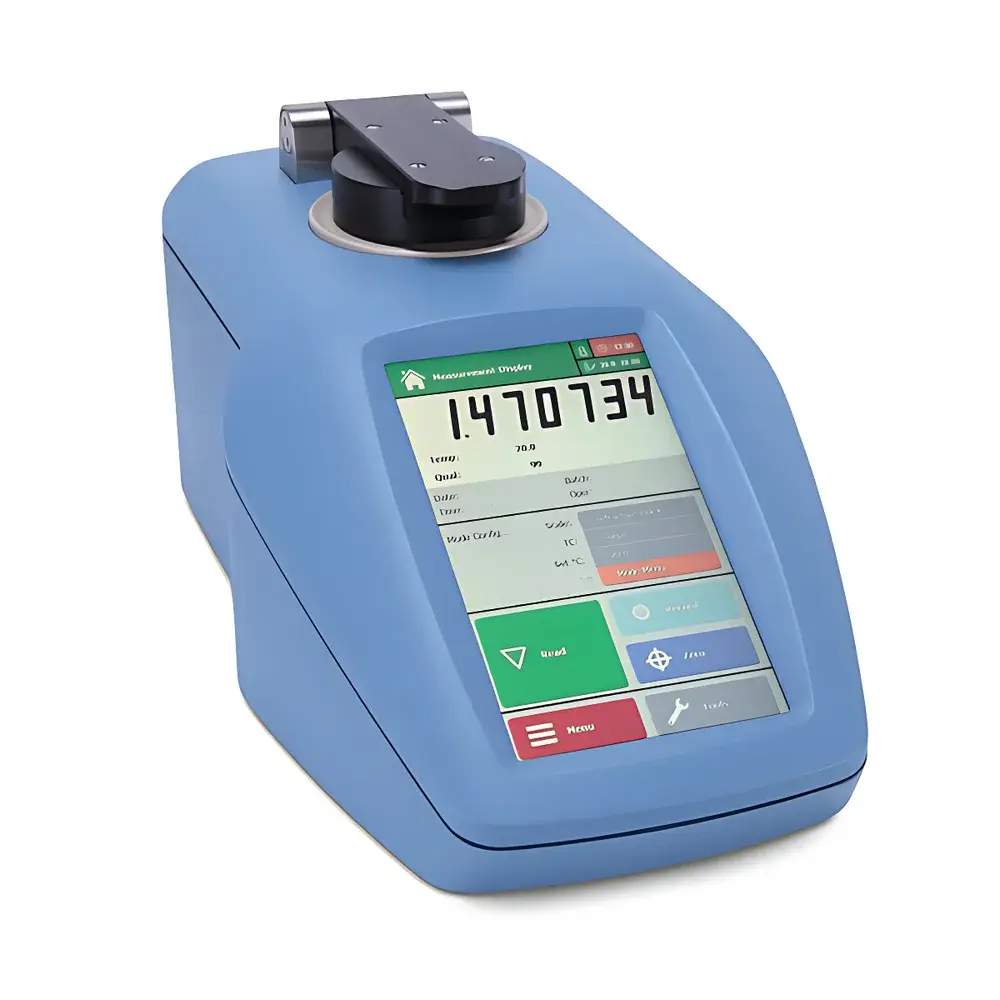
B+S RFM960-T Benchtop Digital Refractometer
| Brand | Bellingham + Stanley |
|---|---|
| Origin | United Kingdom |
| Model | RFM960-T |
| Instrument Type | Benchtop Refractometer |
| Temperature Control | Peltier-based, active stabilization |
| Display | Touchscreen LCD |
| Measurement Range | Refractive Index (RI) 1.300000–1.700000 |
| °Brix | 0.00–100.00 |
| Resolution | RI 0.000001 (1 ppm), °Brix 0.01 |
| Accuracy | ±0.0001 RI / ±0.1 °Brix |
| Sample Interface | Low-profile sample stage with non-contact pneumatic cover |
| Data Storage | 8,000+ measurements with timestamp, user ID, and temperature metadata |
| User Authentication | RFID card reader integrated into top panel |
| Compliance | Designed for GLP/GMP environments |
Overview
The B+S RFM960-T is a high-precision benchtop digital refractometer engineered for laboratories requiring traceable, repeatable refractive index and °Brix measurements across demanding industrial and research applications. It operates on the principle of total internal reflection at the prism–sample interface, where incident light undergoes critical angle shift proportional to the sample’s refractive index. This optical configuration—combined with a stabilized 589 nm sodium-D line equivalent LED source and high-resolution linear CCD array detection—enables measurement resolution down to 1×10⁻⁶ RI units (0.000001) and 0.01 °Brix. Unlike traditional Abbe refractometers, the RFM960-T eliminates manual scale reading and subjective interpretation, delivering objective, digitally captured results fully traceable to NIST-traceable calibration standards. Its design prioritizes metrological integrity: temperature equilibrium is enforced via dual-sensor Peltier control—monitoring both prism surface and ambient chamber—ensuring measurement only initiates when thermal stability (±0.02 °C) is confirmed.
Key Features
- Peltier temperature control system with intelligent thermal management: maintains prism temperature between 10 °C and 40 °C (±0.02 °C), enabling precise temperature-dependent RI studies and compliance with ASTM D1218 and ISO 2859-1 protocols.
- Non-contact pneumatic sample cover actuation: minimizes mechanical wear, prevents sample contamination, and enables hands-free operation—critical in high-throughput QC labs handling corrosive or volatile solvents.
- Integrated RFID authentication: users authenticate via proximity card swipe at instrument top panel; logs user identity automatically with each measurement, supporting multi-user accountability and 21 CFR Part 11-compliant electronic records.
- Low-profile stainless-steel sample stage: optimized for minimal sample volume (as low as 0.5 mL), rapid cleaning, and compatibility with viscous or particulate-laden samples common in pharmaceutical suspensions and essential oil formulations.
- Onboard data management: stores up to 8,192 measurements with full metadata—including timestamp, operator ID, temperature, RI, °Brix, and instrument serial number—exportable via USB or Ethernet to LIMS or ELN systems.
Sample Compatibility & Compliance
The RFM960-T accommodates aqueous solutions, organic solvents (e.g., ethanol, acetone, chloroform), polymer melts, glycerol-based formulations, and emulsions—provided they are optically transparent at 589 nm and non-abrasive to sapphire prism surfaces. Its wide RI range (1.300000–1.700000) supports analysis of specialty chemicals such as fluorinated solvents (e.g., FC-72, RI ≈ 1.27–1.29) and high-index resins (e.g., epoxy monomers, RI > 1.55). The instrument conforms to ISO 17025 calibration traceability requirements when serviced by UKAS-accredited providers. Its firmware architecture supports configurable audit trails, electronic signatures, and role-based access control—meeting foundational expectations for GLP-regulated environments in pharmaceutical development (ICH Q5C) and quality control (USP ).
Software & Data Management
The RFM960-T operates autonomously but integrates seamlessly with B+S RefraLink™ PC software (Windows 10/11, 64-bit) for advanced reporting, statistical process control (SPC), and method validation. RefraLink™ generates IQ/OQ documentation templates aligned with GAMP5 guidelines and exports CSV, PDF, and XML formats compliant with LIMS ingestion schemas. All stored measurements include embedded calibration certificate IDs and temperature-stamped validity flags. When connected to a networked environment, the instrument supports scheduled remote calibration verification and firmware update deployment via secure HTTPS endpoints—eliminating manual intervention during routine maintenance cycles.
Applications
- Pharmaceutical: concentration monitoring of API solutions, excipient purity verification (e.g., sucrose, mannitol), and formulation stability assessment under accelerated temperature conditions.
- Petrochemical: hydrocarbon blend verification (e.g., biodiesel FAME content estimation via RI correlation), solvent recovery efficiency tracking, and crude oil fraction characterization.
- Food & Flavor: real-time °Brix quantification in juice concentrates, syrup density profiling, and essential oil adulteration screening (e.g., detecting dilution with citrus terpenes).
- Academic Research: polymer solution thermodynamics (e.g., LCST/UCST behavior), nanoparticle dispersion stability analysis, and solvent–polymer interaction parameter derivation using Flory–Huggins modeling.
FAQ
Does the RFM960-T support automatic temperature compensation (ATC) for non-standard measurement temperatures?
Yes—the instrument applies real-time ATC using built-in temperature coefficients for over 200 common substances, selectable from an onboard library or customizable via user-defined polynomial equations.
Can the RFID authentication be disabled for shared-lab environments without compromising data integrity?
RFID is optional; manual user selection remains available. However, disabling RFID forfeits automated operator attribution required for 21 CFR Part 11 compliance in regulated workflows.
What is the recommended recalibration interval under continuous 8-hour daily use?
B+S recommends quarterly verification against certified NIST-traceable standards (e.g., Cargille RI liquids, batch-certified) and annual full recalibration by an authorized service center.
Is the sapphire prism replaceable by end users?
No—prism replacement requires factory recalibration and optical alignment verification; field service is performed exclusively by B+S-certified engineers.
Does the instrument meet IP rating requirements for humid laboratory environments?
The RFM960-T carries an IP42 rating, protecting against vertically falling water droplets and solid objects ≥1 mm—suitable for standard analytical lab conditions but not wet-process or cleanroom ISO Class 5+ environments.



