
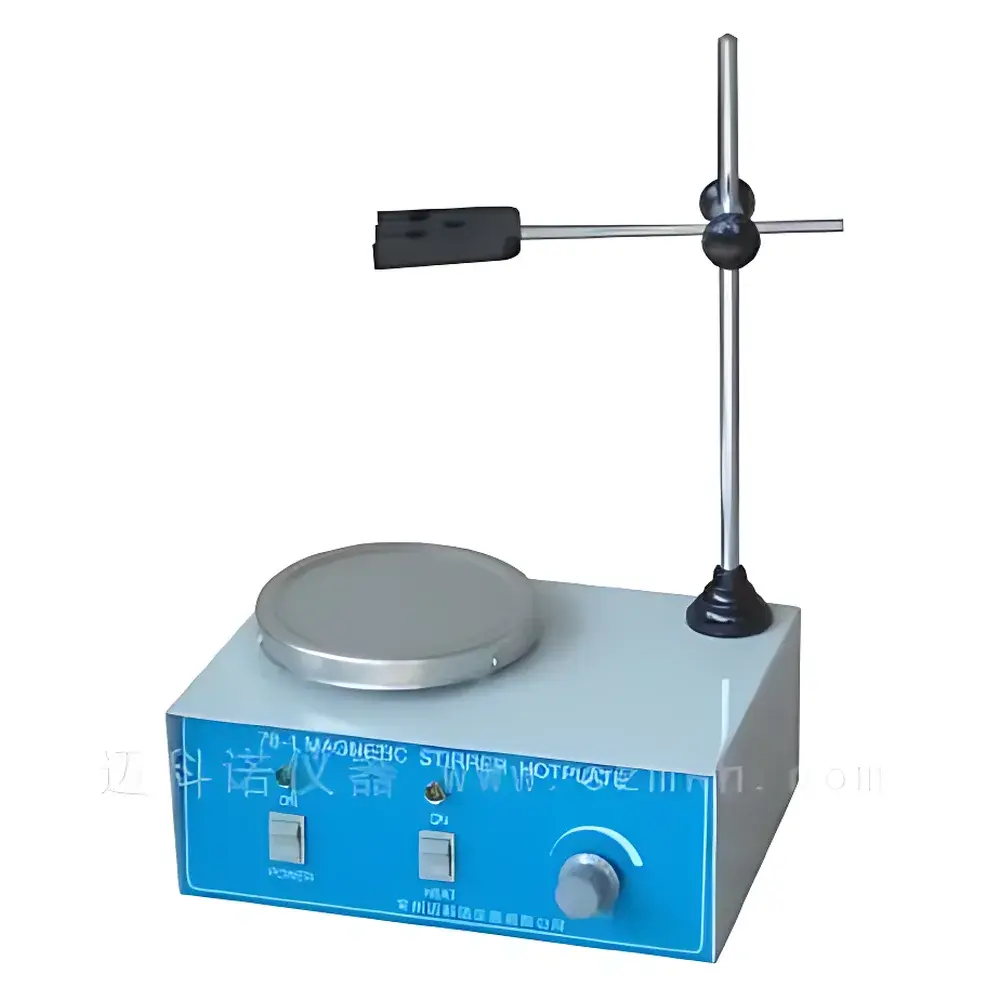
MKN 78-2 Dual-Direction Magnetic Hotplate Stirrer
| Brand | MKN |
|---|---|
| Model | 78-2 |
| Power Supply | 220 V ±10%, 50 Hz ±2% |
| Max. Volume | 3000 mL |
| Speed Range | 0–2000 rpm, infinitely variable, bidirectional |
| Heating Power | 200 W |
| Motor Power | 25 W |
| Stirring Plate Material | Stainless Steel |
| Stir Bar Compatibility | PTFE-coated magnetic stir bars with high-temp and chemically resistant construction |
| Origin | Jiangsu, China |
Overview
The MKN 78-2 Dual-Direction Magnetic Hotplate Stirrer is an engineered solution for precise, reproducible liquid mixing and temperature-controlled homogenization in analytical, quality control, and research laboratories. Designed around a brushless DC motor architecture, it delivers silent operation, extended service life, and exceptional speed stability across its full 0–2000 rpm range. Unlike traditional AC-driven units, the brushless motor eliminates carbon brush wear, reducing maintenance requirements and enhancing long-term torque consistency—critical for viscous or dense suspensions. The dual-direction rotation capability enables controlled agitation of heterogeneous systems where unidirectional shear may induce phase separation or particle settling; this feature is particularly valuable during dissolution testing, catalyst suspension, or polymer blending protocols. Integrated resistive heating (200 W) provides uniform thermal distribution across the stainless steel plate surface, supporting applications requiring simultaneous stirring and temperature stabilization from ambient to ~150 °C (dependent on vessel geometry and ambient conditions). Its compact footprint and sealed-drive design permit safe operation under partial containment—such as inside fume hoods or glove boxes—without compromising performance or operator safety.
Key Features
- Brushless DC motor ensuring low acoustic emission (<45 dB(A) at 1 m), zero brush dust generation, and high-speed repeatability (±1% setpoint deviation at steady state)
- Bidirectional rotation mode programmable via front-panel toggle switch—supports alternating clockwise/counterclockwise cycles to minimize vortex formation and improve bulk mixing efficiency
- Stainless steel heating plate (304 grade) with corrosion-resistant surface finish, optimized for thermal conductivity and mechanical durability
- Infinitely variable speed control with analog potentiometer interface, enabling fine-grained adjustment without digital latency or step discontinuities
- PTFE-encapsulated magnetic stir bars (sold separately) compatible up to 250 °C and resistant to strong acids, bases, and organic solvents per ASTM D543 standards
- Overheat protection circuitry automatically deactivates heating element if plate surface exceeds safe thermal threshold (typically >180 °C)
Sample Compatibility & Compliance
The MKN 78-2 accommodates standard laboratory glassware—including beakers (20–3000 mL), Erlenmeyer flasks, and jacketed reactors—when used with appropriately sized magnetic stir bars. Its non-contact drive mechanism eliminates shaft seals and mechanical couplings, eliminating cross-contamination risk and enabling use with sealed or pressurized vessels (e.g., Schlenk tubes, reactor vials). The unit complies with IEC 61010-1:2010 for electrical safety in laboratory equipment and meets EMC requirements per CISPR 11 Group 1, Class B. While not certified for GMP environments out-of-the-box, its stable speed profile and thermal response support method validation under USP , ISO/IEC 17025, and internal SOPs governing dissolution, extraction, or buffer preparation workflows.
Software & Data Management
As a standalone analog instrument, the MKN 78-2 does not incorporate embedded microprocessors, USB interfaces, or data logging functionality. This design prioritizes operational robustness, electromagnetic immunity, and compliance with environments where digital components may introduce RF interference (e.g., near NMR spectrometers or electrophysiology rigs). All parameter adjustments are made manually via tactile controls; no firmware updates, password locks, or audit trails are implemented. For laboratories requiring electronic recordkeeping, integration with external data acquisition systems (e.g., LabVIEW or PLC-based SCADA) is achievable using optional analog voltage output modules (0–10 VDC proportional to speed or temperature)—though such modules are not included with the base unit.
Applications
- Preparation of calibration standards and reference solutions in environmental, pharmaceutical, and food testing labs
- Dissolution testing of solid dosage forms per USP Apparatus II protocols (with appropriate vessel mounting)
- Homogenization of colloidal suspensions, nanoparticle dispersions, and enzyme reaction mixtures
- Extraction procedures involving Soxhlet-compatible solvents or aqueous-organic biphasic systems
- Temperature-dependent kinetic studies where synchronized heating/stirring minimizes thermal gradients
- Routine buffer equilibration and reagent blending in molecular biology and cell culture workflows
FAQ
Is the MKN 78-2 suitable for use with corrosive reagents such as concentrated HNO₃ or HF?
Yes—provided that PTFE- or ETFE-coated stir bars and chemically inert glassware are employed. The stainless steel plate surface resists mild corrosion but should be wiped clean immediately after exposure to aggressive agents.
Can the unit maintain constant temperature without external feedback?
No. It operates in open-loop heating mode; temperature stability depends on ambient conditions, vessel thermal mass, and insulation. For closed-loop control, pairing with an external PID controller and PT100 probe is recommended.
Does bidirectional operation affect stirring efficiency in high-viscosity media?
Empirical testing shows improved suspension uniformity in >500 cP fluids compared to unidirectional mode, particularly when combined with intermittent dwell intervals between direction changes.
What is the expected service life of the brushless motor under continuous operation?
Rated for >20,000 hours MTBF at rated load and ambient temperatures ≤35 °C, per manufacturer’s accelerated life testing per MIL-HDBK-217F.
Is CE marking applied to this device?
The unit conforms to relevant EU directives (EMC, LVD), but formal CE documentation is issued only upon request and subject to end-user country-specific import regulations.



