
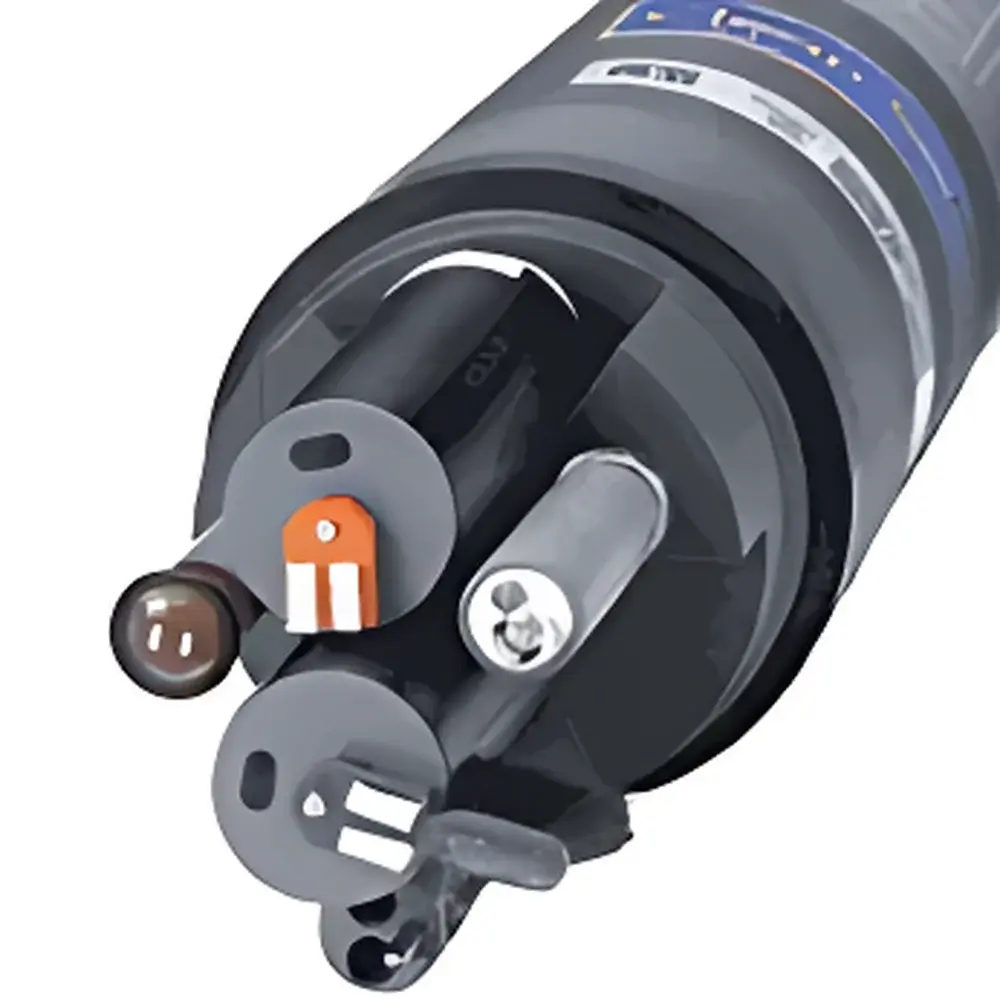
YSI 6600EDS Multi-Parameter Water Quality Monitoring Sonde
| Brand | YSI |
|---|---|
| Origin | USA |
| Model | YSI 6600EDS |
| DO Range (sat.) | 0–500% (±2% or 2% sat., whichever greater, 0–200%) |
| DO Range (mg/L) | 0–50 mg/L (±2% or 0.2 mg/L, 0–20 mg/L) |
| Conductivity | 0–100 mS/cm (±0.5% + 0.001 mS/cm) |
| Temperature | −5 to 50 °C (±0.15 °C) |
| pH | 0–14 (±0.2) |
| ORP | −999 to +999 mV (±20 mV) |
| Salinity | 0–70 ppt (±1.0% or 0.1 ppt) |
| Depth (shallow/medium/deep) | 0–9 m (±0.018 m) / 0–61 m (±0.12 m) / 0–200 m (±0.3 m) |
| Barometric Pressure Compensated Water Level | 0–9 m (±0.003 m) |
| Turbidity | 0–1000 NTU (±2% or 0.3 NTU) |
| Chlorophyll-a | 0–400 µg/L (LOD: 0.1 µg/L |
| Rhodamine WT | 0–200 µg/L (±5% or 1.0 µg/L) |
Overview
The YSI 6600EDS is a rugged, field-deployable multi-parameter water quality monitoring sonde engineered for long-term, unattended operation in challenging aquatic environments—including wastewater effluents, industrial outfalls, eutrophic reservoirs, and tidal estuaries. Built upon YSI’s proven EXO platform architecture, the 6600EDS employs advanced sensor fusion and intelligent anti-fouling design to deliver high-fidelity, time-synchronized measurements across 14 critical parameters without requiring frequent recalibration or physical cleaning. Its core measurement principles include optical fluorescence quenching for dissolved oxygen (DO), four-electrode conductivity with temperature compensation, combination glass electrode for pH, platinum redox electrode for ORP, dual-wavelength nephelometry for turbidity, and in-situ fluorometric detection for chlorophyll-a and rhodamine WT tracers. Designed for continuous immersion, the sonde operates autonomously for up to 80+ days in heavily contaminated waters while maintaining metrological traceability and data integrity—making it suitable for regulatory compliance monitoring, ecological trend analysis, and real-time early-warning systems.
Key Features
- True in-situ measurement capability: Eliminates sampling artifacts caused by draw-and-pump systems, preserving natural chemical equilibria (e.g., CO₂/HCO₃⁻/CO₃²⁻ buffering, redox microgradients, volatile organic compound volatility).
- Extended deployment interval: Field-proven performance over 80 consecutive days in high-fouling environments with no recalibration or manual cleaning required for DO, pH, ORP, turbidity, chlorophyll-a, and rhodamine sensors.
- Modular, field-replaceable sensor cartridges: Individual sensors—including optical DO, pH/ORP combo, turbidity/chlorophyll/rhodamine optical module, and conductivity/temperature/depth (CTD) stack—can be swapped onsite without returning the entire sonde to service centers.
- Multi-range depth sensing: Integrated pressure transducer supports three calibrated depth ranges (shallow: 0–9 m; medium: 0–61 m; deep: 0–200 m), each with independent accuracy specifications and barometric compensation for water level determination.
- Self-diagnostic firmware: Real-time sensor health monitoring, automatic zero/span drift alerts, and configurable data logging intervals (1 second to 24 hours) with onboard memory (≥10 million readings).
Sample Compatibility & Compliance
The YSI 6600EDS is validated for use in freshwater, brackish, and marine matrices—including municipal wastewater, agricultural runoff, cooling tower discharge, and sediment-laden rivers. Its sensor suite meets or exceeds performance criteria specified in ASTM D888 (DO), ASTM D1253 (residual chlorine interference mitigation), ISO 7888 (conductivity), USP (turbidity), and EPA Method 445.0 (chlorophyll-a). The instrument’s data output structure complies with EPA STORET and WQX metadata standards. When paired with YSI’s ProDSS-compatible dataloggers or third-party SCADA systems supporting SDI-12 or Modbus RTU protocols, the 6600EDS supports audit-ready data trails required under GLP and GMP frameworks. Firmware includes configurable user-access levels, electronic signature support, and optional 21 CFR Part 11-compliant data encryption and tamper-evident logging when integrated with YSI’s EcoNet cloud platform.
Software & Data Management
Data acquisition and configuration are managed via YSI’s ECO Manager software (Windows/macOS), which provides sensor calibration validation reports, time-series visualization with statistical overlays (min/max/mean/std dev), and automated export to CSV, Excel, or GIS-ready shapefiles. Raw sensor outputs are stored with embedded timestamps, temperature-compensation coefficients, and diagnostic flags. For networked deployments, the sonde interfaces seamlessly with cellular or satellite telemetry gateways using ASCII or JSON payloads. All firmware updates are digitally signed and delivered over secure HTTPS channels. Historical datasets maintain full backward compatibility across generations of YSI sondes, enabling longitudinal studies spanning decades without format migration overhead.
Applications
- Wastewater treatment plant (WWTP) effluent compliance monitoring per NPDES permits
- Combined sewer overflow (CSO) event characterization and model validation
- Algal bloom forecasting through high-temporal-resolution chlorophyll-a and DO profiling
- Industrial process water quality assurance in pharmaceutical, food & beverage, and power generation facilities
- Long-term watershed health assessment under USGS NWIS or EU WFD reporting requirements
- Tracer studies using rhodamine WT for hydraulic residence time and mixing zone delineation
FAQ
What is the recommended calibration frequency for the YSI 6600EDS in continuous deployment mode?
Calibration is typically performed prior to deployment and verified post-retrieval. Field validation studies show stable DO, pH, and turbidity responses for ≥80 days in high-fouling conditions; however, regulatory programs may require quarterly verification per local QA/QC protocols.
Can the 6600EDS operate at depths exceeding 61 meters?
Yes—the deep-range pressure sensor option supports up to 200 meters with ±0.3 m absolute accuracy; all other sensors (e.g., optical, electrochemical) remain fully functional at these depths provided ambient light and biofouling conditions permit.
Is the chlorophyll-a measurement affected by phycocyanin or phycoerythrin interference?
The 6600EDS uses narrow-band excitation (470 nm) and emission filtering optimized for chlorophyll-a; cross-sensitivity to phycocyanin is <5% and negligible for phycoerythrin under typical freshwater and marine conditions.
How does the system handle barometric pressure fluctuations during water level measurement?
An external barometer (e.g., YSI BPR-1) or internal compensated sensor provides real-time atmospheric pressure input; water level is calculated as differential pressure minus barometric pressure, yielding true gauge-level elevation referenced to mean sea level.
Does the sonde support custom parameter calculations (e.g., saturation deficit, specific conductance)?
Yes—ECO Manager allows user-defined derived parameters using arithmetic expressions referencing raw sensor values, temperature, and site-specific constants; results are logged alongside native measurements.







