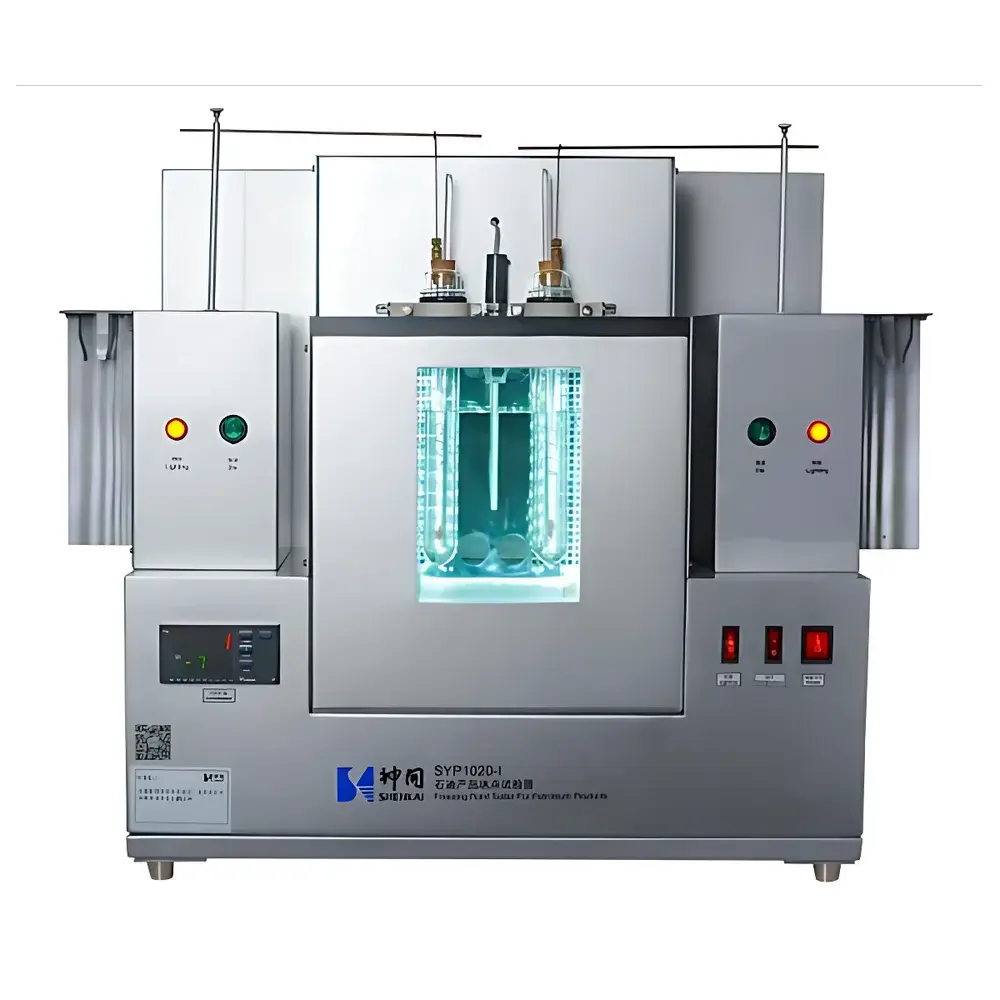
Shenkai SYP1020-I Petroleum Products Freezing Point Tester
| Brand | Shenkai |
|---|---|
| Origin | Shanghai, China |
| Manufacturer Type | Authorized Distributor |
| Country of Origin | China |
| Model | SYP1020-I |
| Price Range | USD 4,200 – 7,000 |
| Standards Compliance | GB/T 2430, SH/T 0090 |
| Temperature Control Range | Ambient to –70 °C |
| Temperature Control Accuracy | ±0.2 °C |
| Test Positions | 2 |
| Sample Stirring Frequency | 60–80 cycles/min |
| Cold Bath Capacity | 4 L |
| Refrigeration System | Dual-stage cascade compressor (imported) |
| Cold Bath Material | Stainless steel with vacuum-insulated glass viewport |
| Illumination | Non-glare LED |
| Power Supply | AC 220 V ±10 %, 50 Hz ±1 Hz |
| Max. Power Consumption | ≤1500 W |
| Dimensions (W×D×H) | 600 × 600 × 590 mm |
| Net Weight | 65 kg |
Overview
The Shenkai SYP1020-I Petroleum Products Freezing Point Tester is a precision-engineered instrument designed for the standardized determination of freezing point in aviation turbine fuels (e.g., Jet A-1, JP-8) and engine coolant formulations, in strict accordance with GB/T 2430 (equivalent to ASTM D2386) and SH/T 0090. The freezing point—defined as the highest temperature at which ice crystals first appear upon controlled cooling—is a critical low-temperature performance parameter governing fuel operability at high altitudes and thermal stability in automotive and aerospace cooling systems. This instrument implements a dynamic crystallization detection methodology: samples are cooled under precisely regulated conditions while continuously stirred; onset of solid phase formation is identified optically through real-time observation of crystal nucleation within the cold bath, supported by high-contrast LED illumination and anti-fog vacuum glass viewing windows.
Key Features
- Double-test configuration: Two independent sample positions enable parallel analysis—improving laboratory throughput without compromising measurement integrity or cross-contamination risk.
- High-stability temperature control architecture: Microprocessor-based PID algorithm ensures continuous, non-cycling regulation across the full operating range (ambient to –70 °C), delivering ±0.2 °C thermal accuracy—essential for reproducible phase transition detection.
- Cascade refrigeration system: Equipped with imported dual-stage compressors for rapid cooldown and sustained sub-ambient stability; achieves –70 °C cold bath temperature with minimal thermal drift over extended test durations.
- Optimized cold bath design: 4 L stainless steel bath with vacuum-insulated double-glazed viewport eliminates condensation and optical distortion; enables unobstructed visual monitoring of crystallization dynamics under non-glare LED illumination.
- Linear-motion sample agitation: Custom-engineered motor-driven stirrer delivers precise vertical oscillation (60–80 cycles/min), ensuring homogeneous thermal distribution and preventing localized supercooling or sedimentation artifacts.
- Robust mechanical and electrical integration: All thermal, optical, and motion subsystems are housed within a rigid, vibration-damped chassis (600 × 600 × 590 mm); total mass of 65 kg enhances operational stability during long-duration tests.
Sample Compatibility & Compliance
The SYP1020-I supports two primary application modes via interchangeable accessories: one optimized for transparent hydrocarbon-based aviation fuels per GB/T 2430, and another configured for aqueous glycol-based coolants per SH/T 0090. Each mode employs distinct sample tubes, stirrer geometries, and optical alignment protocols to accommodate differences in refractive index, viscosity, and crystal morphology. Instrument validation documentation includes traceable calibration certificates for temperature sensors (NIST-traceable Pt100 probes), and operational procedures are structured to support GLP-compliant data recording. While not inherently 21 CFR Part 11 compliant, the system’s deterministic control logic, manual logbook interface, and stable analog output signals allow seamless integration into validated laboratory information management systems (LIMS) when paired with approved electronic record solutions.
Software & Data Management
The SYP1020-I operates in standalone mode with an integrated digital display showing real-time bath temperature, setpoint, and elapsed test time. No embedded firmware or proprietary software is included; all user interaction occurs via tactile front-panel controls and visual observation. Temperature setpoints and dwell times are manually configured, and results are recorded externally—ensuring full auditability and eliminating software validation burdens. Optional RS-232 or 4–20 mA analog outputs (available upon request) permit connection to external chart recorders or SCADA platforms for continuous thermal profiling. This hardware-centric architecture aligns with ISO/IEC 17025 requirements for method transparency and operator-controlled procedural fidelity.
Applications
- Determination of freezing point in aviation turbine fuels for airworthiness certification and batch release testing.
- Quality control of ethylene/propylene glycol–water mixtures used in aircraft and heavy-duty vehicle cooling systems.
- Research and development of low-temperature fuel additives and antifreeze formulations.
- Third-party verification laboratories performing contract testing under CNAS-accredited scopes referencing GB/T 2430 or SH/T 0090.
- Refinery QC labs requiring dual-sample capability to reduce turnaround time without sacrificing repeatability (RSD < 0.3 °C between duplicates).
FAQ
Does the SYP1020-I comply with ASTM D2386?
Yes—GB/T 2430 is the Chinese national adoption of ASTM D2386, and the instrument’s thermal control profile, stirring kinetics, and observation methodology are fully aligned with the standard’s procedural requirements.
Can it test biodiesel blends or synthetic jet fuels?
It may be used for preliminary screening, but formal compliance requires method validation per ASTM D7467 (for biodiesel) or ASTM D7566 Annex A2 (for synthetic hydrocarbons), as crystallization behavior differs significantly from conventional petroleum fractions.
Is external calibration required before each test?
No—routine calibration verification is performed at three points (0 °C, –30 °C, –60 °C) using certified reference thermometers prior to daily operation, per internal SOPs aligned with ISO 17025 Clause 6.5.
What maintenance is recommended for the cascade refrigeration system?
Annual inspection of refrigerant charge, condenser coil cleaning, and compressor oil analysis are advised; service intervals follow manufacturer-specified guidelines for the original equipment compressor OEM.
Are spare parts and consumables available internationally?
Yes—Shenkai provides global distribution of certified cold bath seals, sample tubes, stirrer assemblies, and calibrated Pt100 sensors through authorized regional partners, with lead times documented in the Export Parts Catalog v3.2.