
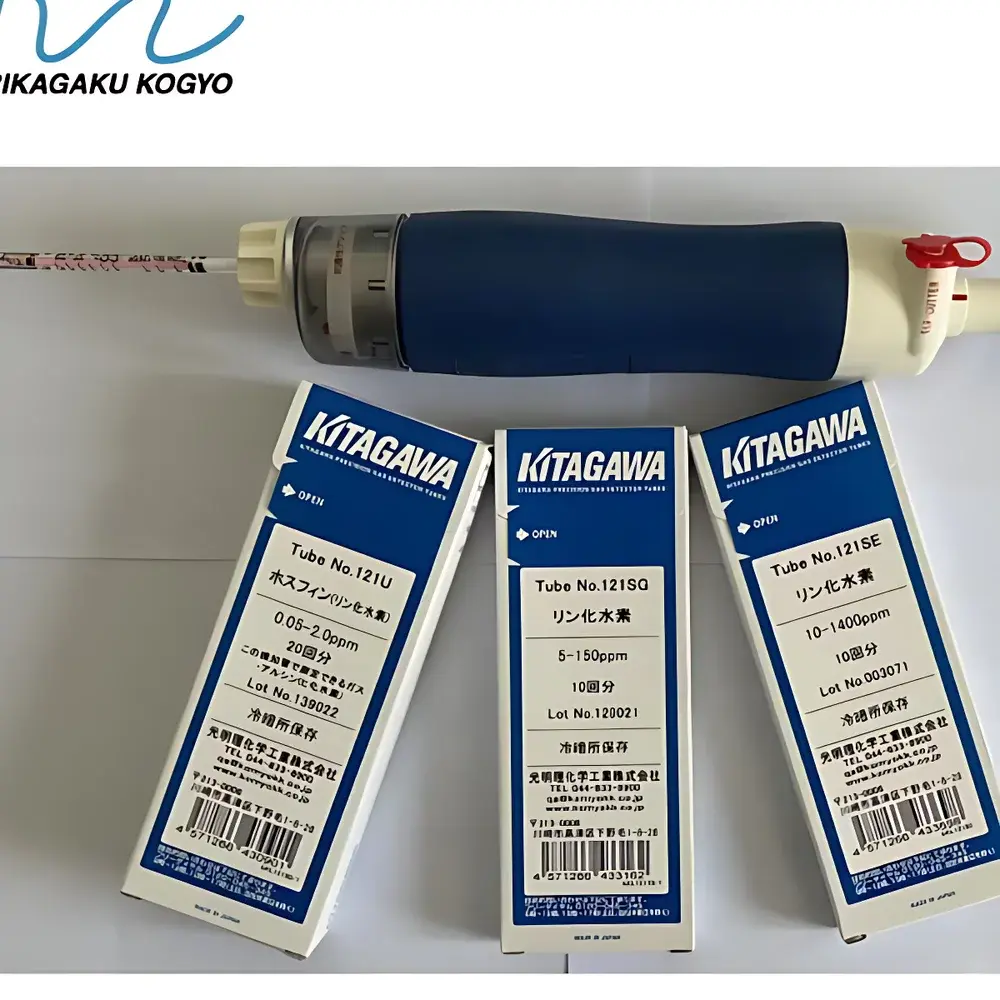
NorthKawamura Phosphine Gas Detection Tubes 121SA / 121SB
| Brand | Meikō Rikagaku |
|---|---|
| Origin | Japan |
| Model | 121SA, 121SB |
| Detection Range (121SA) | 20–800 ppm in acetylene |
| Detection Range (121SB) | 5–90 ppm in acetylene |
| Operating Principle | Colorimetric reaction with calibrated glass tube |
| Required Sampling Device | AP-20 handheld pump |
| Compliance | Designed per JIS K 0321 and ISO 8573-6 for qualitative/semi-quantitative gas analysis |
| Unit Packaging | Single-use, sealed glass ampoules |
| Shelf Life | 24 months from manufacture when stored at ≤25°C and protected from light |
Overview
The NorthKawamura Phosphine Gas Detection Tubes 121SA and 121SB are precision-calibrated, single-use colorimetric indicator tubes engineered for rapid, on-site quantification of phosphine (PH₃) gas concentrations in industrial atmospheres—particularly within acetylene-based environments such as semiconductor fabrication purge lines, fumigation chambers, grain silos, and phosphide alloy processing zones. These tubes operate on the principle of diffusion-controlled, stoichiometric chemical reaction: phosphine gas drawn through the tube via the AP-20 manual piston pump reacts selectively with immobilized reagents (typically lead acetate or palladium chloride impregnated silica gel), generating a sharp, linear color front proportional to concentration. The length of the stained zone is read directly against the pre-etched scale on the tube wall, yielding results in parts per million (ppm) without electrical power, calibration gases, or laboratory infrastructure. This method complies with the fundamental measurement paradigm defined in ISO 8573-6 for compressed air purity assessment and aligns with JIS K 0321 for workplace air monitoring using indicator tubes.
Key Features
- Two dedicated ranges optimized for distinct exposure scenarios: 121SA (20–800 ppm) for high-concentration leak screening and process verification; 121SB (5–90 ppm) for occupational hygiene monitoring near permissible exposure limits (PELs)
- Pre-calibrated traceability: Each batch undergoes gravimetric and dynamic calibration against NIST-traceable phosphine standards under controlled humidity (40–60% RH) and temperature (20–25°C)
- Acetylene-compatible formulation: Reagent chemistry specifically stabilized to suppress interference from co-present acetylene—a critical requirement in electronics manufacturing and metal hydride handling
- Robust borosilicate glass construction: Resistant to thermal shock and mechanical fracture during field deployment; hermetically sealed with flame-fused ends to ensure shelf-life integrity
- No external power or consumables required beyond the AP-20 pump: Enables operation in intrinsically safe (IS) zones, confined spaces, and explosion-hazardous Class I Division 1 areas
- GLP-aligned documentation support: Certificate of Analysis (CoA) provided per lot, including calibration curve data, uncertainty budget (k=2), and expiration date
Sample Compatibility & Compliance
These detection tubes are validated for use in ambient air and acetylene-rich gas matrices up to 99.9% v/v. Cross-sensitivity testing confirms negligible response to common interferents including H₂S (<0.5% signal deviation at 50 ppm), NH₃ (<1.2%), CO (<0.3%), and Cl₂ (10% O₂ with NO₂) or high-humidity conditions (>80% RH), where hydrolysis of the reagent layer may reduce accuracy. Compliant with Japanese Industrial Standard JIS K 0321 “Method for Determination of Gaseous Contaminants in Workplace Air Using Indicator Tubes” and referenced in ISO 8573-6 Annex B for compressed gas purity verification. Suitable for documentation in OSHA 29 CFR 1910.120 (HAZWOPER) initial site characterization and EPA Method IP-1A field screening protocols.
Software & Data Management
As a passive, analog measurement system, the 121SA/121SB tubes require no embedded firmware or digital interface. However, they integrate seamlessly into enterprise EHS management workflows: raw readings are manually entered into validated electronic lab notebooks (ELNs) or LIMS platforms supporting 21 CFR Part 11 audit trails. Optional companion tools include the Meikō Rikagaku Tube Reader App (iOS/Android), which digitizes scale interpretation via image capture and applies batch-specific correction factors—generating PDF reports with timestamp, operator ID, GPS coordinates, and photo evidence of the color front. All calibration records and CoAs are archived in accordance with ISO/IEC 17025 clause 7.7 for measurement traceability.
Applications
- Real-time verification of phosphine residuals after fumigation in food storage facilities (FAO/WHO Codex Alimentarius compliance)
- Leak detection at PH₃ delivery manifolds in semiconductor cleanrooms (SEMI F21-02 guidelines)
- Personal exposure monitoring for workers handling aluminum phosphide or zinc phosphide rodenticides
- Emergency response triage during transportation incidents involving phosphide-containing cargo (DOT Emergency Response Guidebook ERG #131)
- Validation of abatement system efficiency in phosphine exhaust streams prior to stack release
- Periodic safety audits in fertilizer production plants where phosphine forms as a byproduct of phosphate rock processing
FAQ
What is the shelf life of unopened 121SA and 121SB tubes?
Unopened tubes retain accuracy for 24 months from the date of manufacture when stored at ≤25°C in original packaging, away from direct sunlight and volatile organic vapors.
Can these tubes be used in inert atmospheres such as nitrogen or argon?
Yes—performance is validated in N₂, Ar, and He carrier gases; however, calibration curves assume standard atmospheric pressure (760 mmHg) and must be corrected per ISO 8573-6 Annex C for altitudes above 500 m.
Is operator training required for compliant use?
Per JIS K 0321 Section 5.2, users must complete documented competency assessment covering pump actuation technique, timing control (±0.5 s), vertical orientation during development, and endpoint interpretation—available via Meikō Rikagaku’s accredited e-learning module (MR-TRN-PH3-2024).
Do the tubes meet FDA or EU REACH requirements for food contact environments?
While not food-contact devices per se, the glass composition and reagent formulation comply with EU Regulation (EC) No 1935/2004 for materials intended to come into contact with foodstuffs during fumigation residue verification.
How are measurement uncertainties reported for regulatory submissions?
Each CoA states expanded uncertainty (k=2) derived from repeatability (n≥10), reproducibility (inter-operator variance), and calibration standard uncertainty—typically ±12% for 121SA and ±9% for 121SB across their respective mid-range concentrations.
Related Products







