
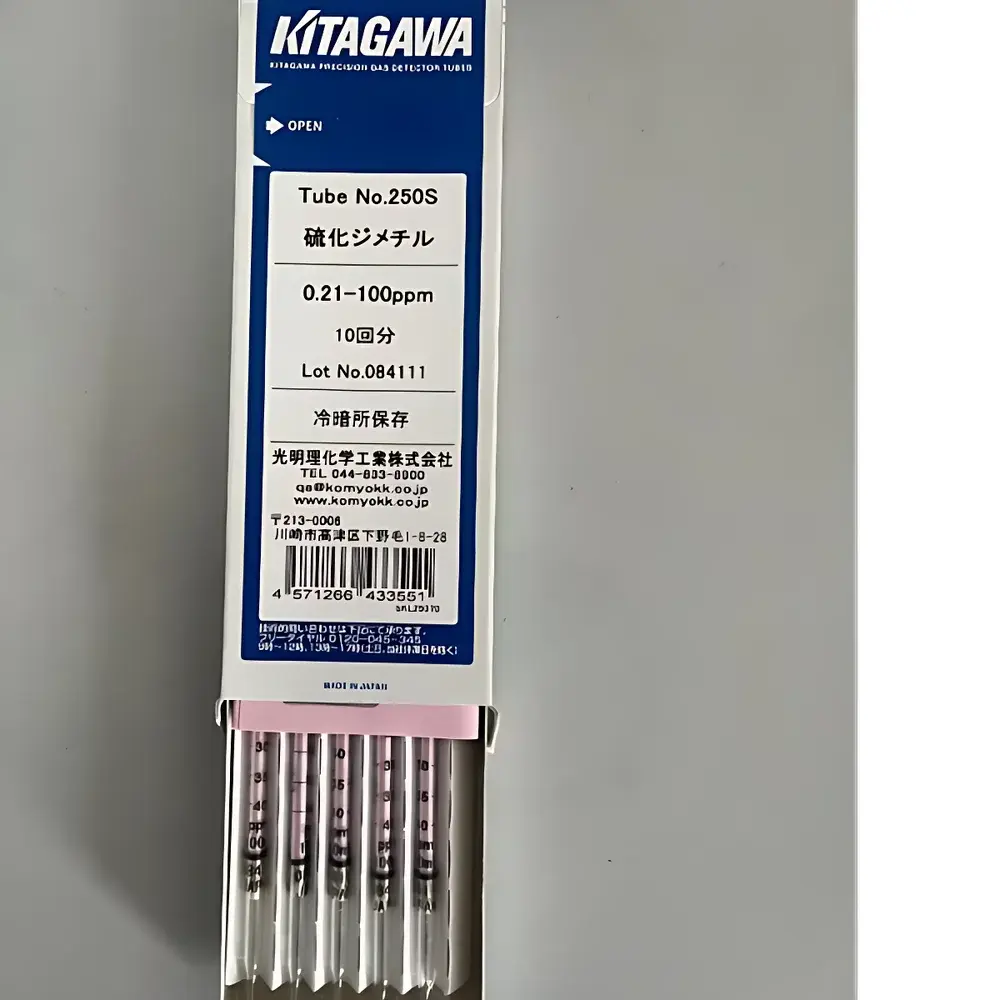
North Kawanishi DMSO2 Gas Detection Tube Model 250S1
| Brand | MeiKo Rikka |
|---|---|
| Origin | Japan |
| Manufacturer Type | Authorized Distributor |
| Origin Category | Imported |
| Model | 250S1 |
| Price | USD 42 (approx.) |
Overview
The North Kawanishi DMSO₂ Gas Detection Tube Model 250S1 is a chemically impregnated, single-use colorimetric gas sampling device engineered for rapid, on-site quantification of dimethyl disulfide (DMSO₂) in ambient air. Based on the principle of selective chemical reaction—where DMSO₂ vapor reacts stoichiometrically with pre-loaded reagents inside the glass tube to produce a visible color change—the 250S1 delivers direct concentration readout without requiring power, calibration gases, or electronic instrumentation. The detection mechanism relies on diffusion-controlled reaction kinetics within a fixed-length silica gel substrate, ensuring high specificity for DMSO₂ and minimal cross-sensitivity to common interferents such as H₂S, SO₂, or volatile organic compounds (VOCs) at typical environmental concentrations. Designed for field use under variable ambient conditions, the tube exhibits no temperature dependence between 5 °C and 40 °C, eliminating the need for real-time thermal compensation—a critical advantage during emergency response or mobile monitoring operations.
Key Features
- Fixed-range detection of dimethyl disulfide (DMSO₂) from 0.12 to 1.2 ppm (v/v) with ±15% analytical uncertainty per ISO 8573-7 and JIS Z 8808 guidelines for colorimetric tube methods
- Pre-calibrated glass microtube with integrated reaction layer; no field calibration required
- Compatible with standard hand pump AP-20 (sold separately), supporting precise volumetric sampling of 50 mL, 100 mL, or cumulative 400 mL via four sequential strokes
- Visual endpoint determination via sharp chromogenic front migration—measured at the uppermost edge of the yellow reaction zone using calibrated scale printed on tube body
- Stable shelf life of 24 months when stored unopened at ≤25 °C and <60% RH; lot-specific expiration date and calibration certificate provided with each box
- Robust mechanical design: borosilicate glass construction with precision-cut scoring grooves for consistent, tool-free end-breaking
Sample Compatibility & Compliance
The 250S1 tube is validated for use in ambient air, stack effluent dilutions, and indoor workplace atmospheres where DMSO₂ may be present due to industrial processes (e.g., pulp & paper bleaching, wastewater treatment, or pharmaceutical synthesis). It complies with Japanese Industrial Standard JIS K 0107 (Methods for Determination of Gaseous Pollutants in Workplace Air) and aligns with OSHA Method ID-135 for qualitative/semi-quantitative screening. While not intended for regulatory compliance reporting under EPA Method TO-15 or ISO 16000-6, it serves as a GLP-aligned preliminary assessment tool prior to confirmatory GC-MS analysis. Each production batch undergoes traceability verification against NIST-traceable DMSO₂ reference standards, and full documentation—including lot-specific calibration curves and interference test reports—is available upon request for audit readiness.
Software & Data Management
As a passive, analog detection system, the 250S1 does not interface with software or digital data acquisition platforms. However, measurement records—including sampling location, time, pump stroke count, observed color front length, and calculated concentration—can be documented manually or entered into laboratory information management systems (LIMS) compliant with 21 CFR Part 11 when paired with electronic field notebooks. For quality assurance, users are advised to maintain logbooks containing tube lot numbers, expiration dates, and operator initials per ISO/IEC 17025 Clause 7.7 (Results Reporting). Digital image capture of the developed tube (with scale reference) is recommended for long-term archival and inter-operator review.
Applications
- Rapid odor source identification near municipal wastewater treatment plants and composting facilities
- Leak screening during maintenance of sulfur-containing chemical process lines
- First-responder triage during accidental DMSO₂ releases (e.g., railcar incidents or storage tank breaches)
- Occupational hygiene surveys in biotechnology labs handling methionine-derived compounds
- Validation of activated carbon filter efficiency in ventilation ducts servicing odor-sensitive zones
- Baseline ambient monitoring in communities adjacent to industrial zones emitting reduced sulfur compounds
FAQ
What is the minimum detectable concentration for DMSO₂ using the 250S1 tube?
The lower limit of quantification (LLOQ) is 0.12 ppm, corresponding to the shortest measurable color front at full 100 mL sample volume.
Can the tube be reused after one measurement?
No. The 250S1 is a single-use, irreversible colorimetric device. Reaction completion permanently alters the reagent matrix; reuse will yield inaccurate or non-reproducible results.
Is humidity correction required?
No correction is needed for relative humidity between 20% and 80%. Above 90% RH, condensation may impair color front resolution; use desiccant pre-filters if sampling in saturated environments.
How should expired tubes be disposed?
Dispose as hazardous chemical waste per local regulations—tubes contain reactive metal salts and acid catalysts. Do not incinerate or discard in general waste streams.
Does this tube meet FDA or EU REACH requirements for workplace monitoring?
While not certified under FDA QSR or EU REACH Annex XVII, the 250S1 satisfies technical equivalence to EN 1231:1998 for detector tube performance and is accepted by Japanese MHLW and Korean MOEL for occupational exposure screening.
Related Products







