
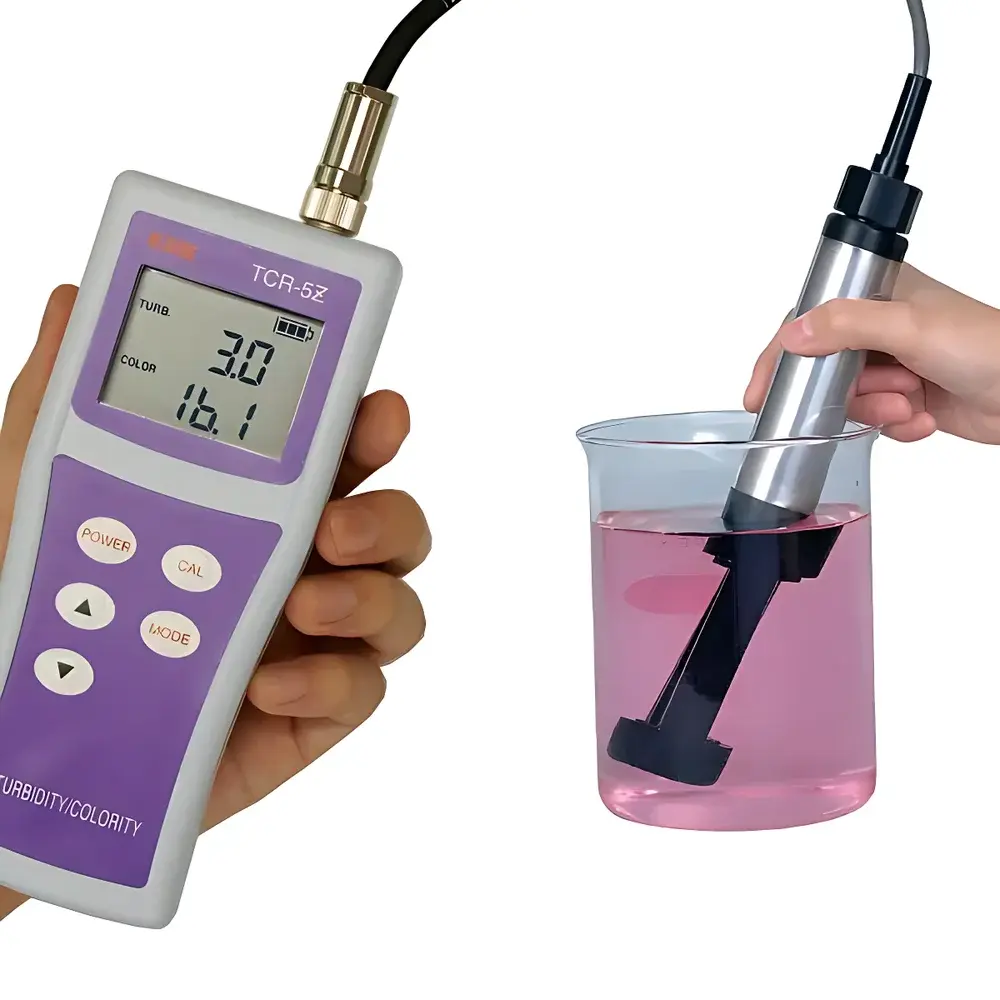
Rikorika TCR-5Z Portable Turbidity and Color Analyzer
| Brand | Rikorika |
|---|---|
| Origin | Japan |
| Model | TCR-5Z |
| Instrument Type | Portable/HANDHELD Water Quality Analyzer |
| Measurement Parameters | Turbidity, Color (Platinum-Cobalt Scale), Absorbance |
| Measurement Principle | Dual-beam Transmittance Photometry (Spectrophotometric Method) |
| Range | Turbidity 0.0–50.0 NTU (Polystyrene Standard), Color 0.0–50.0° (Pt-Co Scale), Absorbance 0.000–1.999 Abs |
| Resolution | 0.1° (0.01° selectable below 10°), 0.001 Abs |
| Repeatability | ±0.5° under specified conditions |
| IP Rating | IP66 (when probe connector is properly mated) |
| Power | 3× AAA alkaline batteries (DC 4.5 V) |
| Operating Temperature | 5–35 °C |
| Dimensions (Main Unit) | 38 × 75 × 180 mm |
| Weight (Main Unit) | ~270 g |
| (Probe TCR-5ZD) | ~350 g (excl. cable) |
| Cable Length | 2 m |
Overview
The Rikorika TCR-5Z is a portable, probe-based turbidity and color analyzer engineered for field-deployable, high-fidelity water quality assessment using dual-beam transmittance photometry—a standardized spectrophotometric method compliant with Japan’s Ministry of Health, Labour and Welfare (MHLW) Ordinance on Water Quality Standards and related industrial water testing protocols. Unlike single-beam instruments susceptible to optical drift or scattering interference, the TCR-5Z employs a dedicated dual-beam optical architecture that simultaneously monitors reference and sample light paths. This design enables real-time compensation for lamp intensity fluctuations and minimizes the influence of suspended particles during color measurement—effectively decoupling true chromatic signal from turbidity-induced attenuation. As a result, the instrument delivers reliable Pt-Co color values even in samples with moderate turbidity (up to 50.0 NTU), without requiring pre-filtration or calibration curve construction. Its handheld form factor, combined with immersion-style probe operation, supports rapid in-situ analysis of drinking water, swimming pool water, spa baths, cooling tower make-up, and process water streams where regulatory compliance and operational continuity are critical.
Key Features
- Dual-beam transmittance photometer with independent optical channels for turbidity and color—ensuring minimal cross-interference between parameters
- Simultaneous display of turbidity (NTU), color (° Pt-Co), and absorbance (Abs) on a 3½-digit LCD screen
- High-resolution measurement: 0.01° resolution selectable for color/turbidity values ≤10.0°, and 0.001 Abs resolution across full absorbance range
- Integrated zero-point calibration using deionized water and span calibration via optional 10° polystyrene (turbidity) or Pt-Co (color) standard solutions
- Automatic power-off after 10 seconds of inactivity to conserve battery life; low-battery and error-state indicators clearly marked on display
- IP66-rated probe housing (when mated correctly with main unit)—providing dust-tight and powerful water-jet resistance for outdoor and humid environments
- Compact, lightweight design: main unit weighs only 270 g; probe (TCR-5ZD) weighs 350 g—optimized for extended field use without fatigue
Sample Compatibility & Compliance
The TCR-5Z is validated for aqueous samples within 5–35 °C, non-freezing, and shielded from direct solar exposure. It is not intended for use with organic solvents, hydrofluoric acid, or strongly acidic/alkaline solutions (pH 10), which may degrade optical surfaces or compromise sensor stability. The instrument conforms to MHLW Notification No. 101 (2003) for potable water testing and aligns with ASTM D1208 (Standard Test Methods for Color of Transparent Liquids) and ISO 7027-1:2016 (Water quality — Determination of turbidity — Part 1: Quantitative methods using nephelometry). While not FDA 21 CFR Part 11–certified out-of-the-box, its fixed calibration protocol, audit-ready manual log capability, and deterministic measurement logic support GLP-compliant data recording when paired with traceable standards and documented SOPs.
Software & Data Management
The TCR-5Z operates as a standalone, embedded-system instrument with no onboard memory or digital connectivity (e.g., Bluetooth, USB, or Wi-Fi). All measurements are displayed in real time and must be manually recorded. This architecture eliminates firmware update dependencies, cybersecurity vulnerabilities, and software validation overhead—making it suitable for regulated environments where device simplicity, deterministic behavior, and long-term calibration stability are prioritized over automated data transfer. Users are advised to maintain physical calibration logs referencing batch-specific standard solution certificates (e.g., NIST-traceable 10° Pt-Co or polystyrene suspensions) to satisfy internal QA audits or third-party inspections.
Applications
- Drinking water distribution system monitoring per Japanese Water Supply Act requirements
- Swimming pool and hot tub facility management in accordance with public health ordinances
- In-process verification of filtration efficiency in municipal wastewater treatment effluent streams
- Quality control of pharmaceutical-grade purified water (PW) and water for injection (WFI) support systems
- Field validation of membrane integrity in reverse osmosis (RO) and ultrafiltration (UF) pilot studies
- Educational laboratory instruction for water chemistry principles, including Beer–Lambert law application and scattering theory
FAQ
Does the TCR-5Z require user-generated calibration curves?
No. It uses factory-established optical gain factors and two-point calibration (zero and span) with certified standards—eliminating the need for multi-point curve fitting.
Can the probe be immersed in seawater or brackish water?
Not recommended. High chloride content and particulate load may accelerate corrosion and fouling; rinse thoroughly with deionized water after any non-freshwater exposure.
Is the 10° standard solution included with the instrument?
No. The 10° turbidity (polystyrene) and 10° color (Pt-Co) standard solutions are optional accessories, sold separately in 250 mL volumes.
What is the expected battery life under typical usage?
Approximately 2,000 measurements (10-second cycles) with fresh AAA alkaline cells—consistent with IEC 60086-2 specifications.
How is measurement reproducibility verified?
Repeatability of ±0.5° is validated per JIS K 0102 Annex B using homogeneous, temperature-stabilized standard solutions under controlled ambient lighting conditions.
Related Products







