
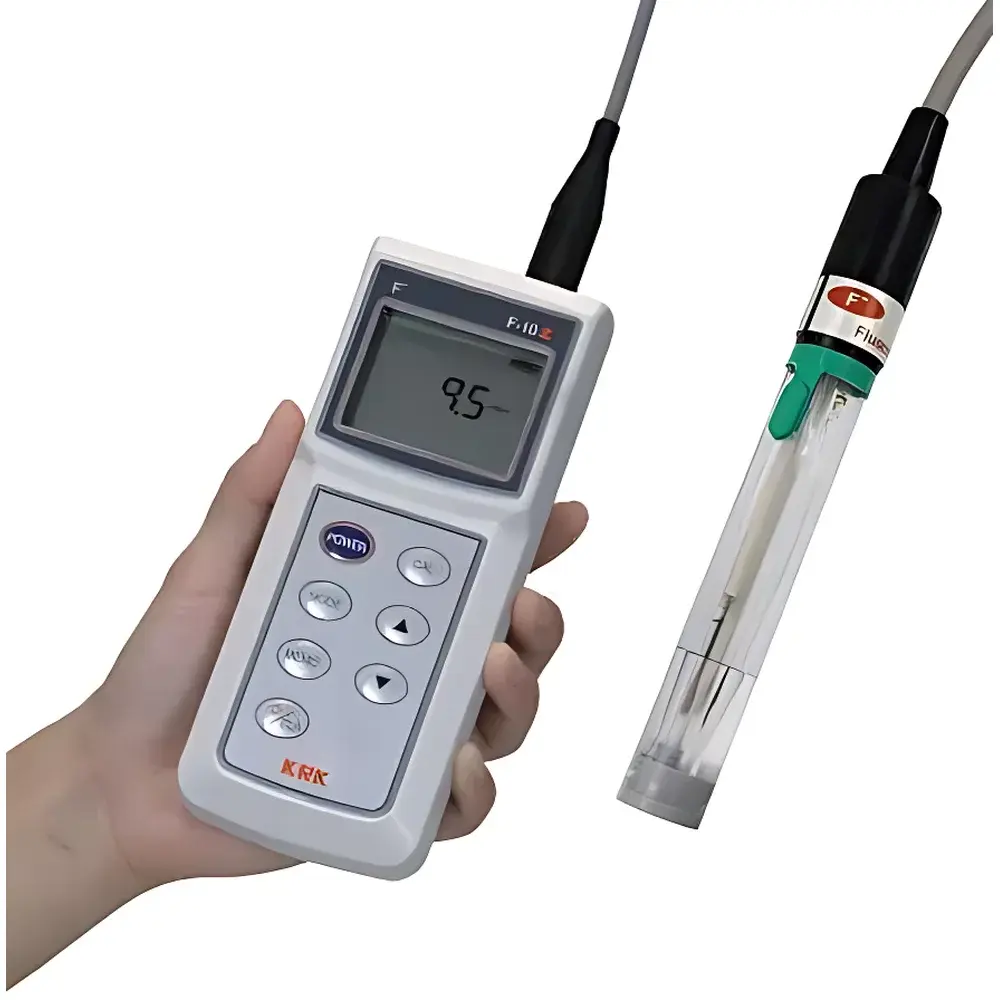
Rikuri Chemical Fluoride Ion Analyzer F-10Z
| Brand | Rikuri Chemical |
|---|---|
| Origin | Japan |
| Model | F-10Z |
| Measurement Principle | Solid-State Lanthanum Fluoride (LaF₃) Crystal Membrane Ion-Selective Electrode (ISE) |
| Range | 0–1999 mg/L F⁻ |
| mV Output Range | −1000 to +1000 mV |
| Resolution | 0.1 mg/L (0.1–99.9 mg/L), 1 mg/L (100–1999 mg/L) |
| Accuracy | ±5% of Full Scale (FS) |
| Display | 3½-digit LCD |
| Temperature Compensation | Automatic (NTC thermistor integrated) |
| Response Time (t₉₀) | ≤60 s |
| Ingress Protection | IP67 |
| Power Supply | DC 4.5 V (3 × AA alkaline batteries) |
| Dimensions (W×H×D) | 70 × 36 × 170 mm |
| Weight | Approx. 290 g (instrument only) |
Overview
The Rikuri Chemical Fluoride Ion Analyzer F-10Z is a portable, field-deployable ion-selective electrode (ISE) instrument engineered for accurate, on-site quantification of free fluoride ion (F⁻) activity in aqueous samples. It operates on the potentiometric principle using a solid-state lanthanum fluoride (LaF₃) single-crystal membrane electrode — a Nernstian sensor with well-documented selectivity for F⁻ over common anions such as Cl⁻, NO₃⁻, and SO₄²⁻, provided pH is maintained between 5.0 and 8.0. The device measures the potential difference (in mV) between the LaF₃ sensing element and a built-in Ag/AgCl reference electrode, converting it into concentration (mg/L) via a calibrated slope of approximately −59.2 mV per decade change in [F⁻] at 25 °C. Critically, the F-10Z detects only *free*, uncomplexed fluoride ions; it does not measure total fluorine or organofluorine compounds (e.g., fluorinated surfactants, PFAS precursors) nor hydrolyzable metal-fluoride complexes (e.g., AlF₆³⁻, FeF₆³⁻). This functional specificity aligns with regulatory monitoring requirements where bioavailable or corrosion-relevant F⁻ species are the parameter of interest — particularly in industrial effluent control and drinking water safety verification.
Key Features
- Integrated LaF₃ crystal ISE with stable Nernstian response and low drift (<0.5 mV/h under continuous operation)
- Automatic temperature compensation using an embedded NTC thermistor (range: 0–50 °C), ensuring consistent calibration across typical environmental and process conditions
- Rugged, IP67-rated housing — fully dust-tight and capable of withstanding immersion in 1 m of water for up to 30 minutes — suitable for outdoor, wastewater channel, or factory floor deployment
- Low-power design powered by three standard AA alkaline cells (DC 4.5 V), providing >200 hours of continuous operation under typical use
- High-contrast 3½-digit LCD display with backlight-independent readability under ambient light, optimized for field technicians wearing PPE
- Direct mV output mode for integration with data loggers or SCADA systems, alongside concentration readout in mg/L
Sample Compatibility & Compliance
The F-10Z is validated for use with clarified, low-turbidity aqueous matrices including municipal drinking water, cooling tower blowdown, semiconductor wet bench rinse water, glass etching bath effluents, and fluoropolymer manufacturing process streams. Samples must be pH-adjusted (using buffer tablets or dilute HNO₃/NaOH) prior to measurement if outside the 5.0–8.0 range, as hydrogen ion interference increases significantly below pH 5. Total suspended solids should be <10 mg/L to prevent membrane fouling; filtration through 0.45 µm membrane is recommended for sludge supernatants or digested biosolids leachates. While not certified to ISO/IEC 17025, the instrument supports GLP-compliant workflows when used with documented calibration records (daily standard verification using 10 mg/L and 100 mg/L F⁻ standards traceable to NIST SRM 3162a), audit-trail-enabled logging (via optional RS-232 interface), and routine electrode maintenance logs.
Software & Data Management
The F-10Z operates as a standalone meter without proprietary software dependency. All calibration and measurement data are retained locally on the device’s non-volatile memory (up to 100 data points with timestamp and temperature). For extended data handling, the optional RS-232 serial interface enables direct connection to Windows-based PCs running terminal emulation (e.g., Tera Term) or custom LabVIEW/Python scripts for automated CSV export. Calibration coefficients (slope, intercept, temperature coefficient) are stored per session and can be recalled or overwritten. The device complies with basic electronic record integrity expectations under FDA 21 CFR Part 11 when paired with validated third-party data acquisition platforms that enforce user authentication and electronic signature controls.
Applications
- Real-time monitoring of fluoride discharge compliance at semiconductor fabrication facilities (per local ordinances limiting F⁻ to <10–20 mg/L)
- Verification of defluoridation efficiency in activated alumina or bone char treatment units serving rural water supplies
- Process control of hydrofluoric acid (HF) concentration in glass etching baths — critical for dimensional accuracy and surface finish
- Leachate testing from landfill sites accepting fluorinated waste or construction debris containing fluoro-minerals
- QA/QC screening of raw water intake points upstream of municipal fluoridation plants to avoid overdosing
- Field assessment of F⁻ mobility in soil pore water extracted via centrifugation or Rhizon samplers
FAQ
Does the F-10Z measure total fluorine or only free fluoride ions?
It measures only free, hydrated fluoride ions (F⁻) in solution. It cannot detect fluorine bound in covalent organic molecules (e.g., PFOS, PFOA) or stable inorganic complexes (e.g., AlF₆³⁻). Total fluorine analysis requires combustion ion chromatography (CIC) or ICP-MS after alkaline fusion.
Can the electrode be used in high-ionic-strength samples such as seawater or brine?
Yes, but activity corrections are required. The F-10Z reports concentration assuming ideal dilute solution behavior. For samples with ionic strength >0.1 M, use the Debye-Hückel equation or standard addition methodology to obtain thermodynamically accurate activity-based results.
How often must the LaF₃ electrode be reconditioned or replaced?
Under normal use (≤5 measurements/day), the crystal membrane requires no polishing and remains functional for ≥2 years. Performance should be verified weekly against two-point calibration standards; replacement is indicated when slope falls below −54 mV/decade or response time exceeds 120 s.
Is the instrument compatible with ASTM D1179 or ISO 10304-1?
While the F-10Z itself is not certified to these standards, its measurement principle and operational parameters conform to the core requirements of ASTM D1179 (Standard Test Method for Fluoride in Water) for ISE-based determination. Users must validate method equivalence per their internal SOPs and regulatory jurisdiction.
Related Products







