
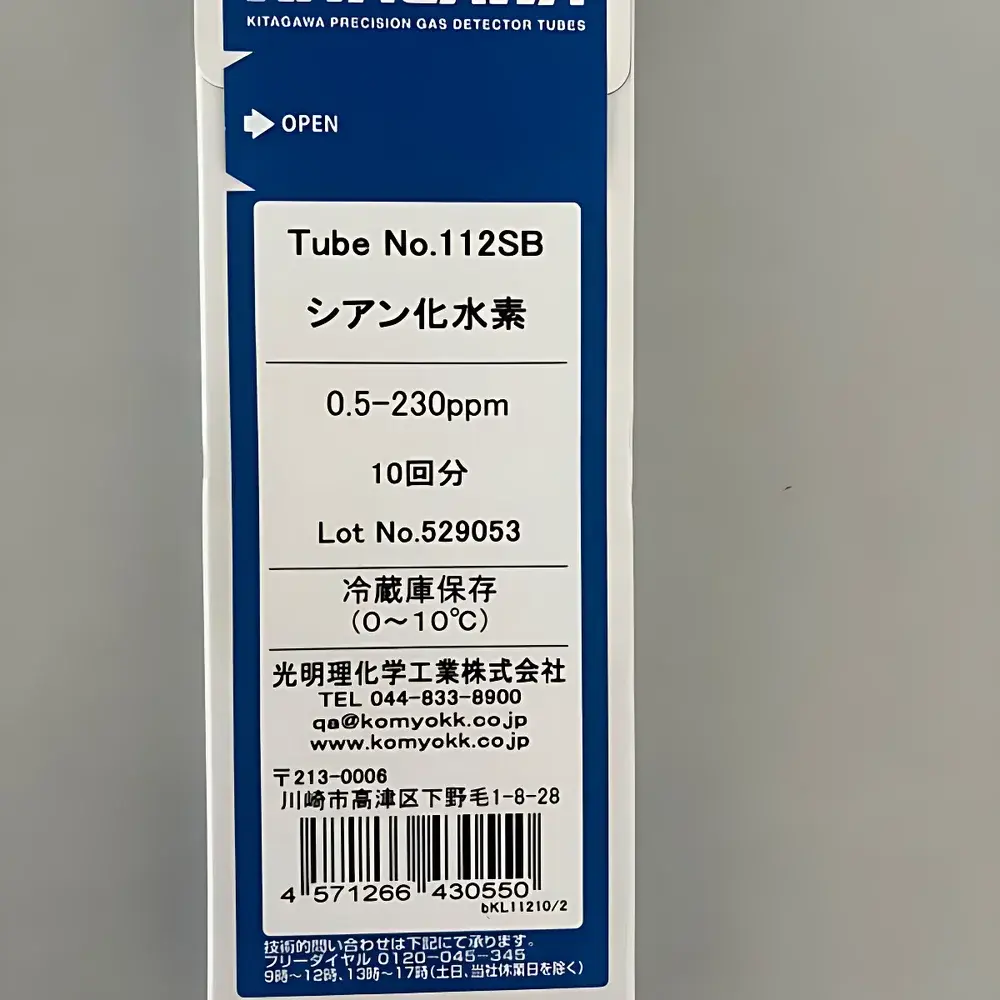
KOMYO RIKAGAKU Model 114 Bromine Gas Length-of-Stain Detector Tube
| Brand | KOMYO RIKAGAKU |
|---|---|
| Origin | Japan |
| Model | 114 |
| Detection Range | 1–20 ppm |
| Measuring Principle | Length-of-stain colorimetric reaction |
| Compatible Pump | AP-20 handheld bellows pump |
| Calibration | Pre-calibrated, single-use |
| Shelf Life | 24 months from manufacture (stored at ≤30°C, dry, dark) |
Overview
The KOMYO RIKAGAKU Model 114 Bromine Gas Length-of-Stain Detector Tube is a precision-engineered, single-use colorimetric gas detection device designed for rapid, on-site quantification of elemental bromine (Br₂) vapor in ambient air. Operating on the established length-of-stain principle—first systematized by Dr. Kitagawa and refined through decades of industrial application—the tube contains a fixed bed of chemically impregnated silica gel reagent. Upon drawing a defined volume of air (typically 100 mL) through the tube using the standardized AP-20 hand pump, bromine gas reacts stoichiometrically with the reagent (typically potassium iodide or o-tolidine-based formulations), producing a discrete, sharply bounded zone of color development along the tube’s calibrated glass bore. The length of the stained segment, measured directly against the printed scale (in mm), correlates linearly to bromine concentration within the specified 1–20 ppm range. This method complies with foundational principles outlined in JIS K 0301 (Japanese Industrial Standard for Gas Detection Tubes) and aligns with ISO 8573-6 Annex B for qualitative/semi-quantitative contaminant screening in field environments.
Key Features
- Pre-calibrated, factory-sealed design ensures batch-to-batch consistency and eliminates user calibration requirements
- Linear response curve validated across the full 1–20 ppm range under standard conditions (23°C, 50% RH, 101.3 kPa)
- Reaction time ≤ 60 seconds after completion of 100 mL air draw; stable stain endpoint maintained for ≥5 minutes post-analysis
- Integrated humidity compensation via desiccant layer minimizes interference from ambient moisture up to 80% RH
- Trace-level sensitivity optimized for occupational exposure assessment—directly comparable to OSHA PEL (0.1 ppm TWA) and ACGIH TLV (0.1 ppm STEL) thresholds
- CE-marked packaging compliant with Directive 2014/68/EU (PED) for pressure equipment handling—AP-20 pump certified to 100 kPa max operating pressure
Sample Compatibility & Compliance
The Model 114 tube is validated exclusively for gaseous elemental bromine (Br₂) in clean, non-condensing air matrices. It is not suitable for brominated organic compounds (e.g., methyl bromide, bromoform), hydrogen bromide (HBr), or aerosolized bromine salts. Cross-sensitivity testing per ASTM D679-20 confirms negligible response to Cl₂ (<2% interference at 20 ppm), NO₂ (<1%), and SO₂ (<0.5%) under controlled conditions. Each production lot undergoes traceability verification against NIST-traceable bromine permeation tubes (SRM 2801). The device meets GLP documentation requirements for field use: lot number, expiration date, and calibration certificate are laser-etched on the tube body and provided with shipment. Conforms to Japanese Ministry of Health, Labour and Welfare (MHLW) Notification No. 115 (2003) for workplace air monitoring devices.
Software & Data Management
As a passive, analog detection system, the Model 114 requires no firmware, drivers, or software integration. Quantitative results are recorded manually in field logs or digital notebooks. For audit readiness, users may photograph the stained tube alongside a calibrated ruler and timestamped GPS metadata—practices aligned with ISO/IEC 17025:2017 Clause 7.5.2 (recording of observations). When used within enterprise EHS platforms (e.g., Intelex, Sphera), data entry fields support direct input of mm-stain length, calculated ppm value, sampling location, and operator ID—enabling trend analysis across multiple locations without proprietary software dependency.
Applications
- Routine leak detection during maintenance of bromine-handling infrastructure (e.g., fumigation chambers, pharmaceutical synthesis reactors, flame retardant production lines)
- Emergency response triage following transportation incidents involving bromine cargo (UN 1740, Class 8 Corrosive)
- Confined space entry pre-screening per OSHA 1910.146(c)(5)(ii) prior to worker deployment
- Verification of local exhaust ventilation (LEV) effectiveness in bromine storage areas
- Educational laboratory demonstrations of halogen reactivity and stoichiometric gas-phase detection principles
FAQ
What is the shelf life of an unopened Model 114 tube?
Unopened tubes retain accuracy for 24 months from date of manufacture when stored at ≤30°C in original packaging, protected from light and humidity.
Can the same AP-20 pump be used for other KOMYO RIKAGAKU tubes?
Yes—the AP-20 is universal across all KOMYO RIKAGAKU length-of-stain tubes requiring 100 mL draw volume, including chlorine, ammonia, hydrogen sulfide, and formaldehyde variants.
Is this tube suitable for continuous monitoring?
No. It is strictly a single-use, grab-sampling tool. Continuous monitoring requires electrochemical or PID-based fixed systems compliant with IEC 60079-29-1.
Does temperature affect measurement accuracy?
Yes. Readings above 35°C or below 10°C require correction per the temperature compensation chart supplied with each lot certificate.
How is measurement uncertainty determined?
Typical expanded uncertainty (k=2) is ±15% of reading, derived from repeatability studies (n=20), inter-lot variability, and pump volume tolerance (±5% per JIS Z 8015).







