
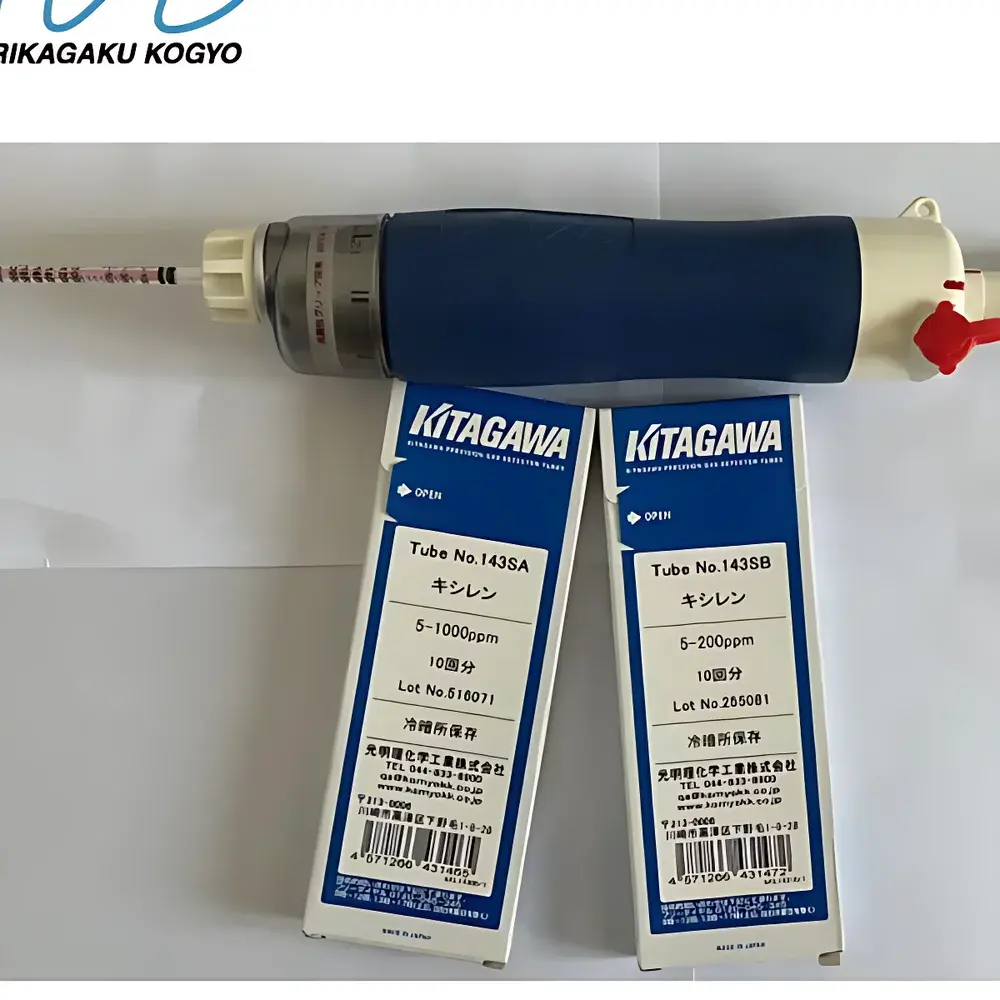
Komyo Rikagaku North川-Style Xylene Gas Detection Tube Model 143SA / 143SB
| Brand | Komyo Rikagaku |
|---|---|
| Origin | Japan |
| Model | 143SA (5–1000 ppm), 143SB (5–200 ppm) |
| Pack Size | 10 tubes per box |
| Detection Principle | Colorimetric Reaction with Pre-impregnated Reagent |
| Compatible Pump | AP-20 Hand Pump |
| Compliance | JIS K 0804, ISO 8573-2 (for sampling methodology), GLP-aligned documentation support |
Overview
The Komyo Rikagaku North川-Style Xylene Gas Detection Tube Series (Models 143SA and 143SB) is a field-deployable, colorimetric gas analysis system engineered for rapid, on-site quantification of xylene isomers (ortho-, meta-, and para-xylene) in ambient air or workplace atmospheres. Based on the classical North川 (Kitagawa) tube principle—first standardized in Japan in the 1950s—the system relies on stoichiometric chemical reaction between gaseous xylene and a pre-loaded solid-phase reagent (typically a sulfonic acid–oxidant mixture) inside a calibrated glass tube. Upon aspiration via the AP-20 handheld piston pump, xylene molecules react to produce a discrete, linear color front whose progression along the tube’s printed scale directly correlates to concentration. This method adheres to fundamental principles of diffusion-controlled reaction kinetics and is recognized under Japanese Industrial Standard JIS K 0804 for qualitative/semi-quantitative gas detection in occupational hygiene and emergency response settings.
Key Features
- Two-range configuration: Model 143SA covers 5–1000 ppm (ideal for industrial leak screening and high-concentration exposure assessment); Model 143SB provides enhanced low-end resolution from 5–200 ppm (optimized for TLV-TWA verification and indoor air quality surveys).
- Pre-calibrated, factory-sealed glass tubes with nitrogen-purged storage—ensuring shelf life of ≥24 months when stored at ≤25°C and protected from light and humidity.
- Compatible exclusively with the Komyo AP-20 dual-stroke hand pump (sold separately), enabling precise 100 mL or 50 mL draw volumes—critical for maintaining measurement linearity across the full range.
- No power, no software, no calibration gases required: fully self-contained operation suitable for confined space entry, fire investigation, hazmat response, and routine facility walk-throughs.
- Traceable lot certification provided with each box; batch-specific calibration curves available upon request for audit compliance (ISO/IEC 17025 supporting documentation).
Sample Compatibility & Compliance
Validated for use with ambient air, compressed air (oil-free), and diluted stack effluents where relative humidity remains below 80% RH and temperature ranges between 5–40°C. Not recommended for high-moisture, high-NOx, or strongly oxidizing atmospheres without prior interference testing. Each tube batch undergoes type testing per JIS K 0804 Annex B for cross-sensitivity against common interferents including toluene, ethylbenzene, acetone, and ethanol—results documented in Certificate of Analysis. While not a primary compliance instrument for OSHA PEL or ACGIH TLV reporting, data generated supports preliminary hazard identification and triggers follow-up quantitative analysis by GC-FID or PID per EPA Method TO-17 or ISO 16017-1.
Software & Data Management
This analog detection system operates independently of digital infrastructure. However, Komyo Rikagaku provides downloadable PDF-based record templates aligned with GLP documentation requirements—including operator ID, sampling location/time/date, pump strokes, observed color front position, environmental conditions, and signature fields. For laboratories integrating detection tube data into LIMS, scanned tube readings may be logged as semi-quantitative observations with defined uncertainty bands (±15% at mid-range, ±25% at range extremes, per JIS K 0804 guidance). No firmware, cloud connectivity, or FDA 21 CFR Part 11 functionality is applicable—consistent with its classification as a Class I exempt analytical aid under global regulatory frameworks.
Applications
- Occupational health monitoring during painting, printing, adhesive application, and resin manufacturing processes.
- Rapid confirmation of xylene presence following solvent spill incidents or drum rupture events.
- Verification of local exhaust ventilation (LEV) effectiveness during maintenance or commissioning.
- First-responder triage in chemical release scenarios where real-time decision-making precedes laboratory confirmation.
- Educational demonstrations of gas-phase reaction kinetics and stoichiometric color development in analytical chemistry curricula.
FAQ
Can Model 143SA and 143SB be used interchangeably?
No. The reagent formulation and internal calibration differ fundamentally. 143SA is optimized for higher concentrations and longer reaction zones; substituting it for 143SB in low-concentration environments results in poor visual resolution and elevated uncertainty.
Is humidity correction required?
Yes—readings above 60% RH should be adjusted using the humidity correction chart supplied in the product manual (JIS K 0804 Table 4). Uncompensated high-humidity sampling may yield up to 30% positive bias.
What is the shelf life, and how should tubes be stored?
24 months from manufacture date when sealed and stored at ≤25°C in original packaging, away from direct sunlight and volatile organics. Do not refrigerate.
Does this system meet ISO 17025 requirements for accredited testing?
No—it is a screening tool. Accredited labs must validate tube performance against reference methods and document uncertainty budgets before using results in certified reports.
Is the AP-20 pump included with the tubes?
No. The AP-20 hand pump is a separate item (Komyo P/N AP-20) and must be purchased independently to ensure accurate volume displacement and stroke consistency.







