
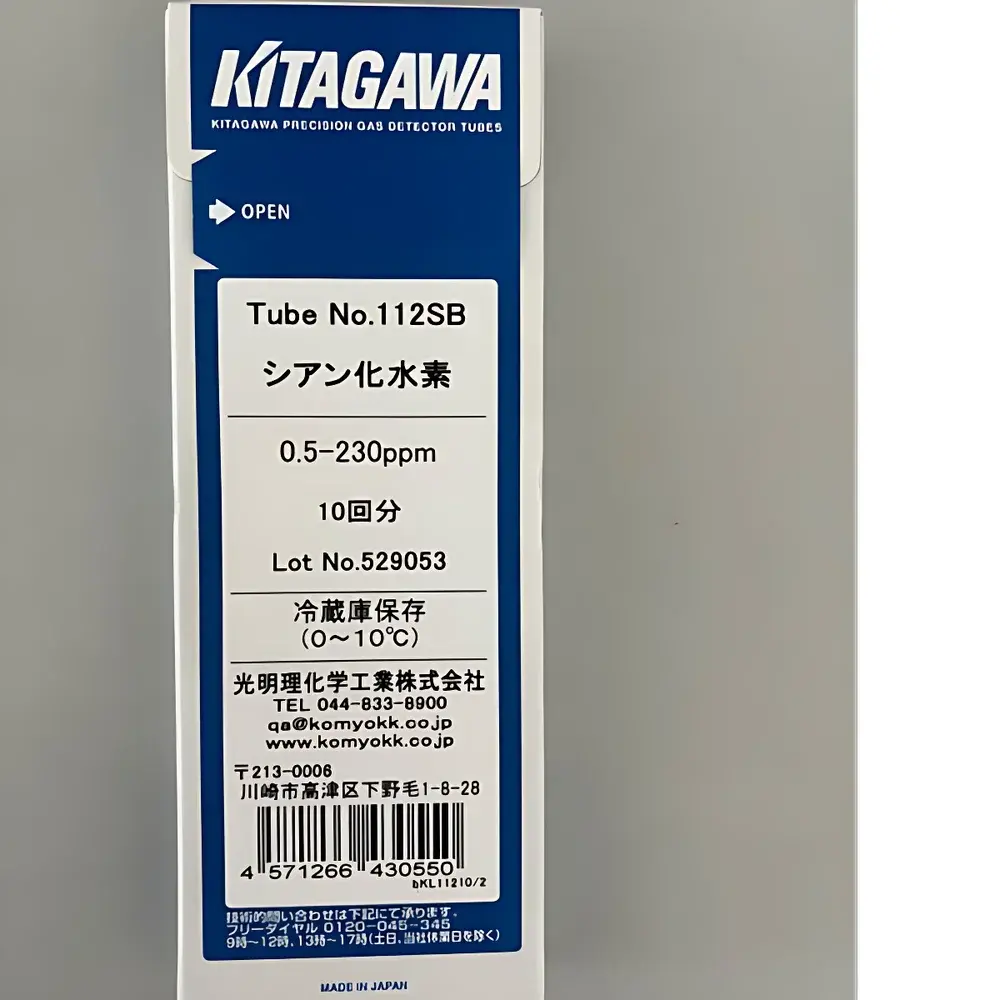
KOMYO RIKAGAKU 189U 2-Butanol Colorimetric Gas Detection Tube
| Brand | KOMYO RIKAGAKU |
|---|---|
| Origin | Japan |
| Manufacturer Type | Authorized Distributor |
| Product Category | Imported |
| Model | 189U |
| Detection Range | 4–120 ppm and 10–300 ppm (dual-scale) |
| Pump Required | AP-20 Hand Pump (sold separately) |
| Principle | Colorimetric Reaction with Pre-impregnated Reagent |
| Compliance | Designed per JIS K 0321 (Japanese Industrial Standard for Gas Detection Tubes) |
Overview
The KOMYO RIKAGAKU 189U 2-Butanol Colorimetric Gas Detection Tube is a field-deployable, single-use analytical device engineered for rapid, on-site quantification of 2-butanol vapor in ambient air. Operating on the well-established colorimetric diffusion principle, the tube contains a precisely formulated solid-phase reagent—typically an oxidizing agent such as potassium permanganate or chromogenic complex—immobilized along a calibrated glass capillary. When air is drawn through the tube using the standardized AP-20 hand pump (100 mL stroke volume, ±5% volumetric accuracy), 2-butanol molecules react selectively with the reagent, producing a discrete, linear color front. The length of the stained zone, measured directly against the engraved scale on the tube wall, correlates quantitatively to the target analyte concentration via pre-determined calibration curves traceable to NIST-traceable reference standards. This method delivers immediate visual results without power, software, or laboratory infrastructure—making it ideal for emergency response, industrial hygiene surveys, and routine workplace exposure monitoring where time-to-result is critical.
Key Features
- Dual-range design: Simultaneous measurement capability across two complementary concentration intervals (4–120 ppm and 10–300 ppm), enabling optimized sensitivity and dynamic range selection based on anticipated exposure levels.
- High specificity: Formulated reagent chemistry minimizes cross-reactivity with common interferents including acetone, ethanol, isopropanol, and methyl ethyl ketone—validated per internal KOMYO RIKAGAKU interference testing protocols.
- Traceable calibration: Each production lot undergoes gravimetric and gas-phase calibration against certified 2-butanol permeation tubes; calibration certificates include uncertainty budgets compliant with ISO/IEC 17025 requirements.
- Rugged construction: Borosilicate glass body with laser-etched scale, hermetically sealed ends, and desiccant barrier layer ensuring shelf life of ≥24 months when stored at 5–30°C and <60% RH.
- Standardized operation: Fully compatible with the AP-20 dual-stroke hand pump (ISO 8519-compliant actuation force and volume delivery), ensuring inter-operator reproducibility within ±10% CV (coefficient of variation) under controlled conditions.
Sample Compatibility & Compliance
The 189U tube is validated for use in clean, dry air matrices at temperatures between 5°C and 40°C and relative humidity ≤80%. Performance remains stable in the presence of particulate matter 90% RH) or acidic gas environments (e.g., HCl, SO₂ >5 ppm) may require pre-filtration using KOMYO’s optional charcoal or silica gel scrubbers. The product conforms to Japanese Industrial Standard JIS K 0321 “Gas Detection Tubes – General Rules”, and supports compliance with OSHA 29 CFR 1910.1200 (Hazard Communication), ACGIH TLV® documentation requirements, and EU Directive 2004/40/EC for occupational exposure assessment. While not a primary instrument for regulatory reporting, data generated are admissible as preliminary screening evidence in GLP-aligned health and safety programs.
Software & Data Management
As a passive, analog detection system, the 189U requires no embedded firmware, drivers, or proprietary software. Quantitative interpretation relies solely on visual reading by trained personnel following KOMYO’s standardized SOPs (provided in English and Japanese). For digital recordkeeping, users may integrate readings into LIMS or EHS platforms via manual entry or barcode-scanned lot-specific calibration data (available upon request). All batch-specific calibration reports, expiration dates, and interference test summaries are archived and retrievable through KOMYO’s global distributor portal—supporting audit readiness under ISO 45001 and FDA 21 CFR Part 11–aligned documentation practices for paper-based records.
Applications
- Occupational hygiene monitoring during solvent handling, paint manufacturing, and coating application processes where 2-butanol serves as a carrier or co-solvent.
- First-responder triage during chemical spills or transportation incidents involving flammable liquid cargoes.
- Verification of ventilation effectiveness in confined spaces prior to worker entry (per OSHA 1910.146).
- Periodic spot-checking in pharmaceutical excipient storage areas and electronics cleaning stations.
- Educational demonstrations of gas-phase stoichiometry and diffusion kinetics in university environmental engineering laboratories.
FAQ
How many measurements can be performed with one 189U tube?
Each tube is designed for a single, 100 mL air sample draw. Reuse is prohibited due to irreversible reagent consumption and potential carryover contamination.
Is temperature correction required during field use?
Yes—readings must be adjusted using the temperature compensation chart provided in the instruction leaflet when ambient temperature falls outside 20–25°C; deviation beyond ±10°C introduces systematic bias exceeding ±15% of indicated value.
Can the 189U be used in oxygen-deficient atmospheres?
No. The reaction mechanism depends on atmospheric oxygen participation; use is restricted to environments with ≥19.5% O₂ by volume.
What is the minimum detectable concentration (MDC) for this tube?
Based on visual acuity limits and calibration linearity, the practical MDC is 4 ppm for the low-range scale and 10 ppm for the high-range scale, consistent with ISO 16000-26 guidance for screening-level detection.
Does KOMYO provide third-party validation reports for this model?
Yes—certified test reports from JQA (Japan Quality Assurance Organization) and SGS Japan are available upon distributor request, covering accuracy, precision, and shelf-life verification per JIS K 0321 Annex B protocols.







