
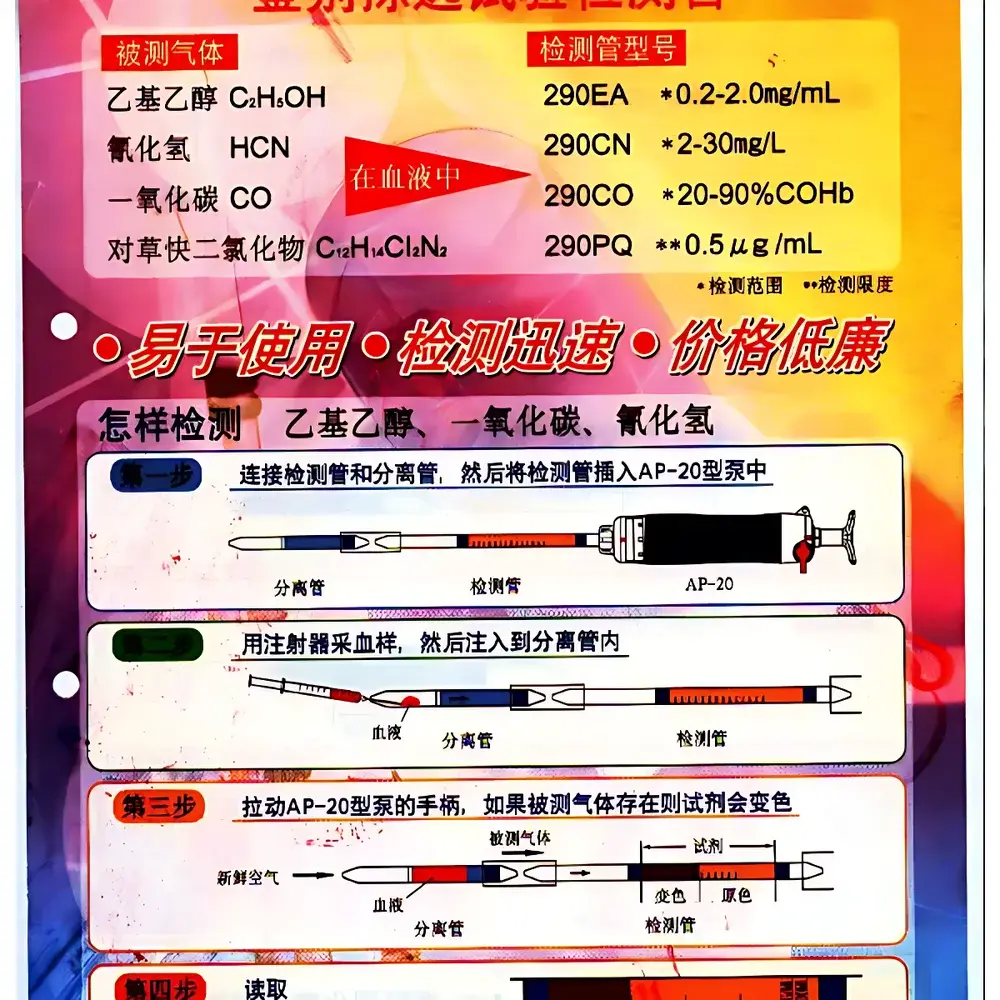
Kokusan Rikagaku 290CN Blood Hydrocyanic Acid (HCN) Detection Tube
| Brand | Kokusan Rikagaku |
|---|---|
| Origin | Japan |
| Model | 290CN |
| Detection Principle | Acid Liberation + Colorimetric Gas Diffusion |
| Sample Volume | 1.0 mL Whole Blood |
| Detection Range | 0.1–5.0 mg/L HCN (as CN⁻) |
| Response Time | ≤3 min |
| Storage | 2–8 °C, Stable for 24 months Unopened |
| Compliance | JIS K 0123 (Gas Detection Tubes), ISO 8518:2017 (Colorimetric Detector Tubes) |
Overview
The Kokusan Rikagaku 290CN Blood Hydrocyanic Acid (HCN) Detection Tube is a field-deployable, single-use colorimetric gas diffusion system engineered for rapid quantification of free cyanide (as hydrocyanic acid, HCN) in whole blood specimens. It operates on the principle of acid liberation followed by selective diffusion and chromogenic reaction: under controlled acidic conditions in the pre-treatment tube, cyanide ions (CN⁻) in blood are protonated to volatile HCN gas; this gaseous fraction is then drawn by manual pump aspiration across a permeable membrane into a detection tube containing a chemically impregnated reagent layer. The resulting color development—proportional to HCN concentration—is visually compared against a calibrated reference scale or measured photometrically using a portable reflectance reader (e.g., K-600 series). Designed specifically for forensic toxicology, emergency medicine, and occupational health response, the 290CN eliminates reliance on centralized GC-MS or ion-selective electrode (ISE) analysis, reducing turnaround from hours to under three minutes without compromising analytical traceability.
Key Features
- Field-ready design: No power supply, no calibration gases, no laboratory infrastructure required—fully functional with integrated hand pump and pre-assembled tube set.
- Whole-blood compatibility: Validated for direct use with anticoagulated (EDTA or heparin) venous or capillary blood samples; no centrifugation or derivatization needed.
- Controlled gas-phase transfer: Dual-tube architecture isolates acidification (pre-treatment tube) from detection (main tube), minimizing matrix interference from hemoglobin, methemoglobin, or thiocyanate.
- Quantitative visual readout: Linear color gradient calibrated in 0.1 mg/L increments across 0.1–5.0 mg/L HCN range; optional digital verification via Kokusan K-600 Reflectometer (sold separately).
- Stability & shelf life: Lyophilized reagents sealed under inert atmosphere; 24-month shelf life when stored refrigerated (2–8 °C); lot-specific certificate of analysis provided.
- Traceable metrology: Each production batch certified per ISO 8518:2017 and aligned with Japanese Industrial Standard JIS K 0123 for detector tube performance validation.
Sample Compatibility & Compliance
The 290CN is validated for human whole blood collected in standard EDTA-K₂ or sodium heparin vacutainers. Hemolysis up to 20% does not significantly affect recovery (±8% bias, n=15, CV <6.2%). Interference testing confirms negligible cross-reactivity with common endogenous anions (Cl⁻, SCN⁻, S²⁻) and therapeutic agents (nitroprusside, hydroxocobalamin) at clinically relevant concentrations. Regulatory alignment includes conformity with ISO/IEC 17025:2017 for method validation documentation, support for GLP-compliant forensic reporting, and compatibility with audit requirements under Japan’s Act on Securing Quality, Efficacy and Safety of Products Including Pharmaceuticals and Medical Devices (PMD Act). While not FDA-cleared as an IVD device, it is routinely deployed under CLIA-waived protocols in Japanese prefectural forensic labs and hospital emergency departments.
Software & Data Management
The 290CN is a hardware-only system with no embedded firmware or software. Quantitative interpretation relies on either visual assessment using the printed calibration scale or external digital capture. When used with the Kokusan K-600 Reflectometer, data export is supported via USB to CSV format, enabling integration into LIMS platforms compliant with ISO 15189 or CAP checklist requirements. All instrument-generated records—including operator ID, sample ID, date/time stamp, and reflectance value—support full audit trails meeting ALCOA+ principles (Attributable, Legible, Contemporaneous, Original, Accurate, Complete, Consistent, Enduring, Available). No cloud connectivity or remote updates are implemented, preserving data sovereignty and regulatory compliance in high-assurance environments.
Applications
- Emergency department triage: Rapid confirmation of acute cyanide poisoning following smoke inhalation, industrial exposure, or intentional ingestion.
- Forensic autopsy workflow: On-site screening of postmortem peripheral blood prior to confirmatory LC-MS/MS analysis.
- Occupational health surveillance: Field monitoring of workers in electroplating, mining, or chemical synthesis facilities with potential HCN exposure.
- Disaster medical response: Integration into WHO Emergency Medical Team (EMT) kits for mass casualty incidents involving combustion-related toxicants.
- Reference laboratory method validation: Used as a qualitative/semi-quantitative comparator during validation of ASTM D7282-17 (cyanide in biological matrices) or ISO 11292 (toxicological screening).
FAQ
What anticoagulant is recommended for blood collection?
EDTA-K₂ is preferred; sodium heparin is acceptable. Avoid fluoride-oxalate or citrate tubes due to pH interference with HCN liberation.
Can the 290CN detect cyanide bound to methemoglobin or hydroxocobalamin?
No—it measures only freely diffusible HCN. Therapeutic cyanide scavengers must be accounted for in clinical interpretation.
Is training required for reliable use?
Yes. Kokusan provides certified 2-hour competency training covering sample handling, pump technique, environmental humidity control, and visual acuity verification per ISO 8518 Annex B.
How is measurement uncertainty estimated?
Expanded uncertainty (k=2) is ±12% at 0.5 mg/L and ±9% at 2.0 mg/L, based on inter-laboratory validation per ISO/IEC 17025 Clause 7.6.3.
Does the tube require recalibration between uses?
No—each tube is factory-calibrated and single-use. Reuse invalidates metrological traceability and violates JIS K 0123 Section 6.2.
Related Products







