
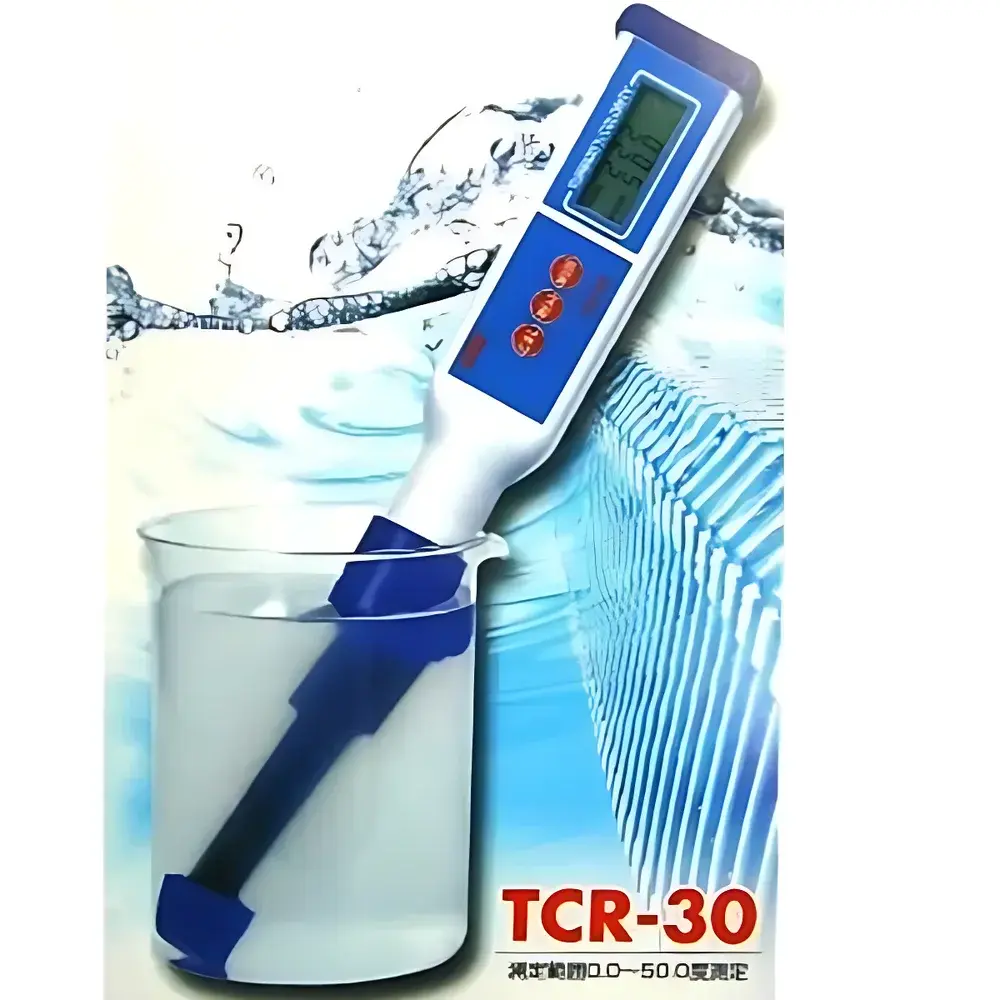
Rikari TRC-30 Dual-Beam Turbidity and Color Analyzer
| Brand | Rikari |
|---|---|
| Origin | Japan |
| Model | TRC-30 |
| Measurement Principle | Dual-Beam Transmittance Photometry (Spectrophotometric Method) |
| Turbidity Range | 0.0–50.0 NTU (Polystyrene Standard) |
| Color Range | 0.0–50.0 Pt-Co Units (Platinum-Cobalt Scale) |
| Resolution | 0.01 unit (0.0–9.99), 0.1 unit (10.0–50.0) |
| Repeatability | ±0.2 units under specified conditions |
| Operating Temperature | 5–35 °C |
| Protection Rating | IP63 (Dust-Resistant & Drip-Protected) |
| Power Supply | 4 × AA Alkaline Batteries (DC 6 V) |
| Dimensions | 54 × 38 × 350 mm |
| Weight | Approx. 300 g |
| Calibration | Zero-point with deionized water |
| Compliance | Aligns with MHLW Ordinance on Water Quality Standards for Public Water Supply (Japan), Industrial Water Testing Methods, and JIS K 0102 Annex B (Transmittance Method) |
Overview
The Rikari TRC-30 Dual-Beam Turbidity and Color Analyzer is a field-deployable, optical instrumentation platform engineered for simultaneous, interference-minimized measurement of turbidity and color in potable water, swimming pool water, spa bathwater, and other low-turbidity aqueous matrices requiring high transparency assurance. It operates on a dual-beam transmittance photometric principle—distinct from nephelometric or scattered-light methods—where two independent optical paths measure sample absorbance at defined wavelengths: one optimized for color quantification (based on the platinum-cobalt scale), and the other for turbidity assessment (referenced to polystyrene formazin-equivalent standards). This architecture decouples chromatic absorption from particulate light attenuation, enabling accurate co-quantification without cross-sensitivity—a critical advantage over single-beam or filter-based instruments when evaluating yellowish or organically stained waters. Designed to meet Japanese Ministry of Health, Labour and Welfare (MHLW) Ordinance No. 101 (2003) and JIS K 0102 Annex B requirements for public water supply testing, the TRC-30 delivers traceable, method-compliant results without reagent addition, calibration curve generation, or laboratory infrastructure.
Key Features
- Dual-beam optical design eliminates spectral interference between turbidity and color measurements, ensuring mutual independence per ISO 7027-1:2016 guidance on optical measurement principles.
- Portable handheld form factor (300 g) with ergonomic grip and integrated measurement chamber—optimized for rapid in-situ deployment across distribution networks, recreational facilities, and municipal inspection points.
- IP63-rated enclosure provides dust resistance and protection against vertically falling droplets, supporting reliable operation in humid outdoor environments including pool decks and water treatment kiosks.
- Auto-ranging resolution: 0.01 unit (0.0–9.99) and 0.1 unit (10.0–50.0) for both turbidity and color, delivering granular sensitivity at low concentrations where regulatory thresholds are most stringent (e.g., MHLW limit: ≤2 NTU for tap water).
- Zero-point calibration using deionized water and span calibration with optional 10-unit certified standards (polystyrene turbidity and Pt-Co color), traceable to NIST-maintained reference materials via JCSS-accredited providers.
- Intelligent status display with dedicated LED indicators for BAT (low battery), CAL (calibration mode), S (sample measurement), ERR (error), TURB (turbidity active), and COLOR (color active)—enabling unambiguous operational feedback without menu navigation.
Sample Compatibility & Compliance
The TRC-30 is validated for use with clear to moderately colored aqueous samples within 5–35 °C, excluding frozen, strongly acidic (pH 10), or fluorinated/organic solvent-containing media. Its transmittance methodology conforms to statutory testing protocols under Japan’s Water Supply Act Enforcement Regulations and aligns with ASTM D1208 (Standard Test Method for Color of Transparent Liquids) and ISO 7887:2011 (Water quality — Examination of colour) for colorimetric analysis. For turbidity, it satisfies the transmittance-based verification criteria outlined in ISO 7027-1:2016 and supports GLP-aligned data integrity when used with documented calibration logs and environmental monitoring records. While not FDA 21 CFR Part 11 compliant out-of-the-box (as it lacks electronic audit trail functionality), its manual calibration traceability and physical measurement repeatability support GMP-relevant process water assessments in non-sterile pharmaceutical utilities.
Software & Data Management
The TRC-30 operates as a standalone instrument with no embedded software, cloud connectivity, or digital data export capability. All measurements are displayed in real time on a high-contrast LCD and retained only as visual readouts. Users are expected to manually record values in field notebooks or LIMS-compatible spreadsheets. This design prioritizes operational simplicity, electromagnetic immunity in electrically noisy environments (e.g., pump stations), and long-term reliability without firmware dependencies. Calibration history, ambient temperature, and operator ID must be documented externally to satisfy ISO/IEC 17025 Clause 7.7 (Ensuring validity of results) and internal QA procedures.
Applications
- Routine verification of turbidity and color in municipal drinking water distribution systems pre- and post-filtration.
- Swimming pool and hot tub water quality compliance checks per Japan’s Public Bathhouse Law and local health department ordinances.
- On-site screening of industrial process water where organic discoloration (e.g., tannins, humic substances) may coexist with suspended solids.
- Educational laboratory instruction in environmental science curricula focusing on optical water quality parameters and method validation principles.
- Emergency response field assessment during source water contamination events involving algal blooms or sediment resuspension.
FAQ
Does the TRC-30 require reagents or chemical consumables for measurement?
No. It performs reagent-free optical transmittance analysis—eliminating disposal concerns, shelf-life management, and inter-lot variability associated with liquid standards.
Can the TRC-30 measure samples with turbidity above 50 NTU?
No. The optical path and detector linearity are validated only up to 50.0 NTU. Samples exceeding this range must be diluted with certified reference water and results mathematically corrected.
Is the instrument suitable for wastewater effluent monitoring?
Not recommended. Its design targets low-turbidity matrices (<50 NTU); highly turbid, opaque, or viscous wastewaters fall outside its validated operating envelope and may cause optical path obstruction or signal saturation.
How often should zero and span calibration be performed?
Zero calibration is required before each measurement session; span calibration with the 10-unit standard is recommended daily for routine use or prior to any critical compliance check.
What is the expected battery life under typical field usage?
Approximately 2,000 measurements per set of four AA alkaline batteries, assuming ambient temperature operation and default auto-shutdown after 10 seconds of inactivity.
Related Products







