
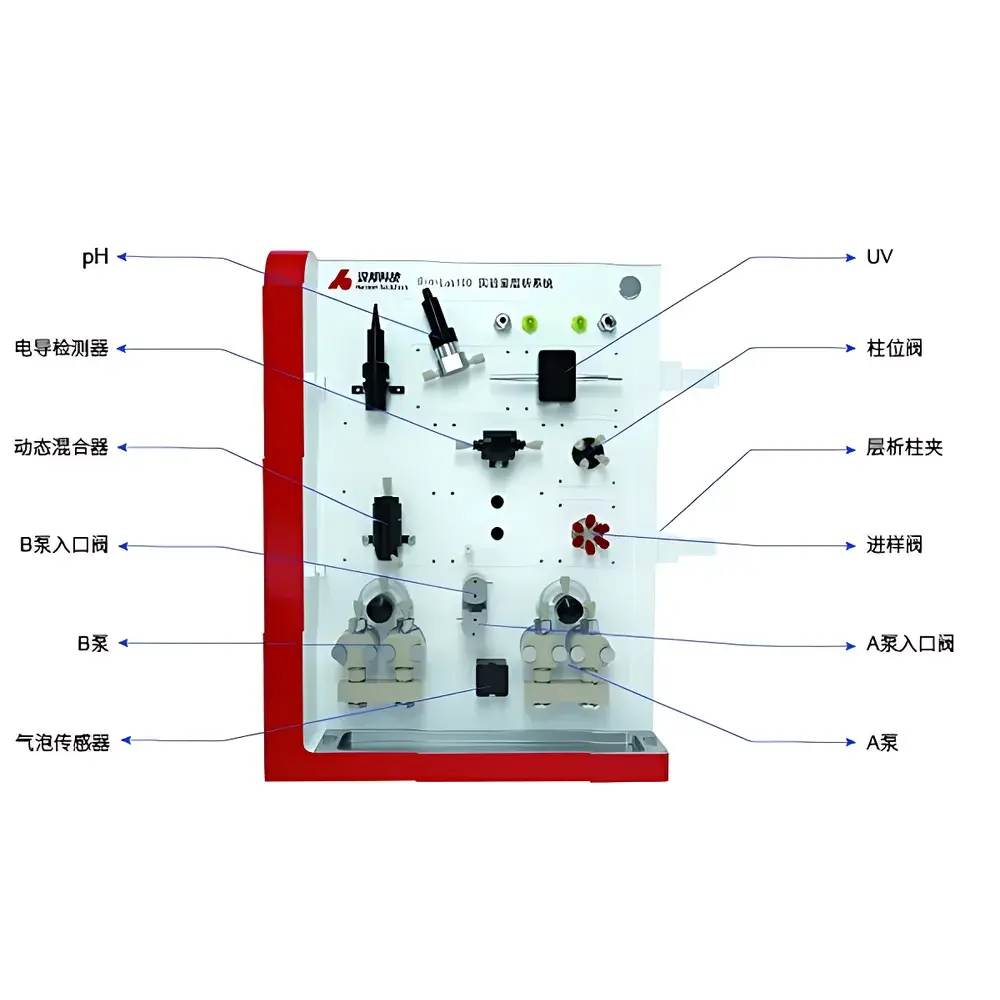
Hanbon Bio-Lab100 Laboratory Chromatography System
| Brand | Hanbon |
|---|---|
| Origin | Jiangsu, China |
| Manufacturer Type | OEM Manufacturer |
| Product Origin | Domestic (China) |
| Model | Bio-Lab100 |
| Price Range | USD 42,000 – 70,000 |
| Purification Principle | Low- to Medium-Pressure Liquid Chromatography (LPLC/MPLC) |
| Detector Types | UV-Vis, pH, Conductivity |
| UV Detection Range | 200–400 nm |
Overview
The Hanbon Bio-Lab100 Laboratory Chromatography System is an engineered low-to-medium pressure liquid chromatography platform designed for reproducible, scalable protein purification workflows in academic research labs, biotech R&D groups, and early-stage process development environments. Built upon a robust fluidic architecture, the system implements classical column chromatography principles—utilizing gravity- or pump-driven mobile phase delivery across packed beds of affinity, ion exchange, size exclusion, or hydrophobic interaction resins—to achieve high-resolution separation of target proteins from complex biological matrices such as cell lysates, clarified supernatants, or fermentation broths. Its modular architecture supports both analytical-scale screening and preparative-scale purification (up to 50 mL column volume), with full compatibility with standard 10–25 mm ID columns and industry-standard fittings (e.g., 1/16″ Swagelok). The system operates within a pressure range of 0–5 MPa (0–725 psi), enabling optimization across diverse resin chemistries without compromising flow stability or gradient fidelity.
Key Features
- High-precision dual-piston reciprocating pump delivering flow rates from 0.01 to 25 mL/min with ≤0.5% RSD at constant pressure mode, ensuring consistent retention time and peak shape across repeated runs.
- Integrated multi-channel detection suite: UV-Vis absorbance detector (200–400 nm, ±1 nm wavelength accuracy, 0.001 AU resolution), real-time pH sensor (±0.02 pH units), and conductivity meter (0–200 mS/cm, ±1% FS), all synchronized with data acquisition at 10 Hz sampling rate.
- Low-dead-volume stacked tubing manifold (total internal volume < 120 µL between pump outlet and detector flow cell), minimizing band broadening and preserving sample integrity during elution.
- Fully biocompatible fluid path constructed from PEEK, titanium, and pharmaceutical-grade stainless steel (316L); all wetted surfaces certified non-pyrogenic and compliant with USP Class VI standards.
- Modular valve manifold supporting up to 8 independent inlet/outlet ports, configurable for automated fraction collection, buffer switching, column regeneration, or multi-column parallel operation.
- Touchscreen HMI with embedded Linux OS and optional remote web interface (HTTPS/TLS 1.2) for secure access from lab networked devices.
Sample Compatibility & Compliance
The Bio-Lab100 accommodates native, denatured, and tagged proteins—including monoclonal antibodies, His-tagged recombinants, GST fusions, and membrane protein solubilizates—in aqueous buffers containing up to 2 M NaCl, 50% glycerol, or 10 mM DTT. It is validated for use with common chromatographic resins (e.g., GE Cytiva Sepharose, Tosoh TSKgel, Bio-Rad UNO series) and supports cleaning-in-place (CIP) protocols using 0.5–1.0 M NaOH. System documentation includes IQ/OQ templates aligned with ISO 9001:2015 and GMP Annex 11 requirements. Audit trail functionality—recording user logins, method changes, run parameters, and detector events—is enabled by default and complies with FDA 21 CFR Part 11 electronic record/electronic signature (ERES) criteria when deployed with password-protected multi-user accounts and digital certificate authentication.
Software & Data Management
Control and analysis are managed via Hanbon ChromaSuite™ v4.2 software, a Windows-based application supporting method development, real-time chromatogram visualization, peak integration (tangent skim, baseline correction), and export to CSV, PDF, or AIA (.cdf) formats. The software includes built-in compliance features: electronic signatures, role-based permissions (Admin, Operator, Viewer), automatic backup of raw data to network drives, and immutable audit logs timestamped to UTC. Data files are structured according to ASAM ODS-compliant metadata schemas, facilitating integration with LIMS platforms (e.g., LabVantage, Thermo Fisher SampleManager) via RESTful API or OPC UA connectivity.
Applications
- Single-step purification of His-tagged proteins using immobilized metal affinity chromatography (IMAC) under native conditions.
- Two-dimensional purification workflows combining anion exchange (AEX) followed by size exclusion chromatography (SEC) for aggregate removal and buffer exchange.
- Process characterization studies evaluating resin binding capacity, dynamic binding capacity (DBC), and elution profile robustness under varying pH/conductivity gradients.
- Stability assessment of purified proteins via real-time monitoring of UV spectral shifts (e.g., tryptophan exposure) and pH-dependent conformational transitions.
- Method transfer from analytical to preparative scale using linear velocity scaling and residence time modeling tools embedded in ChromaSuite™.
FAQ
Is the Bio-Lab100 compatible with prepacked columns from major vendors?
Yes—it accepts standard 10–25 mm ID prepacked columns with 1/16″ or 1/8″ inlet/outlet connections, including those from Cytiva, Tosoh, and Bio-Rad.
Does the system support gradient elution with more than two buffers?
Yes—the quaternary mixing valve enables precise, programmable gradients from up to four independent buffer reservoirs with 0.1% volumetric resolution.
Can I validate the system for GLP or GMP use?
Yes—IQ/OQ documentation packages, calibration certificates traceable to NIST standards, and 21 CFR Part 11-compliant software configuration options are available upon request.
What maintenance intervals are recommended for routine operation?
Pump seals should be inspected every 500 hours; UV lamp replacement is recommended every 2,000 hours; system performance qualification (SPQ) is advised quarterly using standardized bovine serum albumin (BSA) test runs.
Is remote troubleshooting supported?
Yes—optional Hanbon Remote Assist module provides encrypted screen-sharing and diagnostic log retrieval with end-user consent and session logging.





