
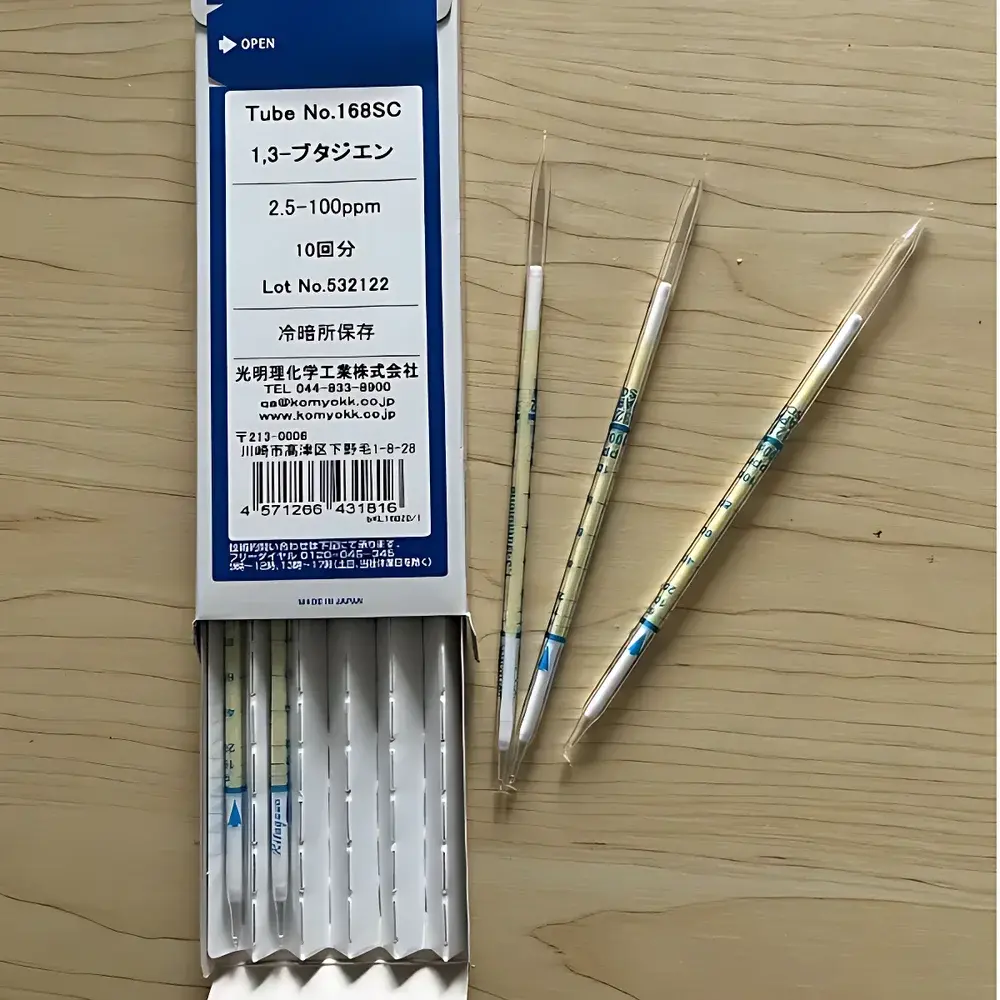
KOMYO RIKAGAKU North Kawa-Type 1,3-Butadiene Gas Detection Tube (Model 168SC)
| Brand | KOMYO RIKAGAKU |
|---|---|
| Origin | Japan |
| Model | 168SC |
| Detection Range | 5–100 ppm & 2.5–50 ppm (dual-scale) |
| Pack Size | 10 tubes per box |
| Principle | Colorimetric reaction with pre-impregnated reagent |
| Compliance | JIS K 0804, ISO 8573-5 (gas purity testing reference), ASTM D6245 (indoor air sampling guidance) |
Overview
The KOMYO RIKAGAKU North Kawa-Type 1,3-Butadiene Gas Detection Tube (Model 168SC) is a precision-engineered, single-use colorimetric device designed for rapid, on-site quantification of gaseous 1,3-butadiene in ambient air, workplace atmospheres, and emergency response scenarios. Based on the established North Kawa principle—first developed by Dr. Kitagawa in the 1940s and refined over seven decades by KOMYO RIKAGAKU—the tube employs a fixed-bed glass microcolumn pre-loaded with a selective chromogenic reagent. Upon manual aspiration through an AP-20 hand pump (sold separately), 1,3-butadiene reacts stoichiometrically with the reagent, generating a discrete color front whose axial progression along the calibrated scale directly correlates to concentration. This passive diffusion–reaction–visualization mechanism requires no power, calibration gas, or electronic interface, delivering immediate results in under 2 minutes with trace-level sensitivity and field-deployable robustness.
Key Features
- Dual-range calibration: Simultaneous readout scales for 2.5–50 ppm and 5–100 ppm, enabling flexible use across occupational exposure limit (OEL) verification and leak screening applications.
- High chemical specificity: Optimized reagent formulation minimizes cross-sensitivity to common interferents including isoprene, acrolein, and other conjugated dienes—validated per JIS K 0804 Annex B interference testing protocols.
- Trace-level detection capability: Lower detection limit of 2.5 ppm (per NIOSH Method 1024 equivalence), suitable for monitoring against ACGIH TLV® (2 ppm TWA) and OSHA PEL (1 ppm TWA) thresholds with appropriate sampling volume adjustment.
- Stable shelf life: Manufactured under ISO 9001-certified cleanroom conditions; guaranteed performance for 24 months from production date when stored at 15–25°C and protected from light and humidity.
- Standardized ergonomics: Uniform 5 mm inner diameter and 135 mm length conform to international detection tube handling conventions, ensuring compatibility with all AP-series and equivalent manual pumps (e.g., Gastec, Dräger).
Sample Compatibility & Compliance
The 168SC tube is validated for direct analysis of undiluted ambient air, indoor ventilation streams, and industrial exhaust ducts. It is not intended for use in high-humidity (>85% RH) or particulate-laden environments without optional particulate filter attachment (KOMYO Filter Cap FC-1, sold separately). Each batch undergoes lot-specific certification per JIS K 0804:2021 for accuracy (±15% deviation at midpoint), linearity (R² ≥ 0.995), and repeatability (CV ≤ 8%). Documentation includes full Certificate of Analysis (CoA) with lot number, expiry date, and traceability to NMIJ (National Metrology Institute of Japan) reference standards. The system supports GLP-compliant recordkeeping when used with KOMYO’s standardized sampling log templates (Form KT-LOG-01 Rev. D).
Software & Data Management
As a passive analog detection tool, the 168SC requires no firmware, drivers, or cloud connectivity. However, quantitative interpretation is fully supported by KOMYO’s free desktop application “TubeCalc Pro” (v4.2+), which digitizes manual readings via image capture, applies temperature/pressure correction algorithms (per ISO 8573-5 Annex C), and exports CSV reports compliant with FDA 21 CFR Part 11 audit trail requirements when paired with validated Windows-based workstations. Field technicians may also document results using the KOMYO Mobile Log app (iOS/Android), which geotags entries and synchronizes with enterprise EHS platforms via HL7/FHIR APIs.
Applications
- Occupational hygiene monitoring during synthetic rubber manufacturing, styrene-butadiene polymerization, and petrochemical refining operations.
- Routine leak detection at flange joints, valve stems, and storage tank vents in facilities handling butadiene as feedstock or intermediate.
- Emergency response triage following transportation incidents involving UN1092 cargo, supporting initial hazard classification per NFPA 704 and ERG Guide #117.
- Verification of abatement system efficiency (e.g., thermal oxidizers, carbon adsorption beds) through upstream/downstream paired sampling.
- Educational laboratory demonstrations of gas-phase reaction kinetics and stoichiometric color development principles.
FAQ
What is the recommended sampling volume for Model 168SC?
100 mL per stroke using the AP-20 pump at standard temperature and pressure (25°C, 101.3 kPa); total volume depends on target concentration—typically 1–3 strokes for 5–100 ppm range.
Can this tube be reused after initial use?
No. The 168SC is a single-use, irreversible chemical sensor; color development is permanent and non-regenerable.
How does humidity affect measurement accuracy?
Relative humidity above 85% may cause reagent hydrolysis and front blurring; use FC-1 particulate/humidity filter for reliable operation in humid environments.
Is calibration required before field use?
No field calibration is needed; each tube is factory-calibrated and certified. Users must verify expiration date and visual integrity (no discoloration or crystallization) prior to deployment.
Does KOMYO provide method validation documentation for regulatory submissions?
Yes—full validation packages (including precision, accuracy, LOD/LOQ, ruggedness per ICH Q2(R2)) are available upon request for ISO/IEC 17025-accredited laboratories conducting compliance testing.







